Driving a restored 1955 Mercedes-Benz 220 Ponton: Start of S-Class' legacy
The W116 kicked-off the S-Class legacy; the W180 was one of the most famous, recognisable and luxurious cars in Mercedes' history. We drove an immaculately restored 1955 Mercedes-Benz 220 Ponton straight from the Mercedes-Benz classic car collection.
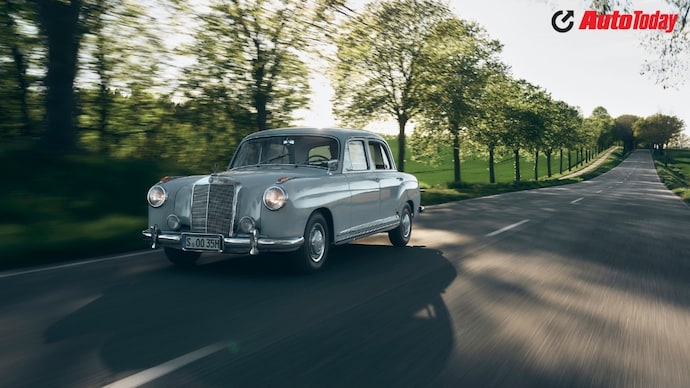
I was told that we would be getting an opportunity to drive some classic Mercedes cars and was looking forward to driving them, but when I got to the place where they were supposed to be available and saw the Ponton parked by itself in the middle of a sprawling courtyard, I could not believe my luck. Although I have —in the past— driven some of the more famous cars in the marques history, like the 300 SL Roadster (from Brooklands to Goodwood), the Ponton is a classic of the classics as well and one of my bucket list cars.
It all started off with the brand’s post-WWII efforts to make a car with a wider appeal and the ponton body styling was adopted for the W120 model, first of the unibody architecture (predecessor of today’s monocoque architecture) cars that was powered by a four-cylinder engine in 1954. It was the 180, the nomenclature being based on engine capacity. However, to increase its upmarket appeal and address the more premium segment, Mercedes decided to put a six-cylinder engine under the hood and hence was born the W180 – with a lengthening of the car with additional space under the hood to accommodate the straight six and additional space in the rear to increase comfort and the legroom. The W180 was termed the 220 with nearly a 2.2-litre straight six-engine and is clearly differentiated from its predecessor because of the extra quarter glass behind the roll-up rear windows. With a reworked rear suspension and particular attention to materials and detailing, the Ponton was not only the epitome of luxury but has aged gracefully to become a global classic.
During its heyday it was the preferred vehicle of a lot of celebrities with people like Elvis Presley and Cary Grant having the later 220S versions of the Ponton. The one I drove in Germany was the 220a and that was the ride of the Aga Khan in Europe and Miles Davis across the pond. The car itself is awe-inspiring with its uninterrupted tall grille, the majestic ponton flare that gracefully flows through the length of the body and in this case the immaculately polished chrome elements including the grille surround, the bumpers, the headlight rings and the door handles. That’s how the cars of the day would have looked! On the inside again a mixture of wood and chrome with a thin but large steering wheel and the chrome ring in it for the horn, all delightful.
The instrument panel is rectangular and placed horizontally with the top half having the speed display running across all the way to 180kmph (with the top speed of the car being 150kmph). The bottom half has five displays for water temperature, oil pressure, odometer, trip and a fuel gauge. The centre of the dashboard has a radio with what has been a standard feature of many Mercedes cars through the ages, an analogue clock above. The dashboard is all wooden with chrome elements, like the handle of the glove compartment or the small round air vents on either side with levers for them.
I get into the car and run a practice routine of shifting gears using the column-mounted gear lever which operates a four-speed gearbox. I put the key in and turned the ignition. Unlike the older cars that I remember driving, all that turning the key does is switch on the electric current and there is a small button next to it that I need to press to start the car. I look around for the seatbelt on the really comfortable bench seat up front – but back in 1955 there were none. The engine splutters to life with the slightest of coaxing and I am ready to go. Of all the classic cars I would be driving that day, this would be the only manual and I am a little apprehensive. With 85bhp of max power available from the 2195cc six-cylinder engine I am wondering whether I am going to stall the engine.
But the lever moves effortlessly up and I am off. The car is easy to drive, the steering feels refreshing in my hands and as I slowly move up the gears I feel that this gearbox is slick, better than many currently in production and perhaps falls easily into gear perhaps due to years of use. The car rides well despite its size and I cruised at country road speeds of 100kmph that the car maintained with effortless ease. Driving a legend and ticking off another of the cars from my bucket list feels surreal and I can well imagine the celebrities of the 1950s feeling proud of the W180 like I am this summer’s day in 2026.
Subscribe to Auto Today Magazine
I was told that we would be getting an opportunity to drive some classic Mercedes cars and was looking forward to driving them, but when I got to the place where they were supposed to be available and saw the Ponton parked by itself in the middle of a sprawling courtyard, I could not believe my luck. Although I have —in the past— driven some of the more famous cars in the marques history, like the 300 SL Roadster (from Brooklands to Goodwood), the Ponton is a classic of the classics as well and one of my bucket list cars.
It all started off with the brand’s post-WWII efforts to make a car with a wider appeal and the ponton body styling was adopted for the W120 model, first of the unibody architecture (predecessor of today’s monocoque architecture) cars that was powered by a four-cylinder engine in 1954. It was the 180, the nomenclature being based on engine capacity. However, to increase its upmarket appeal and address the more premium segment, Mercedes decided to put a six-cylinder engine under the hood and hence was born the W180 – with a lengthening of the car with additional space under the hood to accommodate the straight six and additional space in the rear to increase comfort and the legroom. The W180 was termed the 220 with nearly a 2.2-litre straight six-engine and is clearly differentiated from its predecessor because of the extra quarter glass behind the roll-up rear windows. With a reworked rear suspension and particular attention to materials and detailing, the Ponton was not only the epitome of luxury but has aged gracefully to become a global classic.
During its heyday it was the preferred vehicle of a lot of celebrities with people like Elvis Presley and Cary Grant having the later 220S versions of the Ponton. The one I drove in Germany was the 220a and that was the ride of the Aga Khan in Europe and Miles Davis across the pond. The car itself is awe-inspiring with its uninterrupted tall grille, the majestic ponton flare that gracefully flows through the length of the body and in this case the immaculately polished chrome elements including the grille surround, the bumpers, the headlight rings and the door handles. That’s how the cars of the day would have looked! On the inside again a mixture of wood and chrome with a thin but large steering wheel and the chrome ring in it for the horn, all delightful.
The instrument panel is rectangular and placed horizontally with the top half having the speed display running across all the way to 180kmph (with the top speed of the car being 150kmph). The bottom half has five displays for water temperature, oil pressure, odometer, trip and a fuel gauge. The centre of the dashboard has a radio with what has been a standard feature of many Mercedes cars through the ages, an analogue clock above. The dashboard is all wooden with chrome elements, like the handle of the glove compartment or the small round air vents on either side with levers for them.
I get into the car and run a practice routine of shifting gears using the column-mounted gear lever which operates a four-speed gearbox. I put the key in and turned the ignition. Unlike the older cars that I remember driving, all that turning the key does is switch on the electric current and there is a small button next to it that I need to press to start the car. I look around for the seatbelt on the really comfortable bench seat up front – but back in 1955 there were none. The engine splutters to life with the slightest of coaxing and I am ready to go. Of all the classic cars I would be driving that day, this would be the only manual and I am a little apprehensive. With 85bhp of max power available from the 2195cc six-cylinder engine I am wondering whether I am going to stall the engine.
But the lever moves effortlessly up and I am off. The car is easy to drive, the steering feels refreshing in my hands and as I slowly move up the gears I feel that this gearbox is slick, better than many currently in production and perhaps falls easily into gear perhaps due to years of use. The car rides well despite its size and I cruised at country road speeds of 100kmph that the car maintained with effortless ease. Driving a legend and ticking off another of the cars from my bucket list feels surreal and I can well imagine the celebrities of the 1950s feeling proud of the W180 like I am this summer’s day in 2026.
Subscribe to Auto Today Magazine

