Findings from a week with the Tata Harrier.ev QWD: Still a mixed-bag
After spending a week with the Tata Harrier.ev in varied driving conditions, we set out to discover whether its specifications translate into a polished real-world experience. Here's how Tata's flagship electric SUV fared in our test.
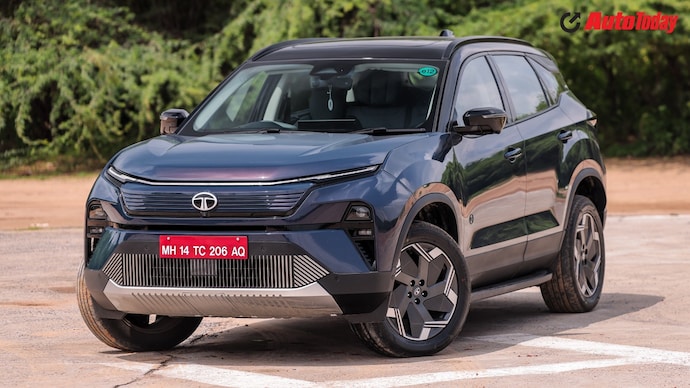
Our first brief encounter with the Tata Harrier.ev left us wanting. It was the automotive equivalent of a movie trailer that shows you all the explosions but hides the plot. To truly understand if this massive leap forward has actually landed on solid ground, we needed a proper, week-long road test. Which is exactly what we did in late October. Although this review has been a while in the making.
Beneath the familiar, imposing sheet metal lies Tata’s dual-motor, all-wheel-drive powertrain, drawing life from a substantial 75kWh battery pack. It kicks out a healthy 390bhp and 504Nm of torque. Now, Tata hasn't revealed the exact kerb weight, but if you employ the trusted rule of thumb of 10kg per kWh of battery and factor in the mechanical heft of a second electric motor, you are looking at a machine that comfortably clears the 2.2-tonne mark. It is a heavy thing.
From a manufacturing standpoint, the build quality has undeniably taken a massive step in the right direction. The materials look premium, and the general fit and finish feel substantially tighter. However, it still has some ways to go. Where the Harrier.ev genuinely struggles is the digital handshake between software and hardware. The ADAS suite lacks polish; functions like auto-park feel glitchy and fail to inspire confidence in tight Indian conditions, a frustration mirrored by the overly defensive or sometimes entirely absent front collision warning sensors.
On the upside, the hardware behind the air-conditioning is sensational, cooling the vast cabin instantly. The infotainment platform offers a deeply immersive audio experience through its premium speakers. It would be a flawless victory if the central screen hadn't blacked out entirely three times during our week with the car. In an electric vehicle, when the screen goes dark, you endure a few deeply unnerving moments wondering if the entire car has shut down or if it’s just the dashboard playing dead.
Testing in the chilly winter ambient temperatures worked to the vehicle's advantage. Keeping my right foot out of the aggressive boost mode, the Harrier returned an efficient 5.75 to 6 km/kWh, equating to a highly respectable 430 to 450km city range. While we didn't do a full-scale highway test, a steady cruise between 80 to 100 kmph in Eco mode should realistically net around 4.5 to 5 km/kWh.
The performance is genuinely rapid, though it wasn't entirely without drama. On one isolated occasion, the throttle stayed wide open for nearly three seconds after lifting off mid-corner, refusing to back down even as I stood on the brakes. It was a passing electronic glitch, but one that certainly gets the adrenaline moving.
Thankfully, the terrain response system is absolutely impeccable. Developed in-house by Tata ELXSI on robust Bosch and Continental hardware, it manages power delivery flawlessly across mixed surfaces. It is easily the most seamless, confidence-inspiring aspect of the entire package.
There are still a few rough edges that need smoothing out before this vehicle feels entirely complete. At triple-digit speeds, the steering loses some of that reassuring weight you want on the highway, feeling a bit disconnected. Bringing this heavy EV to a halt also requires a surprisingly deep stab at the brake pedal due to a slightly spongy initial response, and the sleek, haptic climate controls on the dash are all too eager to register accidental inputs when you're just trying to rest your hand.
Nevertheless, if this is a sign of where the homegrown brand is heading, the future looks incredibly promising.
Subscribe to Auto Today Magazine
Our first brief encounter with the Tata Harrier.ev left us wanting. It was the automotive equivalent of a movie trailer that shows you all the explosions but hides the plot. To truly understand if this massive leap forward has actually landed on solid ground, we needed a proper, week-long road test. Which is exactly what we did in late October. Although this review has been a while in the making.
Beneath the familiar, imposing sheet metal lies Tata’s dual-motor, all-wheel-drive powertrain, drawing life from a substantial 75kWh battery pack. It kicks out a healthy 390bhp and 504Nm of torque. Now, Tata hasn't revealed the exact kerb weight, but if you employ the trusted rule of thumb of 10kg per kWh of battery and factor in the mechanical heft of a second electric motor, you are looking at a machine that comfortably clears the 2.2-tonne mark. It is a heavy thing.
From a manufacturing standpoint, the build quality has undeniably taken a massive step in the right direction. The materials look premium, and the general fit and finish feel substantially tighter. However, it still has some ways to go. Where the Harrier.ev genuinely struggles is the digital handshake between software and hardware. The ADAS suite lacks polish; functions like auto-park feel glitchy and fail to inspire confidence in tight Indian conditions, a frustration mirrored by the overly defensive or sometimes entirely absent front collision warning sensors.
On the upside, the hardware behind the air-conditioning is sensational, cooling the vast cabin instantly. The infotainment platform offers a deeply immersive audio experience through its premium speakers. It would be a flawless victory if the central screen hadn't blacked out entirely three times during our week with the car. In an electric vehicle, when the screen goes dark, you endure a few deeply unnerving moments wondering if the entire car has shut down or if it’s just the dashboard playing dead.
Testing in the chilly winter ambient temperatures worked to the vehicle's advantage. Keeping my right foot out of the aggressive boost mode, the Harrier returned an efficient 5.75 to 6 km/kWh, equating to a highly respectable 430 to 450km city range. While we didn't do a full-scale highway test, a steady cruise between 80 to 100 kmph in Eco mode should realistically net around 4.5 to 5 km/kWh.
The performance is genuinely rapid, though it wasn't entirely without drama. On one isolated occasion, the throttle stayed wide open for nearly three seconds after lifting off mid-corner, refusing to back down even as I stood on the brakes. It was a passing electronic glitch, but one that certainly gets the adrenaline moving.
Thankfully, the terrain response system is absolutely impeccable. Developed in-house by Tata ELXSI on robust Bosch and Continental hardware, it manages power delivery flawlessly across mixed surfaces. It is easily the most seamless, confidence-inspiring aspect of the entire package.
There are still a few rough edges that need smoothing out before this vehicle feels entirely complete. At triple-digit speeds, the steering loses some of that reassuring weight you want on the highway, feeling a bit disconnected. Bringing this heavy EV to a halt also requires a surprisingly deep stab at the brake pedal due to a slightly spongy initial response, and the sleek, haptic climate controls on the dash are all too eager to register accidental inputs when you're just trying to rest your hand.
Nevertheless, if this is a sign of where the homegrown brand is heading, the future looks incredibly promising.
Subscribe to Auto Today Magazine

