The Untold Story Behind India's Birth: Josy Joseph Reveals Forgotten Heroes and Secret Missions
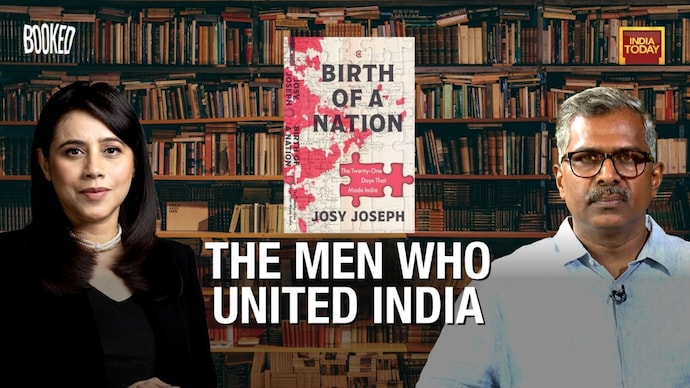
On Booked, Josy Joseph tells Marya Shakil how Birth of a Nation revisits the integration of princely states after Independence. Drawing on declassified archives, the book foregrounds overlooked figures who helped hold the new Union together.
How did India become India?
The answer, according to investigative journalist and author Josy Joseph, is far more dramatic, fragile and fascinating than many history books suggest.
Speaking to India Today’s Marya Shakil on Booked, Joseph discussed his latest book Birth of a Nation, a decade-long research project built on thousands of archival documents from India and the United Kingdom.
The book revisits one of the most consequential periods in modern history — the integration of hundreds of princely states into the Indian Union after Independence.
Joseph revealed that his journey began after an archivist casually mentioned that vast numbers of declassified files connected to the transfer of power were lying largely unexplored. What followed was years of research that uncovered a layered story of political manoeuvring, secret intelligence networks and little-known individuals who helped shape the Republic.
One of the book’s central figures is K.C.S. Mani, whose attack on Travancore’s powerful Diwan, Sir C.P. Ramaswami Aiyar, in July 1947 had consequences far beyond Kerala. Joseph argues that the incident triggered a domino effect among princely states considering independence and altered the course of India’s integration.
The book also shines a spotlight on V.P. Menon, the former typist who rose through the colonial bureaucracy to become one of the principal architects of India’s unification. Working alongside Sardar Vallabhbhai Patel, Menon helped devise and execute the strategy that persuaded hundreds of rulers to join the Indian Union.
According to Joseph, the threat of India’s fragmentation was far more serious than commonly understood. On the eve of Independence, major princely states such as Hyderabad remained outside the Union, while others were still undecided. He believes future archival discoveries may reveal that India came even closer to Balkanisation than current records suggest.
Among the most remarkable discoveries in the book is the story of Araumuthu Iyengar, a minister within Hyderabad’s administration who secretly passed crucial information to New Delhi. Joseph described him as a forgotten patriot whose intelligence reports provided real-time updates during a critical phase of nation-building. Remarkably, even Iyengar’s descendants were unaware of his role until Joseph’s research uncovered it.
For Joseph, however, the book is ultimately about ordinary people who played extraordinary roles.
“I wanted to write about the small men who built the republic,” he said during the conversation.
As debates over history continue to dominate public discourse, Birth of a Nation offers a fresh perspective on 1947 — one that moves beyond familiar names and celebrates the countless unsung individuals whose efforts helped hold a diverse and newly independent country together.
How did India become India?
The answer, according to investigative journalist and author Josy Joseph, is far more dramatic, fragile and fascinating than many history books suggest.
Speaking to India Today’s Marya Shakil on Booked, Joseph discussed his latest book Birth of a Nation, a decade-long research project built on thousands of archival documents from India and the United Kingdom.
The book revisits one of the most consequential periods in modern history — the integration of hundreds of princely states into the Indian Union after Independence.
Joseph revealed that his journey began after an archivist casually mentioned that vast numbers of declassified files connected to the transfer of power were lying largely unexplored. What followed was years of research that uncovered a layered story of political manoeuvring, secret intelligence networks and little-known individuals who helped shape the Republic.
One of the book’s central figures is K.C.S. Mani, whose attack on Travancore’s powerful Diwan, Sir C.P. Ramaswami Aiyar, in July 1947 had consequences far beyond Kerala. Joseph argues that the incident triggered a domino effect among princely states considering independence and altered the course of India’s integration.
The book also shines a spotlight on V.P. Menon, the former typist who rose through the colonial bureaucracy to become one of the principal architects of India’s unification. Working alongside Sardar Vallabhbhai Patel, Menon helped devise and execute the strategy that persuaded hundreds of rulers to join the Indian Union.
According to Joseph, the threat of India’s fragmentation was far more serious than commonly understood. On the eve of Independence, major princely states such as Hyderabad remained outside the Union, while others were still undecided. He believes future archival discoveries may reveal that India came even closer to Balkanisation than current records suggest.
Among the most remarkable discoveries in the book is the story of Araumuthu Iyengar, a minister within Hyderabad’s administration who secretly passed crucial information to New Delhi. Joseph described him as a forgotten patriot whose intelligence reports provided real-time updates during a critical phase of nation-building. Remarkably, even Iyengar’s descendants were unaware of his role until Joseph’s research uncovered it.
For Joseph, however, the book is ultimately about ordinary people who played extraordinary roles.
“I wanted to write about the small men who built the republic,” he said during the conversation.
As debates over history continue to dominate public discourse, Birth of a Nation offers a fresh perspective on 1947 — one that moves beyond familiar names and celebrates the countless unsung individuals whose efforts helped hold a diverse and newly independent country together.

