The changing face of India's gold craze
Gold still holds a special place in Indian homes, but the reasons for buying it are quietly evolving. Is the yellow metal becoming less about tradition and more about investment?
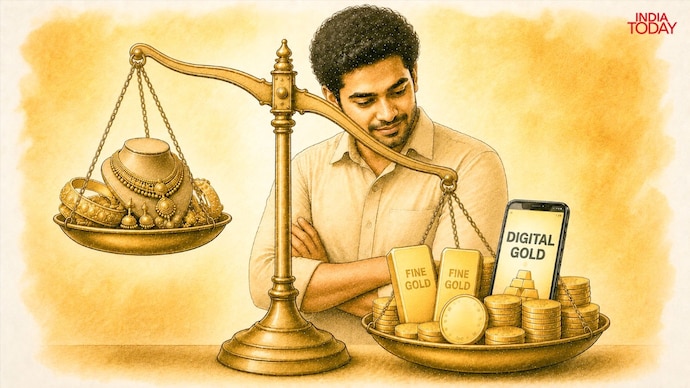
For generations, gold has occupied a special place in Indian homes. It has been gifted at weddings, passed down through generations and tucked away in lockers as a symbol of security and prosperity. In many families, buying gold has been as much about emotion as it has been about wealth.
But look a little closer today, and a subtle shift is beginning to emerge.
The modern Indian buyer is no longer asking only, "Which piece of jewellery should I buy?" Increasingly, the question is, "Should I buy a Gold ETF instead?" With 24-carat gold trading at nearly Rs 1.45 lakh per 10 grams, around 80% higher than a year ago, the yellow metal is gradually acquiring a new identity. It is no longer just something to wear; it is also becoming a financial asset.
India isn't falling out of love with gold. It is simply redefining what owning gold means.
FROM ORNAMENTS TO PORTFOLIOS
Gold buying hasn't disappeared. It has simply evolved. More Indians are now splitting their gold purchases between jewellery and investment products, reflecting a shift in the way households think about the yellow metal.
According to the World Gold Council's Q1 2026 India report, investment demand through bars, coins and Gold ETFs jumped 54% year-on-year to 82 tonnes, accounting for nearly 70% of total gold demand. Jewellery's share, meanwhile, slipped to around 30%, the lowest since comparable data began in 2000.
Prashant Mishra, Founder and CEO of Agnam Advisors, an investment advisory firm and multi-family office, believes this marks a fundamental shift in consumer behaviour.
"Gold hasn't lost its emotional pull; it has simply acquired a second identity. The same household that buys a bangle for a wedding is now also running a Gold ETF SIP for wealth creation."
In other words, gold is no longer viewed only as an ornament. It is increasingly being seen as a financial asset.
HIGH PRICES ARE RESHAPING BUYING HABITS
One of the biggest drivers of this shift has been gold's extraordinary rally over the past year.
With gold prices at record highs, many households have kept their budgets unchanged but reduced the quantity they purchase.
The result is visible across jewellery stores.
Jewellery demand fell 19% in the first quarter of 2026 to 66 tonnes, one of the weakest first-quarter performances in over two decades. Yet spending on jewellery touched a record Rs 99,900 crore, showing that buyers are spending more while taking home lighter pieces.
Mishra says consumers are adapting rather than stepping away from gold.
"The rupee budget has stayed constant while the grammage has shrunk. Buyers are choosing lighter, lower-carat and studded jewellery, coins for gifting, and digital gold or ETFs for pure investment exposure."
A NEW GENERATION IS CHANGING THE GOLD STORY
Perhaps the biggest transformation is being driven by younger Indians.
Unlike previous generations, who often entered the gold market through weddings or family traditions, millennials and Gen Z are approaching the yellow metal from an investment perspective, says Mishra.
Many now buy gold through mobile apps in small monthly instalments, treating it much like a mutual fund SIP.
"The younger investor treats gold as an asset class first and an ornament second," he says.
He further adds that an increasing number of young investors prefer digital or paper gold over jewellery.
"They buy in Rs 500 or Rs 1,000 instalments, track it like a mutual fund and think in terms of portfolio allocation. Weddings still matter, but they are no longer the entry point."
THE RISE OF 'FINANCIAL GOLD'
Investing in gold has never been easier.
Gold ETFs and gold mutual funds have removed many of the barriers associated with physical gold, including making charges, storage costs and purity concerns.
The numbers reflect this growing shift.
Gold ETF assets under management surged from around Rs 59,000 crore in March 2025 to more than Rs 1.7 lakh crore by March 2026.
According to Mishra, this is evidence of a much deeper transformation.
"These products have democratised and financialised gold. They allow investors to accumulate gold through SIPs without worrying about storage or purity."
TRADITION REMAINS, BUT INVESTMENT IS CATCHING UP
None of this suggests that jewellery is losing its place in Indian culture.
Weddings continue to generate enormous demand for gold, and family traditions remain deeply rooted.
What has changed is the behaviour around discretionary purchases.
"Weddings remain the bedrock because they are non-deferrable," Mishra says.
"But festive and discretionary purchases have become much more price-sensitive and are increasingly being replaced with coins, digital gold or ETF units. Cultural demand sets the floor; financial demand now sets the direction."
That distinction could shape India's gold market for years to come.
MORE THAN A PRICE STORY
Is this simply a temporary reaction to soaring prices, or does it signal a permanent change?
Mishra believes the answer is clear.
"It is structural, with a cyclical overlay. The price shock explains the timing, but the enablers—UPI, demat accounts, fintech platforms and a generation comfortable with SIPs—are permanent. Once households experience the convenience of financial gold, they rarely go back to holding all of it in a locker."
JEWELLERS ARE EVOLVING WITH CONSUMERS
Consumers aren't the only ones adapting. Jewellers are changing too.
Instead of focusing only on heavier ornaments, jewellers are expanding their collections to include lightweight, customised and lower-carat designs that fit fixed budgets.
The extension of hallmarking to 9-carat gold reflects this move towards affordability, says Mishra.
According to him, many organised retailers are also expanding beyond traditional jewellery. "Many large retailers are offering gold savings schemes and buyback-linked products to keep customers within their ecosystem."
GOLD'S NEXT CHAPTER
India's fascination with gold is far from over. If anything, it is becoming more sophisticated.
The necklace bought for a wedding and the Gold ETF purchased through a monthly SIP now sit comfortably in the same household. One satisfies tradition. The other builds wealth.
Perhaps that is the biggest shift of all.
For generations, owning gold was about preserving family wealth in a locker. Today, for a growing number of Indians, it is equally about growing wealth in a portfolio.
Gold is still woven into India's traditions, weddings and celebrations. What is changing is not the country's love for the yellow metal, but the way that love is expressed. For a growing number of Indians, gold is no longer just a treasured possession locked away for the future—it is also an investment working for that future.
For generations, gold has occupied a special place in Indian homes. It has been gifted at weddings, passed down through generations and tucked away in lockers as a symbol of security and prosperity. In many families, buying gold has been as much about emotion as it has been about wealth.
But look a little closer today, and a subtle shift is beginning to emerge.
The modern Indian buyer is no longer asking only, "Which piece of jewellery should I buy?" Increasingly, the question is, "Should I buy a Gold ETF instead?" With 24-carat gold trading at nearly Rs 1.45 lakh per 10 grams, around 80% higher than a year ago, the yellow metal is gradually acquiring a new identity. It is no longer just something to wear; it is also becoming a financial asset.
India isn't falling out of love with gold. It is simply redefining what owning gold means.
FROM ORNAMENTS TO PORTFOLIOS
Gold buying hasn't disappeared. It has simply evolved. More Indians are now splitting their gold purchases between jewellery and investment products, reflecting a shift in the way households think about the yellow metal.
According to the World Gold Council's Q1 2026 India report, investment demand through bars, coins and Gold ETFs jumped 54% year-on-year to 82 tonnes, accounting for nearly 70% of total gold demand. Jewellery's share, meanwhile, slipped to around 30%, the lowest since comparable data began in 2000.
Prashant Mishra, Founder and CEO of Agnam Advisors, an investment advisory firm and multi-family office, believes this marks a fundamental shift in consumer behaviour.
"Gold hasn't lost its emotional pull; it has simply acquired a second identity. The same household that buys a bangle for a wedding is now also running a Gold ETF SIP for wealth creation."
In other words, gold is no longer viewed only as an ornament. It is increasingly being seen as a financial asset.
HIGH PRICES ARE RESHAPING BUYING HABITS
One of the biggest drivers of this shift has been gold's extraordinary rally over the past year.
With gold prices at record highs, many households have kept their budgets unchanged but reduced the quantity they purchase.
The result is visible across jewellery stores.
Jewellery demand fell 19% in the first quarter of 2026 to 66 tonnes, one of the weakest first-quarter performances in over two decades. Yet spending on jewellery touched a record Rs 99,900 crore, showing that buyers are spending more while taking home lighter pieces.
Mishra says consumers are adapting rather than stepping away from gold.
"The rupee budget has stayed constant while the grammage has shrunk. Buyers are choosing lighter, lower-carat and studded jewellery, coins for gifting, and digital gold or ETFs for pure investment exposure."
A NEW GENERATION IS CHANGING THE GOLD STORY
Perhaps the biggest transformation is being driven by younger Indians.
Unlike previous generations, who often entered the gold market through weddings or family traditions, millennials and Gen Z are approaching the yellow metal from an investment perspective, says Mishra.
Many now buy gold through mobile apps in small monthly instalments, treating it much like a mutual fund SIP.
"The younger investor treats gold as an asset class first and an ornament second," he says.
He further adds that an increasing number of young investors prefer digital or paper gold over jewellery.
"They buy in Rs 500 or Rs 1,000 instalments, track it like a mutual fund and think in terms of portfolio allocation. Weddings still matter, but they are no longer the entry point."
THE RISE OF 'FINANCIAL GOLD'
Investing in gold has never been easier.
Gold ETFs and gold mutual funds have removed many of the barriers associated with physical gold, including making charges, storage costs and purity concerns.
The numbers reflect this growing shift.
Gold ETF assets under management surged from around Rs 59,000 crore in March 2025 to more than Rs 1.7 lakh crore by March 2026.
According to Mishra, this is evidence of a much deeper transformation.
"These products have democratised and financialised gold. They allow investors to accumulate gold through SIPs without worrying about storage or purity."
TRADITION REMAINS, BUT INVESTMENT IS CATCHING UP
None of this suggests that jewellery is losing its place in Indian culture.
Weddings continue to generate enormous demand for gold, and family traditions remain deeply rooted.
What has changed is the behaviour around discretionary purchases.
"Weddings remain the bedrock because they are non-deferrable," Mishra says.
"But festive and discretionary purchases have become much more price-sensitive and are increasingly being replaced with coins, digital gold or ETF units. Cultural demand sets the floor; financial demand now sets the direction."
That distinction could shape India's gold market for years to come.
MORE THAN A PRICE STORY
Is this simply a temporary reaction to soaring prices, or does it signal a permanent change?
Mishra believes the answer is clear.
"It is structural, with a cyclical overlay. The price shock explains the timing, but the enablers—UPI, demat accounts, fintech platforms and a generation comfortable with SIPs—are permanent. Once households experience the convenience of financial gold, they rarely go back to holding all of it in a locker."
JEWELLERS ARE EVOLVING WITH CONSUMERS
Consumers aren't the only ones adapting. Jewellers are changing too.
Instead of focusing only on heavier ornaments, jewellers are expanding their collections to include lightweight, customised and lower-carat designs that fit fixed budgets.
The extension of hallmarking to 9-carat gold reflects this move towards affordability, says Mishra.
According to him, many organised retailers are also expanding beyond traditional jewellery. "Many large retailers are offering gold savings schemes and buyback-linked products to keep customers within their ecosystem."
GOLD'S NEXT CHAPTER
India's fascination with gold is far from over. If anything, it is becoming more sophisticated.
The necklace bought for a wedding and the Gold ETF purchased through a monthly SIP now sit comfortably in the same household. One satisfies tradition. The other builds wealth.
Perhaps that is the biggest shift of all.
For generations, owning gold was about preserving family wealth in a locker. Today, for a growing number of Indians, it is equally about growing wealth in a portfolio.
Gold is still woven into India's traditions, weddings and celebrations. What is changing is not the country's love for the yellow metal, but the way that love is expressed. For a growing number of Indians, gold is no longer just a treasured possession locked away for the future—it is also an investment working for that future.

