South Korea's Kospi tumbles 8%, Japan's Nikkei down 5%: Why Asian markets are bleeding
South Korea's KOSPI fell 8.2%, prompting authorities to halt program trading for 20 minutes after steep losses rippled across the market. Japan's Nikkei 225 dropped 5%, while Hong Kong's Hang Seng declined 2.4%.
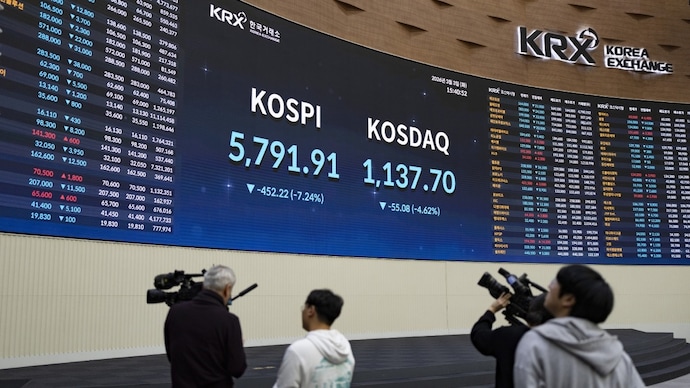
Asian stock markets plunged on Friday as a global selloff in technology stocks gathered pace, with South Korea's benchmark KOSPI tumbling more than 8% and triggering a circuit breaker, while Japan's Nikkei slumped nearly 5% amid fears that the artificial intelligence rally may have run too far, too fast.
South Korea's KOSPI fell 8.2%, prompting authorities to halt program trading for 20 minutes after steep losses rippled across the market. Japan's Nikkei 225 dropped 5%, while Hong Kong's Hang Seng declined 2.4%. China's blue-chip CSI300 index slipped 2.9% and the Shanghai Composite lost more than 2%. Friday's slump followed another broad-based selloff across Asian markets on June 23.
The broader MSCI Asia-Pacific index excluding Japan fell 3.8%, putting it on track for its biggest weekly decline in over a year after an extraordinary rally earlier this quarter.
The selloff followed sharp overnight losses on Wall Street, where Apple erased nearly $250 billion in market value after announcing price increases for iPads and MacBooks to offset soaring memory and storage chip costs. Apple's shares plunged 6.1%, raising concerns that rising AI infrastructure and semiconductor costs are beginning to squeeze even the world's largest technology companies.
The move dampened enthusiasm generated just a day earlier by memory-chip giant Micron Technology, whose blockbuster earnings had fuelled optimism around AI demand and sent its shares to record highs.
"Apple's price increases were a reflection of how big tech may at some point start to feel the pain of these higher component costs," Charu Chanana, chief investment strategist at Saxo, told news agency Reuters.
"That can become a broader ecosystem headwind. Higher input costs, heavier capital expenditure and rising funding needs are making investors more selective about AI exposure."
The technology-heavy selloff was particularly severe across Asia.
China's CSI Artificial Intelligence Index dropped 5%, while the CSI 5G Communication Index plunged 6.3%. Optical module maker Zhongji Innolight, a key supplier to global AI infrastructure, fell nearly 6%.
Hong Kong's Hang Seng Tech Index slid 3.3% on Friday and was headed for its worst weekly performance since October 2025.
Analysts said the declines were also driven by investors locking in profits at the end of the quarter after one of the strongest rallies in years.
South Korea's KOSPI, despite Friday's crash, is still up about 62% for the quarter. Japan's Nikkei has gained roughly 34% over the same period, while the MSCI Asia-Pacific index remains up more than 20%.
Adding to investor caution was weakness in U.S. equity futures. Nasdaq futures dropped 1.7% in Asian trading after reports that OpenAI may delay its long-awaited public listing until next year, raising questions about valuations across the AI ecosystem.
Elsewhere, oil prices extended losses, with Brent crude falling below $74 a barrel as Saudi Aramco resumed shipments from its Ras Tanura export terminal after months of disruption. Lower oil prices provided little relief to broader market sentiment.
Investors also kept a close watch on Japan's currency markets, where the yen hovered near a 40-year low against the U.S. dollar, renewing speculation that Japanese authorities could intervene to support the currency.
Market participants said Friday's selloff does not necessarily signal the end of the AI boom, but rather reflects growing concerns that valuations had become stretched after months of relentless gains. With technology stocks accounting for a large share of global equity market returns this year, any signs of pressure on earnings or profit margins are now prompting investors to rapidly trim risk.
For now, the combination of expensive AI valuations, rising semiconductor costs, quarter-end profit booking and uncertainty around future earnings has turned one of this year's strongest trades into a sharp global correction.
Asian stock markets plunged on Friday as a global selloff in technology stocks gathered pace, with South Korea's benchmark KOSPI tumbling more than 8% and triggering a circuit breaker, while Japan's Nikkei slumped nearly 5% amid fears that the artificial intelligence rally may have run too far, too fast.
South Korea's KOSPI fell 8.2%, prompting authorities to halt program trading for 20 minutes after steep losses rippled across the market. Japan's Nikkei 225 dropped 5%, while Hong Kong's Hang Seng declined 2.4%. China's blue-chip CSI300 index slipped 2.9% and the Shanghai Composite lost more than 2%. Friday's slump followed another broad-based selloff across Asian markets on June 23.
The broader MSCI Asia-Pacific index excluding Japan fell 3.8%, putting it on track for its biggest weekly decline in over a year after an extraordinary rally earlier this quarter.
The selloff followed sharp overnight losses on Wall Street, where Apple erased nearly $250 billion in market value after announcing price increases for iPads and MacBooks to offset soaring memory and storage chip costs. Apple's shares plunged 6.1%, raising concerns that rising AI infrastructure and semiconductor costs are beginning to squeeze even the world's largest technology companies.
The move dampened enthusiasm generated just a day earlier by memory-chip giant Micron Technology, whose blockbuster earnings had fuelled optimism around AI demand and sent its shares to record highs.
"Apple's price increases were a reflection of how big tech may at some point start to feel the pain of these higher component costs," Charu Chanana, chief investment strategist at Saxo, told news agency Reuters.
"That can become a broader ecosystem headwind. Higher input costs, heavier capital expenditure and rising funding needs are making investors more selective about AI exposure."
The technology-heavy selloff was particularly severe across Asia.
China's CSI Artificial Intelligence Index dropped 5%, while the CSI 5G Communication Index plunged 6.3%. Optical module maker Zhongji Innolight, a key supplier to global AI infrastructure, fell nearly 6%.
Hong Kong's Hang Seng Tech Index slid 3.3% on Friday and was headed for its worst weekly performance since October 2025.
Analysts said the declines were also driven by investors locking in profits at the end of the quarter after one of the strongest rallies in years.
South Korea's KOSPI, despite Friday's crash, is still up about 62% for the quarter. Japan's Nikkei has gained roughly 34% over the same period, while the MSCI Asia-Pacific index remains up more than 20%.
Adding to investor caution was weakness in U.S. equity futures. Nasdaq futures dropped 1.7% in Asian trading after reports that OpenAI may delay its long-awaited public listing until next year, raising questions about valuations across the AI ecosystem.
Elsewhere, oil prices extended losses, with Brent crude falling below $74 a barrel as Saudi Aramco resumed shipments from its Ras Tanura export terminal after months of disruption. Lower oil prices provided little relief to broader market sentiment.
Investors also kept a close watch on Japan's currency markets, where the yen hovered near a 40-year low against the U.S. dollar, renewing speculation that Japanese authorities could intervene to support the currency.
Market participants said Friday's selloff does not necessarily signal the end of the AI boom, but rather reflects growing concerns that valuations had become stretched after months of relentless gains. With technology stocks accounting for a large share of global equity market returns this year, any signs of pressure on earnings or profit margins are now prompting investors to rapidly trim risk.
For now, the combination of expensive AI valuations, rising semiconductor costs, quarter-end profit booking and uncertainty around future earnings has turned one of this year's strongest trades into a sharp global correction.

