Ahmedabad murder case exposes interstate fake currency racket
During a search of the deceased's residence, investigators recovered a partially burnt Rs 100 note, which raised suspicions about a possible counterfeit currency operation. Further examination led police to uncover what they described as a large-scale fake currency manufacturing unit operating from the house.
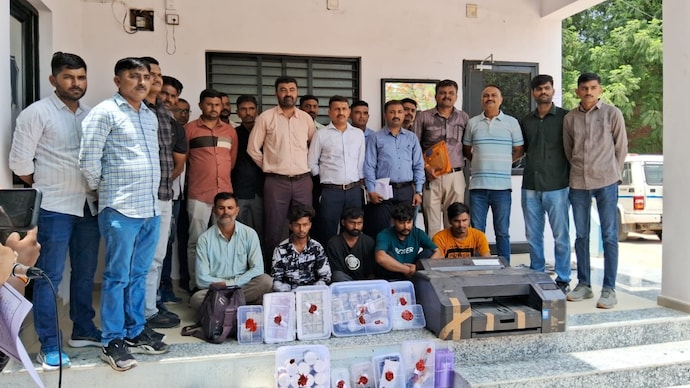
An interstate counterfeit currency racket has come to light during the investigation into a murder case in Ahmedabad, with police claiming that fake currency worth nearly Rs 60 lakh was printed and circulated through the network. Six accused, including a juvenile, have been arrested so far.
The breakthrough came while police were investigating the murder of Imran Shabbir Sindha, who was found dead at a rented house in Ahmedabad's Satej on May 27.
During a search of the deceased's residence, investigators recovered a partially burnt Rs 100 note, which raised suspicions about a possible counterfeit currency operation. Further examination led police to uncover what they described as a large-scale fake currency manufacturing unit operating from the house.
A joint operation by local police and the Crime Branch later busted the racket, seizing counterfeit currency along with printers, machines, special paper, ink and other materials allegedly used for producing fake Indian currency notes.
MURDER UNCOVERS FAKE NOTES RACKET
According to DCP Mayur Patil, the murder investigation revealed that Imran had rented the house and brought several associates from different states to run the counterfeit currency operation, recruiting them to manufacture fake notes from the premises.
The accused named in the case include the deceased mastermind Imran Shabbir Sindha, Suraj Sahni and Ravikumar Shah from Bihar, Virendra Singh alias Viru Baghel and Chandramohan Sharma from Uttar Pradesh, Merajbhai Rabari from Banaskantha, and a juvenile.
Investigators said Imran was allegedly killed by his roommates following a dispute at the rented accommodation. Subsequently, police officials tracked down and arrested Singh and Sharma in Haryana's Palwal, recovering 11 counterfeit Rs 500 notes from them.
Further investigation led police to the juvenile accused in Agra, where counterfeit currency worth more than Rs 28 lakh was recovered, helping investigators piece together the scale of the operation.
FAKE NOTES PRINTED OVER THREE MONTHS
Police believe fake notes worth nearly Rs 60 lakh were printed over the past three months. According to investigators, fake currency worth around Rs 30 lakh had been handed over to Rabari for circulation. While Rabari has been arrested, the notes allegedly distributed through him are yet to be recovered.
The gang primarily printed counterfeit Rs 500 notes. Preparations were also underway to print fake Rs 100 notes when the murder of the alleged mastermind exposed the operation.
Investigators believe the counterfeit notes were difficult to identify when bundled with genuine currency and may have been intended for circulation in rural areas where detection would be harder.
POLICE RECOVER RAW MATERIALS
The probe has revealed that specialised paper, ink and security-thread-like materials were sourced from Noida. Police are now investigating the supply chain and whether others were involved in procuring raw materials for the racket.
Among the items seized from the house were a lamination machine, a laser jet printer, bundles of thin paper, coloured ink cartridges, adhesive cans labelled in Chinese, A4-sized sheets, Gandhi watermark impressions, butter paper bearing Rs 500 and Rs 100 note designs, and thread strips resembling those used in genuine Indian currency notes.
Police have registered separate cases related to murder and counterfeit currency and said further investigation is underway to identify other members of the network and trace the circulation of the fake notes.
An interstate counterfeit currency racket has come to light during the investigation into a murder case in Ahmedabad, with police claiming that fake currency worth nearly Rs 60 lakh was printed and circulated through the network. Six accused, including a juvenile, have been arrested so far.
The breakthrough came while police were investigating the murder of Imran Shabbir Sindha, who was found dead at a rented house in Ahmedabad's Satej on May 27.
During a search of the deceased's residence, investigators recovered a partially burnt Rs 100 note, which raised suspicions about a possible counterfeit currency operation. Further examination led police to uncover what they described as a large-scale fake currency manufacturing unit operating from the house.
A joint operation by local police and the Crime Branch later busted the racket, seizing counterfeit currency along with printers, machines, special paper, ink and other materials allegedly used for producing fake Indian currency notes.
MURDER UNCOVERS FAKE NOTES RACKET
According to DCP Mayur Patil, the murder investigation revealed that Imran had rented the house and brought several associates from different states to run the counterfeit currency operation, recruiting them to manufacture fake notes from the premises.
The accused named in the case include the deceased mastermind Imran Shabbir Sindha, Suraj Sahni and Ravikumar Shah from Bihar, Virendra Singh alias Viru Baghel and Chandramohan Sharma from Uttar Pradesh, Merajbhai Rabari from Banaskantha, and a juvenile.
Investigators said Imran was allegedly killed by his roommates following a dispute at the rented accommodation. Subsequently, police officials tracked down and arrested Singh and Sharma in Haryana's Palwal, recovering 11 counterfeit Rs 500 notes from them.
Further investigation led police to the juvenile accused in Agra, where counterfeit currency worth more than Rs 28 lakh was recovered, helping investigators piece together the scale of the operation.
FAKE NOTES PRINTED OVER THREE MONTHS
Police believe fake notes worth nearly Rs 60 lakh were printed over the past three months. According to investigators, fake currency worth around Rs 30 lakh had been handed over to Rabari for circulation. While Rabari has been arrested, the notes allegedly distributed through him are yet to be recovered.
The gang primarily printed counterfeit Rs 500 notes. Preparations were also underway to print fake Rs 100 notes when the murder of the alleged mastermind exposed the operation.
Investigators believe the counterfeit notes were difficult to identify when bundled with genuine currency and may have been intended for circulation in rural areas where detection would be harder.
POLICE RECOVER RAW MATERIALS
The probe has revealed that specialised paper, ink and security-thread-like materials were sourced from Noida. Police are now investigating the supply chain and whether others were involved in procuring raw materials for the racket.
Among the items seized from the house were a lamination machine, a laser jet printer, bundles of thin paper, coloured ink cartridges, adhesive cans labelled in Chinese, A4-sized sheets, Gandhi watermark impressions, butter paper bearing Rs 500 and Rs 100 note designs, and thread strips resembling those used in genuine Indian currency notes.
Police have registered separate cases related to murder and counterfeit currency and said further investigation is underway to identify other members of the network and trace the circulation of the fake notes.

