Delhi monsoon rain floods roads, triggers snarls on coldest July day
Heavy monsoon rain flooded roads and markets across Delhi on Tuesday. The downpour disrupted traffic, cooled the city sharply and lifted air quality.
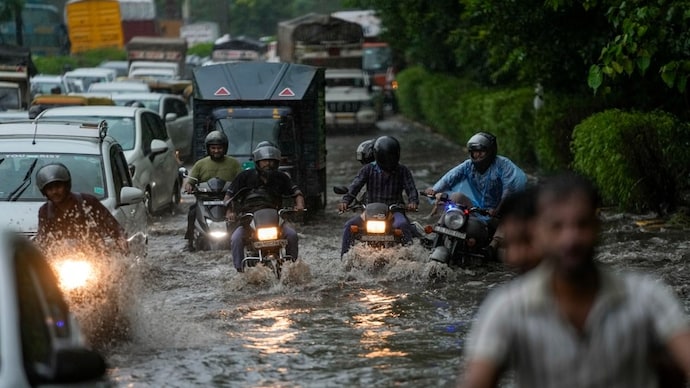
Heavy monsoon rain brought Delhi to a crawl on Tuesday, with flooded roads, waterlogged markets and long traffic tails disrupting daily life across the city. The downpour made it the rainiest day of the year so far and also the coldest day in July in the past three years, according to the India Meteorological Department.
The rain led to widespread complaints of waterlogging, fallen trees and power outages, even as the city’s air turned cleaner. Safdarjung, Delhi’s base station, recorded 57.6 mm of rainfall between 8.30 am and 5.30 pm, while some areas received heavier showers, with Pusa recording the highest at 88.5 mm during the period.
The rain left several parts of the capital submerged, prompting the Municipal Corporation of Delhi, the Public Works Department and the New Delhi Municipal Council to respond to at least 136 complaints.
The MCD said its central control room received 36 complaints between 2 pm and 6 pm, including 20 reports of waterlogging and 16 of fallen trees, from areas such as Paschim Vihar West, Okhla Phase II, Vasant Kunj, Laxmi Nagar, Safdarjung Enclave, Daryaganj, Mayapuri, Punjabi Bagh and several localities in Rohini and Dwarka.
A PWD official said the department received around 60 complaints of waterlogging, most of which were resolved within an hour, along with 15 complaints related to fallen trees.
The NDMC said it attended on priority to 38 rain-related complaints, including 19 cases of waterlogging, six tree falls and 13 power outages, from Gole Market, Shahjahan Road, Krishna Menon Marg, Golf Links, Janpath, Connaught Place, Lodhi Colony, Sarojini Nagar, South Avenue, INA and nearby areas.
In Rajendra Nagar, a major coaching hub, roads were submerged, bringing back memories of the 2024 tragedy in which three civil services aspirants drowned after rainwater entered the basement of a coaching centre.
Cars, motorcycles and auto-rickshaws were seen partially submerged there. In Sadar Bazar, knee-deep water filled narrow lanes, and murky water along with floating garbage forced residents, schoolchildren and shoppers to wade through the streets.
Water also entered several shops, affecting business. Connaught Place and the adjoining Janpath market also saw severe waterlogging.
Traffic snarls were reported across several stretches. According to social media posts, heavy traffic built up from Greater Kailash-II to Savitri Cinema, Chirag Dilli, Hauz Khas and RK Puram, and from Sangam Vihar to Khanpur via MB Road on both carriageways.
Congestion linked to waterlogging was also reported on NH-8 near Shankar Vihar, Zakir Hussain Road, the Delhi Cantt-Naraina Flyover-Mayapuri stretch, ITO, Old Rohtak Road, the Madhuban Chowk-Netaji Subhash Place stretch, Peeragarhi, NH-48 near AIIMS, the Delhi-Noida Road, Kalindi Kunj and Vikas Marg, among other arterial roads.
PWD minister Parvesh Sahib Singh shared a video on X from Minto Bridge and said that while rain continued across the city, life on the stretch remained uninterrupted.
Aam Aadmi Party leader Saurabh Bharadwaj also posted a video from Sadar Bazar showing knee-deep water, with schoolchildren, office-goers and shoppers moving through flooded streets.
Rainfall figures varied across Delhi. Between 8.30 am and 5.30 pm, Lodi Road received 68.8 mm, Safdarjung 57.6 mm, Ayanagar 51.5 mm, Rajghat 47.2 mm, Ridge 40.6 mm, Mayur Vihar 36 mm, Palam 27.8 mm and Najafgarh 0.5 mm.
The maximum temperature at Safdarjung settled at 29 degrees Celsius, 5.9 notches below normal and 9.1 degrees lower than the previous day.
It was the lowest maximum recorded in July since July 8, 2023, when it stood at 28.7 degrees Celsius. Palam and Lodi Road recorded 29.6 degrees Celsius, 5.7 and 4.4 notches below normal, and 7.6 degrees lower than the previous day, respectively.
Ridge recorded a maximum of 28.9 degrees Celsius, 5 notches below normal and 7.5 degrees lower than the previous day, while Ayanagar recorded 29.1 degrees Celsius, 5.4 notches below normal and 7.3 degrees lower than a day earlier. Till 8.30 am, Ridge had recorded the highest cumulative rainfall at 37.6 mm, followed by Lodi Road at 36.7 mm, Safdarjung at 32.4 mm, Ayanagar at 4 mm and Palam at 0.8 mm.
The minimum temperature at Safdarjung was 25.5 degrees Celsius, 1.8 notches below normal. Palam recorded 25 degrees Celsius, 2.1 notches below normal, Lodi Road 25.8 degrees Celsius, 0.2 notch below normal, Ridge 23.2 degrees Celsius, 2.3 notches below normal, and Ayanagar 27.1 degrees Celsius, 1.1 notches above normal.
Delhi’s air quality remained in the ‘satisfactory’ category for the 11th time this month, with the AQI at 66 at 4 pm, according to the Central Pollution Control Board. An AQI between 0 and 50 is classified as ‘good’, 51 to 100 as ‘satisfactory’, 101 to 200 as ‘moderate’, 201 to 300 as ‘poor’, 301 to 400 as ‘very poor’, and 401 to 500 as ‘severe’.
With Tuesday’s rain, Safdarjung has received 197.1 mm of rainfall this month against the long-period average of 192.6 mm, an excess of 4.5 mm or 2 per cent. The Ridge observatory has recorded 244.9 mm against its long-period average of 179.3 mm, an excess of 65.6 mm or about 37 per cent.
The IMD has issued a yellow alert for Wednesday and forecast a generally cloudy sky with light to moderate rain. The maximum and minimum temperatures are likely to settle around 33 degrees Celsius and 23 degrees Celsius, respectively.
The weather office has also forecast light to moderate rain over the capital till the end of the month, after a day in which heavy showers disrupted traffic and daily life even as they brought cleaner air and pushed July rainfall above normal in parts of Delhi.
Heavy monsoon rain brought Delhi to a crawl on Tuesday, with flooded roads, waterlogged markets and long traffic tails disrupting daily life across the city. The downpour made it the rainiest day of the year so far and also the coldest day in July in the past three years, according to the India Meteorological Department.
The rain led to widespread complaints of waterlogging, fallen trees and power outages, even as the city’s air turned cleaner. Safdarjung, Delhi’s base station, recorded 57.6 mm of rainfall between 8.30 am and 5.30 pm, while some areas received heavier showers, with Pusa recording the highest at 88.5 mm during the period.
The rain left several parts of the capital submerged, prompting the Municipal Corporation of Delhi, the Public Works Department and the New Delhi Municipal Council to respond to at least 136 complaints.
The MCD said its central control room received 36 complaints between 2 pm and 6 pm, including 20 reports of waterlogging and 16 of fallen trees, from areas such as Paschim Vihar West, Okhla Phase II, Vasant Kunj, Laxmi Nagar, Safdarjung Enclave, Daryaganj, Mayapuri, Punjabi Bagh and several localities in Rohini and Dwarka.
A PWD official said the department received around 60 complaints of waterlogging, most of which were resolved within an hour, along with 15 complaints related to fallen trees.
The NDMC said it attended on priority to 38 rain-related complaints, including 19 cases of waterlogging, six tree falls and 13 power outages, from Gole Market, Shahjahan Road, Krishna Menon Marg, Golf Links, Janpath, Connaught Place, Lodhi Colony, Sarojini Nagar, South Avenue, INA and nearby areas.
In Rajendra Nagar, a major coaching hub, roads were submerged, bringing back memories of the 2024 tragedy in which three civil services aspirants drowned after rainwater entered the basement of a coaching centre.
Cars, motorcycles and auto-rickshaws were seen partially submerged there. In Sadar Bazar, knee-deep water filled narrow lanes, and murky water along with floating garbage forced residents, schoolchildren and shoppers to wade through the streets.
Water also entered several shops, affecting business. Connaught Place and the adjoining Janpath market also saw severe waterlogging.
Traffic snarls were reported across several stretches. According to social media posts, heavy traffic built up from Greater Kailash-II to Savitri Cinema, Chirag Dilli, Hauz Khas and RK Puram, and from Sangam Vihar to Khanpur via MB Road on both carriageways.
Congestion linked to waterlogging was also reported on NH-8 near Shankar Vihar, Zakir Hussain Road, the Delhi Cantt-Naraina Flyover-Mayapuri stretch, ITO, Old Rohtak Road, the Madhuban Chowk-Netaji Subhash Place stretch, Peeragarhi, NH-48 near AIIMS, the Delhi-Noida Road, Kalindi Kunj and Vikas Marg, among other arterial roads.
PWD minister Parvesh Sahib Singh shared a video on X from Minto Bridge and said that while rain continued across the city, life on the stretch remained uninterrupted.
Aam Aadmi Party leader Saurabh Bharadwaj also posted a video from Sadar Bazar showing knee-deep water, with schoolchildren, office-goers and shoppers moving through flooded streets.
Rainfall figures varied across Delhi. Between 8.30 am and 5.30 pm, Lodi Road received 68.8 mm, Safdarjung 57.6 mm, Ayanagar 51.5 mm, Rajghat 47.2 mm, Ridge 40.6 mm, Mayur Vihar 36 mm, Palam 27.8 mm and Najafgarh 0.5 mm.
The maximum temperature at Safdarjung settled at 29 degrees Celsius, 5.9 notches below normal and 9.1 degrees lower than the previous day.
It was the lowest maximum recorded in July since July 8, 2023, when it stood at 28.7 degrees Celsius. Palam and Lodi Road recorded 29.6 degrees Celsius, 5.7 and 4.4 notches below normal, and 7.6 degrees lower than the previous day, respectively.
Ridge recorded a maximum of 28.9 degrees Celsius, 5 notches below normal and 7.5 degrees lower than the previous day, while Ayanagar recorded 29.1 degrees Celsius, 5.4 notches below normal and 7.3 degrees lower than a day earlier. Till 8.30 am, Ridge had recorded the highest cumulative rainfall at 37.6 mm, followed by Lodi Road at 36.7 mm, Safdarjung at 32.4 mm, Ayanagar at 4 mm and Palam at 0.8 mm.
The minimum temperature at Safdarjung was 25.5 degrees Celsius, 1.8 notches below normal. Palam recorded 25 degrees Celsius, 2.1 notches below normal, Lodi Road 25.8 degrees Celsius, 0.2 notch below normal, Ridge 23.2 degrees Celsius, 2.3 notches below normal, and Ayanagar 27.1 degrees Celsius, 1.1 notches above normal.
Delhi’s air quality remained in the ‘satisfactory’ category for the 11th time this month, with the AQI at 66 at 4 pm, according to the Central Pollution Control Board. An AQI between 0 and 50 is classified as ‘good’, 51 to 100 as ‘satisfactory’, 101 to 200 as ‘moderate’, 201 to 300 as ‘poor’, 301 to 400 as ‘very poor’, and 401 to 500 as ‘severe’.
With Tuesday’s rain, Safdarjung has received 197.1 mm of rainfall this month against the long-period average of 192.6 mm, an excess of 4.5 mm or 2 per cent. The Ridge observatory has recorded 244.9 mm against its long-period average of 179.3 mm, an excess of 65.6 mm or about 37 per cent.
The IMD has issued a yellow alert for Wednesday and forecast a generally cloudy sky with light to moderate rain. The maximum and minimum temperatures are likely to settle around 33 degrees Celsius and 23 degrees Celsius, respectively.
The weather office has also forecast light to moderate rain over the capital till the end of the month, after a day in which heavy showers disrupted traffic and daily life even as they brought cleaner air and pushed July rainfall above normal in parts of Delhi.
Heavy monsoon rain brought Delhi to a crawl on Tuesday, with flooded roads, waterlogged markets and long traffic tails disrupting daily life across the city. The downpour made it the rainiest day of the year so far and also the coldest day in July in the past three years, according to the India Meteorological Department.
The rain led to widespread complaints of waterlogging, fallen trees and power outages, even as the city’s air turned cleaner. Safdarjung, Delhi’s base station, recorded 57.6 mm of rainfall between 8.30 am and 5.30 pm, while some areas received heavier showers, with Pusa recording the highest at 88.5 mm during the period.
The rain left several parts of the capital submerged, prompting the Municipal Corporation of Delhi, the Public Works Department and the New Delhi Municipal Council to respond to at least 136 complaints.
The MCD said its central control room received 36 complaints between 2 pm and 6 pm, including 20 reports of waterlogging and 16 of fallen trees, from areas such as Paschim Vihar West, Okhla Phase II, Vasant Kunj, Laxmi Nagar, Safdarjung Enclave, Daryaganj, Mayapuri, Punjabi Bagh and several localities in Rohini and Dwarka.
A PWD official said the department received around 60 complaints of waterlogging, most of which were resolved within an hour, along with 15 complaints related to fallen trees.
The NDMC said it attended on priority to 38 rain-related complaints, including 19 cases of waterlogging, six tree falls and 13 power outages, from Gole Market, Shahjahan Road, Krishna Menon Marg, Golf Links, Janpath, Connaught Place, Lodhi Colony, Sarojini Nagar, South Avenue, INA and nearby areas.
In Rajendra Nagar, a major coaching hub, roads were submerged, bringing back memories of the 2024 tragedy in which three civil services aspirants drowned after rainwater entered the basement of a coaching centre.
Cars, motorcycles and auto-rickshaws were seen partially submerged there. In Sadar Bazar, knee-deep water filled narrow lanes, and murky water along with floating garbage forced residents, schoolchildren and shoppers to wade through the streets.
Water also entered several shops, affecting business. Connaught Place and the adjoining Janpath market also saw severe waterlogging.
Traffic snarls were reported across several stretches. According to social media posts, heavy traffic built up from Greater Kailash-II to Savitri Cinema, Chirag Dilli, Hauz Khas and RK Puram, and from Sangam Vihar to Khanpur via MB Road on both carriageways.
Congestion linked to waterlogging was also reported on NH-8 near Shankar Vihar, Zakir Hussain Road, the Delhi Cantt-Naraina Flyover-Mayapuri stretch, ITO, Old Rohtak Road, the Madhuban Chowk-Netaji Subhash Place stretch, Peeragarhi, NH-48 near AIIMS, the Delhi-Noida Road, Kalindi Kunj and Vikas Marg, among other arterial roads.
PWD minister Parvesh Sahib Singh shared a video on X from Minto Bridge and said that while rain continued across the city, life on the stretch remained uninterrupted.
Aam Aadmi Party leader Saurabh Bharadwaj also posted a video from Sadar Bazar showing knee-deep water, with schoolchildren, office-goers and shoppers moving through flooded streets.
Rainfall figures varied across Delhi. Between 8.30 am and 5.30 pm, Lodi Road received 68.8 mm, Safdarjung 57.6 mm, Ayanagar 51.5 mm, Rajghat 47.2 mm, Ridge 40.6 mm, Mayur Vihar 36 mm, Palam 27.8 mm and Najafgarh 0.5 mm.
The maximum temperature at Safdarjung settled at 29 degrees Celsius, 5.9 notches below normal and 9.1 degrees lower than the previous day.
It was the lowest maximum recorded in July since July 8, 2023, when it stood at 28.7 degrees Celsius. Palam and Lodi Road recorded 29.6 degrees Celsius, 5.7 and 4.4 notches below normal, and 7.6 degrees lower than the previous day, respectively.
Ridge recorded a maximum of 28.9 degrees Celsius, 5 notches below normal and 7.5 degrees lower than the previous day, while Ayanagar recorded 29.1 degrees Celsius, 5.4 notches below normal and 7.3 degrees lower than a day earlier. Till 8.30 am, Ridge had recorded the highest cumulative rainfall at 37.6 mm, followed by Lodi Road at 36.7 mm, Safdarjung at 32.4 mm, Ayanagar at 4 mm and Palam at 0.8 mm.
The minimum temperature at Safdarjung was 25.5 degrees Celsius, 1.8 notches below normal. Palam recorded 25 degrees Celsius, 2.1 notches below normal, Lodi Road 25.8 degrees Celsius, 0.2 notch below normal, Ridge 23.2 degrees Celsius, 2.3 notches below normal, and Ayanagar 27.1 degrees Celsius, 1.1 notches above normal.
Delhi’s air quality remained in the ‘satisfactory’ category for the 11th time this month, with the AQI at 66 at 4 pm, according to the Central Pollution Control Board. An AQI between 0 and 50 is classified as ‘good’, 51 to 100 as ‘satisfactory’, 101 to 200 as ‘moderate’, 201 to 300 as ‘poor’, 301 to 400 as ‘very poor’, and 401 to 500 as ‘severe’.
With Tuesday’s rain, Safdarjung has received 197.1 mm of rainfall this month against the long-period average of 192.6 mm, an excess of 4.5 mm or 2 per cent. The Ridge observatory has recorded 244.9 mm against its long-period average of 179.3 mm, an excess of 65.6 mm or about 37 per cent.
The IMD has issued a yellow alert for Wednesday and forecast a generally cloudy sky with light to moderate rain. The maximum and minimum temperatures are likely to settle around 33 degrees Celsius and 23 degrees Celsius, respectively.
The weather office has also forecast light to moderate rain over the capital till the end of the month, after a day in which heavy showers disrupted traffic and daily life even as they brought cleaner air and pushed July rainfall above normal in parts of Delhi.

