Ground report: Families keep vigil at Mehrauli collapse site as search drags on
The building that collapsed in Delhi's Mehrauli on Saturday evening was more than brick and mortar. Home to a coaching centre, a mess, paying guest accommodation and residential units, it is now a heap of broken concrete and twisted steel, with every piece of debris removed carrying the hope of an answer.
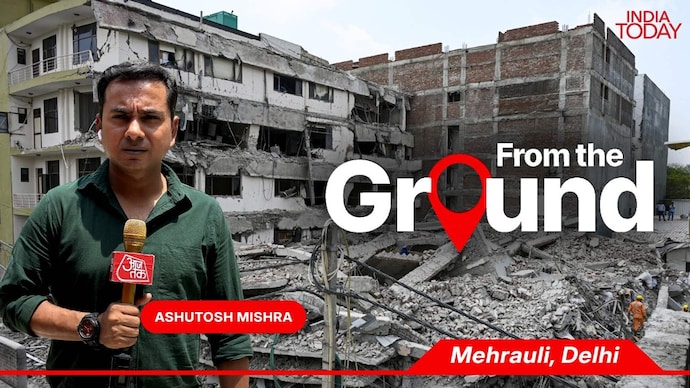
The collapse of a five-storey structure in Delhi’s Mehrauli has left behind more than twisted steel and shattered concrete. It has left a trail of unanswered phone calls and desperate hope as rescue teams race to find those feared trapped beneath the debris.
The building, which collapsed around 7.30 pm on Saturday, was more than just a residential structure in south Delhi. It housed a coaching centre, a mess facility, a paying guest accommodation and residential units.
Now, all that remains is a mountain of concrete, twisted steel and unanswered questions.
One of the first responders at the site, a 102 ambulance driver, recalled the chaos that unfolded in the minutes after the collapse. Injured survivors were rushed to hospitals in ambulances and PCR vehicles even as rescuers scrambled to assess the scale of the disaster. As JCB machines rolled in and emergency personnel fanned out across the site, frantic relatives began arriving, desperately searching for missing family members.
Before formal rescue efforts gained momentum, local residents had already joined the race against time, pulling two people alive from the debris.
By Sunday afternoon, rescuers had brought 11 people out from the rubble, out of which, two victims were declared dead at hospital, while three others remained in critical condition. Officials have not confirmed how many people may still be trapped.
As excavators clawed through the rubble and rescue workers shouted instructions, dozens stood behind police barricades, their eyes fixed on every movement. Some repeatedly dialled missing relatives. Others scanned the faces of those being brought out from beneath the debris.
A father waited for news of his daughter. Nearby, a group of young men stood silently, hoping for word about friends who had gone missing after the collapse.
Among them was Anuj Kumar, a student associated with the coaching centre that operated from the building. He said several of his friends could still be trapped underneath.
"Many phones are still unreachable," he said, watching rescue teams work through the wreckage. "We are waiting, but the operation is moving very slowly."
Neha, who has been searching for her friend Ekta, said the two shared a common routine around the coaching centre. After classes, Ekta would often head to the building's mess for meals.
On Saturday, that routine was shattered. Neha was not with Ekta when the building collapsed. Nearly a day later, she remained at the site, anxiously waiting for any information that might emerge from beneath the rubble.
Meanwhile, rescue operations continue around the clock, led jointly by the Delhi Fire Services and specialised NDRF teams. Amid twisted concrete and mounds of debris, rescuers are relying on thermal imaging cameras, victim locator devices, electronic search equipment and sniffer dogs in a painstaking effort to detect even the faintest signs of life beneath the rubble.
On Sunday, Delhi Chief Minister Rekha Gupta visited the site to review the ongoing rescue operation and promised an investigation into allegations of illegal construction, a charge repeatedly raised by local residents standing amid the debris.
Disaster response experts often refer to the first six hours after a collapse as the "golden hours" - a critical period when the chances of finding survivors are highest. Though many hours have passed since the building came down, rescue teams continue their search, driven by the possibility that someone may still be alive beneath the debris.
The collapse of a five-storey structure in Delhi’s Mehrauli has left behind more than twisted steel and shattered concrete. It has left a trail of unanswered phone calls and desperate hope as rescue teams race to find those feared trapped beneath the debris.
The building, which collapsed around 7.30 pm on Saturday, was more than just a residential structure in south Delhi. It housed a coaching centre, a mess facility, a paying guest accommodation and residential units.
Now, all that remains is a mountain of concrete, twisted steel and unanswered questions.
One of the first responders at the site, a 102 ambulance driver, recalled the chaos that unfolded in the minutes after the collapse. Injured survivors were rushed to hospitals in ambulances and PCR vehicles even as rescuers scrambled to assess the scale of the disaster. As JCB machines rolled in and emergency personnel fanned out across the site, frantic relatives began arriving, desperately searching for missing family members.
Before formal rescue efforts gained momentum, local residents had already joined the race against time, pulling two people alive from the debris.
By Sunday afternoon, rescuers had brought 11 people out from the rubble, out of which, two victims were declared dead at hospital, while three others remained in critical condition. Officials have not confirmed how many people may still be trapped.
As excavators clawed through the rubble and rescue workers shouted instructions, dozens stood behind police barricades, their eyes fixed on every movement. Some repeatedly dialled missing relatives. Others scanned the faces of those being brought out from beneath the debris.
A father waited for news of his daughter. Nearby, a group of young men stood silently, hoping for word about friends who had gone missing after the collapse.
Among them was Anuj Kumar, a student associated with the coaching centre that operated from the building. He said several of his friends could still be trapped underneath.
"Many phones are still unreachable," he said, watching rescue teams work through the wreckage. "We are waiting, but the operation is moving very slowly."
Neha, who has been searching for her friend Ekta, said the two shared a common routine around the coaching centre. After classes, Ekta would often head to the building's mess for meals.
On Saturday, that routine was shattered. Neha was not with Ekta when the building collapsed. Nearly a day later, she remained at the site, anxiously waiting for any information that might emerge from beneath the rubble.
Meanwhile, rescue operations continue around the clock, led jointly by the Delhi Fire Services and specialised NDRF teams. Amid twisted concrete and mounds of debris, rescuers are relying on thermal imaging cameras, victim locator devices, electronic search equipment and sniffer dogs in a painstaking effort to detect even the faintest signs of life beneath the rubble.
On Sunday, Delhi Chief Minister Rekha Gupta visited the site to review the ongoing rescue operation and promised an investigation into allegations of illegal construction, a charge repeatedly raised by local residents standing amid the debris.
Disaster response experts often refer to the first six hours after a collapse as the "golden hours" - a critical period when the chances of finding survivors are highest. Though many hours have passed since the building came down, rescue teams continue their search, driven by the possibility that someone may still be alive beneath the debris.

