Stalled for years: Ashwini Vaishnaw says Kolkata Metro's 62-metre gap finally bridged
Ashwini Vaishnaw announced the completion of girder launching at Chingrighata Crossing. The work closes a key viaduct gap on Kolkata Metro's Orange Line after a long permissions impasse.
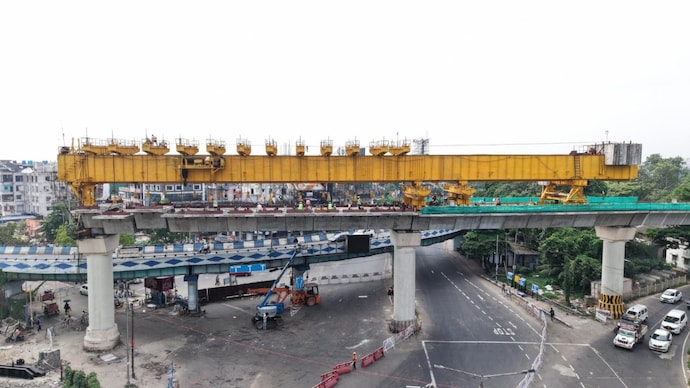
For years, it was the missing piece hanging over one of Kolkata’s busiest crossings - a 62-metre gap that became as much a political flashpoint as an engineering challenge. Now, after court battles, traffic disputes and years of delay, the final stretch of the Kolkata Metro’s Orange Line has finally been bridged.
Railway Minister Ashwini Vaishnaw on Monday announced the completion of the crucial viaduct work at Chingrighata crossing on the EM Bypass, calling it a breakthrough for the long-delayed New Garia-Airport metro corridor.
"We have successfully bridged the 62-metre viaduct gap at Chingrighata – a critical link on Kolkata Metro’s Orange Line," Vaishnaw posted on X.
The minister directly blamed the previous Trinamool Congress administration for delaying the project, alleging that the state government had "kept it stalled for years by refusing basic traffic diversion permissions."
“Even after the High Court and Supreme Court cleared the project, the work still never moved,” he said.
The breakthrough came after authorities imposed night traffic blockades across two successive weekends to carry out the girder launching work at the crucial crossing connecting Sector V, New Town and large parts of north and south Kolkata.
“The obstruction ended. With night traffic blockades over two successive weekends, the work is complete, and the busy crossing road reopened 3 hours ahead of schedule,” Vaishnaw said.
Metro Railway officials confirmed that the long-pending girder launching work was completed around 5 am on Monday and traffic movement on the EM Bypass was restored soon after.
Officials said commercial operations on the stretch are expected to begin by December this year.
A Metro Railway official said the work was completed with the active support of the West Bengal government, marking a shift after years of deadlock over traffic permissions and road blockades.
The project had previously drawn sharp observations from the judiciary. In March, the Supreme Court criticised the West Bengal government for creating roadblocks in the metro project and warned against politicising infrastructure development beneficial to the public.
The Calcutta High Court had also expressed concern over repeated delays and directed authorities to complete the pending work by February 15, 2026.
Online, many Kolkata residents reacted emotionally to the breakthrough, with several calling it a game changer for the city’s transport network.
One user wrote, "We the citizens of Calcutta are excited for metro rollout ASAP."
Another user questioned why the project had remained stalled for so long, while Kolkata resident Joydeep Ganguly described the development as an absolute game changer that would transform connectivity between South Kolkata, Sector V and New Town.
"Wipro More where two metro lines will now converge is the new hot spot," he wrote.
Once operational, the Orange Line is expected to significantly reduce travel time between Kolkata’s southern neighbourhoods, IT hubs and the airport, while easing congestion along one of the city’s busiest traffic corridors.
For years, it was the missing piece hanging over one of Kolkata’s busiest crossings - a 62-metre gap that became as much a political flashpoint as an engineering challenge. Now, after court battles, traffic disputes and years of delay, the final stretch of the Kolkata Metro’s Orange Line has finally been bridged.
Railway Minister Ashwini Vaishnaw on Monday announced the completion of the crucial viaduct work at Chingrighata crossing on the EM Bypass, calling it a breakthrough for the long-delayed New Garia-Airport metro corridor.
"We have successfully bridged the 62-metre viaduct gap at Chingrighata – a critical link on Kolkata Metro’s Orange Line," Vaishnaw posted on X.
The minister directly blamed the previous Trinamool Congress administration for delaying the project, alleging that the state government had "kept it stalled for years by refusing basic traffic diversion permissions."
“Even after the High Court and Supreme Court cleared the project, the work still never moved,” he said.
The breakthrough came after authorities imposed night traffic blockades across two successive weekends to carry out the girder launching work at the crucial crossing connecting Sector V, New Town and large parts of north and south Kolkata.
“The obstruction ended. With night traffic blockades over two successive weekends, the work is complete, and the busy crossing road reopened 3 hours ahead of schedule,” Vaishnaw said.
Metro Railway officials confirmed that the long-pending girder launching work was completed around 5 am on Monday and traffic movement on the EM Bypass was restored soon after.
Officials said commercial operations on the stretch are expected to begin by December this year.
A Metro Railway official said the work was completed with the active support of the West Bengal government, marking a shift after years of deadlock over traffic permissions and road blockades.
The project had previously drawn sharp observations from the judiciary. In March, the Supreme Court criticised the West Bengal government for creating roadblocks in the metro project and warned against politicising infrastructure development beneficial to the public.
The Calcutta High Court had also expressed concern over repeated delays and directed authorities to complete the pending work by February 15, 2026.
Online, many Kolkata residents reacted emotionally to the breakthrough, with several calling it a game changer for the city’s transport network.
One user wrote, "We the citizens of Calcutta are excited for metro rollout ASAP."
Another user questioned why the project had remained stalled for so long, while Kolkata resident Joydeep Ganguly described the development as an absolute game changer that would transform connectivity between South Kolkata, Sector V and New Town.
"Wipro More where two metro lines will now converge is the new hot spot," he wrote.
Once operational, the Orange Line is expected to significantly reduce travel time between Kolkata’s southern neighbourhoods, IT hubs and the airport, while easing congestion along one of the city’s busiest traffic corridors.

