Delhi doesn't get rain. It gets ambushed
Just 72.6 mm fell on July 9, 2026 — the second-wettest July 9 in 16 years. It was enough to submerge the city.
Delhi's monsoon does not arrive. It lands.
On July 9, 2026, the city's Safdarjung gauge recorded 72.6 mm of rain in 24 hours, the second-wettest July 9 in the 16 years the India Meteorological Department has published for the station, and its wettest since 2023. There was "moderate rain at a few places with heavy rain at many places" over Delhi in those 24 hours, and the day's maximum temperature fell by 6–8°C, leaving it markedly below normal.
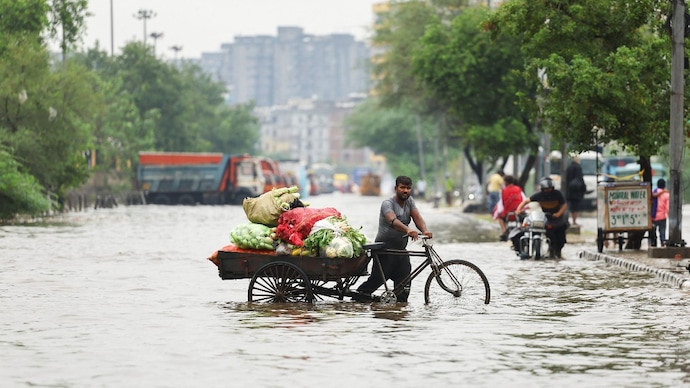
Delhi and the National Capital Region flooded again after the rains on July 8 and 9, according to Down To Earth, in what it called the first major spell of the season. Water closed the Mehrauli-Badarpur road, backed up traffic on NH-24 near Akshardham and on the Delhi-Noida Expressway, and stood on Vikas Marg, at New Delhi railway station, in Munirka, Sadar Bazar, and Dwarka.
Three days earlier, the same gauge had measured nothing at all. On July 5 and 6, not a drop.
The city's July rain arrives in a handful of days. Its drains must carry a month's worth in an afternoon, then sit idle for weeks. Of the 465 July days between 2011 and 2025, 236 were completely dry.
IN NUMBERS
- 51 per cent of Delhi's July days between 2011 and 2025 recorded no rain at all
- In eight of those 15 Julys, the gauge never once recorded a heavy day
- 70 per cent of the month's rain so far has arrived in a single 24-hour period
In 15 Julys, Delhi has recorded only three days of "very heavy" rain, IMD's term for 115.6 mm or more: 153.0 mm on July 9, 2023; 123.4 mm on July 21, 2013; and 117.2 mm on July 1, 2022. Ten more days reached "heavy", between 64.5 and 115.5 mm.
Everything else, 452 days, was moderate, light, or nothing. In eight of those 15 Julys, the gauge never once recorded a heavy day. Delhi can go an entire monsoon month without a single downpour worth the name. This year's July 9 joins the second group. Of the 229 July days on which any rain fell, only seven delivered more.
WHY SO LITTLE WATER GOES SO FAR
The rain that fell on July 9, 2026, was not, by the standards of the Indian monsoon, remarkable. What made it consequential was that it arrived all at once.
Delhi received 5.4 mm across the first six days of July. It then took 98.7 mm over the next three days, and 72.6 mm of that fell on a single day. That’s 70 per cent of the month's rain so far, in 24 hours.
The drains carry a month's load in an afternoon. Down To Earth put it as the question the city keeps failing to answer: why does the national capital flood at the slightest spell of rainfall? Its answer is Delhi's stormwater drainage, and it is a criticism as old as the drains.
THE COMPLICATION
A single gauge is not a city. Rainfall over the National Capital Region varies sharply from one suburb to the next, and Safdarjung is one station in the middle of it. On July 9, it was a fair one: IMD's other Delhi stations recorded between 57.4 mm at Ayanagar and 80.2 mm at Lodhi Road, with Ridge at 77.8 mm and Palam at 63.0 mm. The whole city got soaked, and Safdarjung sat in the middle of the range.
Nor can a rain gauge show a flooded underpass. That Delhi went under on July 8 and 9 is reported, not measured. What the gauge can show is how unusual the rain was, and how ordinary the drainage failure has become.
WHAT COMES NEXT?
The season turned on the same day. The monsoon covered the entire country on July 9, one day after its normal date of July 8, according to the IMD, having advanced into the last of Rajasthan, Haryana, and Punjab. The department had forecast isolated, very heavy rainfall over Haryana, Chandigarh, and Delhi that day. It got it. It now expects isolated heavy rainfall over Delhi between July 10 and 13.
Delhi will end most Julys with roughly the same rainfall. Whether it floods depends on almost none of that. If the rest of the month arrives as it did on July 9, the drains will fail again. If it arrives as a fortnight of moderate showers, nobody will notice at all.
The total is not what does the damage. The arrival is.
Delhi's monsoon does not arrive. It lands.
On July 9, 2026, the city's Safdarjung gauge recorded 72.6 mm of rain in 24 hours, the second-wettest July 9 in the 16 years the India Meteorological Department has published for the station, and its wettest since 2023. There was "moderate rain at a few places with heavy rain at many places" over Delhi in those 24 hours, and the day's maximum temperature fell by 6–8°C, leaving it markedly below normal.
Delhi and the National Capital Region flooded again after the rains on July 8 and 9, according to Down To Earth, in what it called the first major spell of the season. Water closed the Mehrauli-Badarpur road, backed up traffic on NH-24 near Akshardham and on the Delhi-Noida Expressway, and stood on Vikas Marg, at New Delhi railway station, in Munirka, Sadar Bazar, and Dwarka.
Three days earlier, the same gauge had measured nothing at all. On July 5 and 6, not a drop.
The city's July rain arrives in a handful of days. Its drains must carry a month's worth in an afternoon, then sit idle for weeks. Of the 465 July days between 2011 and 2025, 236 were completely dry.
IN NUMBERS
- 51 per cent of Delhi's July days between 2011 and 2025 recorded no rain at all
- In eight of those 15 Julys, the gauge never once recorded a heavy day
- 70 per cent of the month's rain so far has arrived in a single 24-hour period
In 15 Julys, Delhi has recorded only three days of "very heavy" rain, IMD's term for 115.6 mm or more: 153.0 mm on July 9, 2023; 123.4 mm on July 21, 2013; and 117.2 mm on July 1, 2022. Ten more days reached "heavy", between 64.5 and 115.5 mm.
Everything else, 452 days, was moderate, light, or nothing. In eight of those 15 Julys, the gauge never once recorded a heavy day. Delhi can go an entire monsoon month without a single downpour worth the name. This year's July 9 joins the second group. Of the 229 July days on which any rain fell, only seven delivered more.
WHY SO LITTLE WATER GOES SO FAR
The rain that fell on July 9, 2026, was not, by the standards of the Indian monsoon, remarkable. What made it consequential was that it arrived all at once.
Delhi received 5.4 mm across the first six days of July. It then took 98.7 mm over the next three days, and 72.6 mm of that fell on a single day. That’s 70 per cent of the month's rain so far, in 24 hours.
The drains carry a month's load in an afternoon. Down To Earth put it as the question the city keeps failing to answer: why does the national capital flood at the slightest spell of rainfall? Its answer is Delhi's stormwater drainage, and it is a criticism as old as the drains.
THE COMPLICATION
A single gauge is not a city. Rainfall over the National Capital Region varies sharply from one suburb to the next, and Safdarjung is one station in the middle of it. On July 9, it was a fair one: IMD's other Delhi stations recorded between 57.4 mm at Ayanagar and 80.2 mm at Lodhi Road, with Ridge at 77.8 mm and Palam at 63.0 mm. The whole city got soaked, and Safdarjung sat in the middle of the range.
Nor can a rain gauge show a flooded underpass. That Delhi went under on July 8 and 9 is reported, not measured. What the gauge can show is how unusual the rain was, and how ordinary the drainage failure has become.
WHAT COMES NEXT?
The season turned on the same day. The monsoon covered the entire country on July 9, one day after its normal date of July 8, according to the IMD, having advanced into the last of Rajasthan, Haryana, and Punjab. The department had forecast isolated, very heavy rainfall over Haryana, Chandigarh, and Delhi that day. It got it. It now expects isolated heavy rainfall over Delhi between July 10 and 13.
Delhi will end most Julys with roughly the same rainfall. Whether it floods depends on almost none of that. If the rest of the month arrives as it did on July 9, the drains will fail again. If it arrives as a fortnight of moderate showers, nobody will notice at all.
The total is not what does the damage. The arrival is.

