BTech CSE: Thapar, Plaksha or Manipal?
From tuition fees and placement records to teaching approach and campus life, here's how Thapar Institute of Engineering & Technology, Plaksha University and Manipal Institute of Technology compare for a BTech in Computer Science.
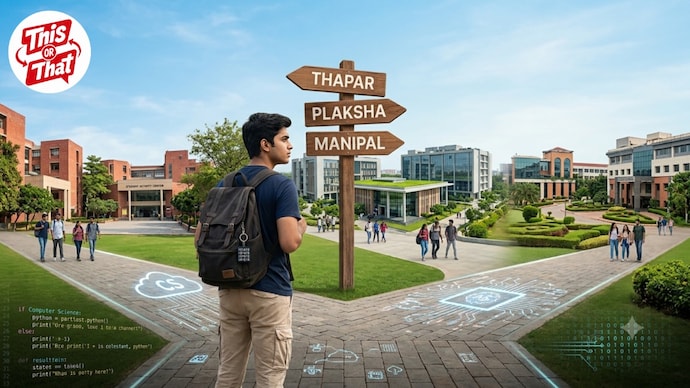
As engineering admissions enter the counselling phase, students with strong Joint Entrance Examination (JEE) Main or Manipal Entrance Test (MET) scores are often faced with a familiar dilemma: Should they choose an established private engineering college like Thapar Institute of Engineering and Technology or Manipal Institute of Technology, or opt for the newer, research-focused Plaksha University? Here's how the three compare.
For many engineering aspirants who miss out on a seat in the Indian Institutes of Technology (IITs) or top National Institutes of Technology (NITs), private universities become the next best option. Among the sought-after institutions for Computer Science and Engineering (CSE) are Thapar Institute of Engineering and Technology (TIET), Plaksha University and Manipal Institute of Technology (MIT), Manipal.
While Thapar and Manipal are among India's oldest private engineering institutions with decades of alumni and recruiter relationships, Plaksha, established in 2021, is positioning itself as a technology university inspired by global institutions with an interdisciplinary approach to engineering education.
| Institute | Established | Admission route | Highlights |
|---|---|---|---|
| Thapar Institute of Engineering & Technology | 1956 | JEE Main and Class 12-based counselling | Strong placements, large alumni network |
| Plaksha University | 2021 | JEE Main, SAT, Class 12 marks, profile review and interview | Interdisciplinary curriculum, research and entrepreneurship focus |
| Manipal Institute of Technology | 1957 | Manipal Entrance Test (MET); JEE Main for select admissions | Large campus, international exposure, established placements |
CURRICULUM: TRADITIONAL ENGINEERING VS INTERDISCIPLINARY LEARNING
THAPAR INSTITUTE OF ENGINEERING & TECHNOLOGY
Thapar follows a conventional engineering curriculum that has evolved over the years to include emerging areas such as Artificial Intelligence, Machine Learning, Data Science and Cyber Security. Students receive a strong grounding in core computer science subjects during the initial semesters before moving to electives and specialised courses.
The institute also offers opportunities for undergraduate research, hackathons and industry projects, although the programme remains rooted in a traditional engineering framework.
PLAKSHA UNIVERSITY
Plaksha takes a markedly different approach. Instead of rigid departmental boundaries, students begin with a common engineering foundation before choosing majors and interdisciplinary pathways.
The university integrates computing with subjects such as biology, economics and design, while placing significant emphasis on project-based learning from the first year. Courses in entrepreneurship, communication and liberal arts are also embedded into the curriculum.
MANIPAL INSTITUTE OF TECHNOLOGY
Manipal offers a well-established Computer Science programme with several specialisation options, including Artificial Intelligence and Machine Learning, Cyber Security, Data Science, Robotics and Artificial Intelligence, Internet of Things and Software Engineering.
Students can choose these tracks after completing the initial semesters, allowing greater flexibility within the degree programme.
THAPAR, PLAKSHA OR MANIPAL: ADMISSIONS
The admission processes differ significantly.
Thapar primarily admits students through JEE Main scores, with counselling conducted by the institute.
Manipal conducts its own entrance examination — the Manipal Entrance Test (MET). Students are allotted seats based on their MET rank, while JEE Main scores may also be considered under certain admission categories.
Plaksha, meanwhile, follows a holistic admissions process. Along with JEE Main or SAT scores, the university evaluates Class 12 performance, extracurricular achievements, personal essays and interviews before making admission offers.
THAPAR, PLAKSHA OR MANIPAL: FEES
The cost of studying varies considerably across the three institutions.
Approximate tuition fees for BTech Computer Science are:
Thapar Institute of Engineering & Technology: Around Rs 14 to 16 lakh for the programme.
Manipal Institute of Technology: About Rs 24.4 lakh for the four-year programme, excluding hostel and personal expenses.
Plaksha University: Among the most expensive, with the total cost of attendance crossing Rs 30 lakh before scholarships in many cases.
Students should also factor in hostel fees, mess charges and living expenses while comparing overall costs.
THAPAR, PLAKSHA OR MANIPAL: PLACEMENTS
Placement performance remains one of the biggest deciding factors for engineering aspirants.
THAPAR INSTITUTE OF ENGINEERING & TECHNOLOGY
Thapar has a mature placement ecosystem built over several decades. Major recruiters include Microsoft, JP Morgan Chase, IBM, Samsung, Deloitte, Goldman Sachs and American Express. Its extensive alumni network across the technology sector continues to strengthen internship and placement opportunities.
MANIPAL INSTITUTE OF TECHNOLOGY
Manipal also attracts a large number of technology recruiters every year. According to the institute, over 300 companies, including more than 50 Fortune 500 firms, participate in placements and internships across programmes. Recruiters for Computer Science include Microsoft, Goldman Sachs, SAP Labs, VMware, Citrix, Cloudera and Western Digital, among others.
PLAKSHA UNIVERSITY
As a relatively young university, Plaksha has only recently begun graduating undergraduate batches. While its placement data is still evolving, the university highlights strong internship opportunities, startup exposure and partnerships with technology companies. Early placement reports indicate interest from consulting, software and deep-tech firms, though comparisons with decades-old institutions should be made cautiously because of the smaller graduating batch sizes.
THAPAR, PLAKSHA OR MANIPAL: RESEARCH AND INTERNATIONAL COLLABORATIONS
This is where the three institutions begin to differ more noticeably.
Plaksha positions research and innovation at the centre of its undergraduate education. Students work on interdisciplinary projects, innovation labs and startup incubation from the early semesters, with mentorship from faculty trained at leading global universities.
Thapar has collaborated with universities in Europe, North America and Australia, offering exchange programmes and joint research opportunities. In the NIRF 2025 Research Rankings, Thapar Institute of Engineering & Technology was placed 42nd in the country, reflecting its performance across research publications, citations, patents and professional practice. NIRF rankings are released by the Ministry of Education annually. Thapar’s own Scopus dashboard gives a non-EduRank source, and its homepage shows 15,734 total publications and 327,792 total citations.
Manipal, through the Manipal Academy of Higher Education (MAHE), has one of the largest international collaboration networks among private universities in India and regularly hosts international students and faculty. MAHE is ranked at the 19th position in the NIRF research category. A similar public source exists for MIT on Manipal’s researcher portal, which shows its research output and citation metrics. The page lists 10,432 articles, 3,094 conference contributions, 988 review articles, 447 chapters, and 342,019 citations for Manipal Institute of Technology, Manipal.
THAPAR, PLAKSHA OR MANIPAL: CAMPUS LIFE
The student experience also varies considerably.
Thapar has a campus in Patiala with a vibrant coding culture, technical societies and entrepreneurship cells.
Manipal is often regarded as one of India's most active residential campuses, offering extensive student clubs, cultural festivals, sports infrastructure and international exposure.
Plaksha, with its smaller cohort size, offers a more personalised academic environment with close faculty interaction and project-based learning.
THAPAR, PLAKSHA OR MANIPAL: WHICH ONE SHOULD YOU CHOOSE?
There is no single answer, as the "best" choice depends on what students prioritise.
Choose Thapar Institute of Engineering and Technology if you want a well-established engineering brand, a large alumni network and a long track record of campus placements.
Choose Manipal Institute of Technology if you are looking for a comprehensive campus experience, multiple Computer Science specialisations and strong industry connections through a large recruiter base.
Choose Plaksha University if you are interested in interdisciplinary learning, research, entrepreneurship and are comfortable investing in a newer institution with a different educational model.
Ultimately, aspirants should compare not just placement figures or fees, but also the curriculum, learning environment, peer group, financial aid and long-term career goals before making a decision.
Disclaimer: This comparison is part of our This vs That series. The institutions have been selected based on popular student comparisons and do not represent a ranking or endorsement.
As engineering admissions enter the counselling phase, students with strong Joint Entrance Examination (JEE) Main or Manipal Entrance Test (MET) scores are often faced with a familiar dilemma: Should they choose an established private engineering college like Thapar Institute of Engineering and Technology or Manipal Institute of Technology, or opt for the newer, research-focused Plaksha University? Here's how the three compare.
For many engineering aspirants who miss out on a seat in the Indian Institutes of Technology (IITs) or top National Institutes of Technology (NITs), private universities become the next best option. Among the sought-after institutions for Computer Science and Engineering (CSE) are Thapar Institute of Engineering and Technology (TIET), Plaksha University and Manipal Institute of Technology (MIT), Manipal.
While Thapar and Manipal are among India's oldest private engineering institutions with decades of alumni and recruiter relationships, Plaksha, established in 2021, is positioning itself as a technology university inspired by global institutions with an interdisciplinary approach to engineering education.
| Institute | Established | Admission route | Highlights |
|---|---|---|---|
| Thapar Institute of Engineering & Technology | 1956 | JEE Main and Class 12-based counselling | Strong placements, large alumni network |
| Plaksha University | 2021 | JEE Main, SAT, Class 12 marks, profile review and interview | Interdisciplinary curriculum, research and entrepreneurship focus |
| Manipal Institute of Technology | 1957 | Manipal Entrance Test (MET); JEE Main for select admissions | Large campus, international exposure, established placements |
CURRICULUM: TRADITIONAL ENGINEERING VS INTERDISCIPLINARY LEARNING
THAPAR INSTITUTE OF ENGINEERING & TECHNOLOGY
Thapar follows a conventional engineering curriculum that has evolved over the years to include emerging areas such as Artificial Intelligence, Machine Learning, Data Science and Cyber Security. Students receive a strong grounding in core computer science subjects during the initial semesters before moving to electives and specialised courses.
The institute also offers opportunities for undergraduate research, hackathons and industry projects, although the programme remains rooted in a traditional engineering framework.
PLAKSHA UNIVERSITY
Plaksha takes a markedly different approach. Instead of rigid departmental boundaries, students begin with a common engineering foundation before choosing majors and interdisciplinary pathways.
The university integrates computing with subjects such as biology, economics and design, while placing significant emphasis on project-based learning from the first year. Courses in entrepreneurship, communication and liberal arts are also embedded into the curriculum.
MANIPAL INSTITUTE OF TECHNOLOGY
Manipal offers a well-established Computer Science programme with several specialisation options, including Artificial Intelligence and Machine Learning, Cyber Security, Data Science, Robotics and Artificial Intelligence, Internet of Things and Software Engineering.
Students can choose these tracks after completing the initial semesters, allowing greater flexibility within the degree programme.
THAPAR, PLAKSHA OR MANIPAL: ADMISSIONS
The admission processes differ significantly.
Thapar primarily admits students through JEE Main scores, with counselling conducted by the institute.
Manipal conducts its own entrance examination — the Manipal Entrance Test (MET). Students are allotted seats based on their MET rank, while JEE Main scores may also be considered under certain admission categories.
Plaksha, meanwhile, follows a holistic admissions process. Along with JEE Main or SAT scores, the university evaluates Class 12 performance, extracurricular achievements, personal essays and interviews before making admission offers.
THAPAR, PLAKSHA OR MANIPAL: FEES
The cost of studying varies considerably across the three institutions.
Approximate tuition fees for BTech Computer Science are:
Thapar Institute of Engineering & Technology: Around Rs 14 to 16 lakh for the programme.
Manipal Institute of Technology: About Rs 24.4 lakh for the four-year programme, excluding hostel and personal expenses.
Plaksha University: Among the most expensive, with the total cost of attendance crossing Rs 30 lakh before scholarships in many cases.
Students should also factor in hostel fees, mess charges and living expenses while comparing overall costs.
THAPAR, PLAKSHA OR MANIPAL: PLACEMENTS
Placement performance remains one of the biggest deciding factors for engineering aspirants.
THAPAR INSTITUTE OF ENGINEERING & TECHNOLOGY
Thapar has a mature placement ecosystem built over several decades. Major recruiters include Microsoft, JP Morgan Chase, IBM, Samsung, Deloitte, Goldman Sachs and American Express. Its extensive alumni network across the technology sector continues to strengthen internship and placement opportunities.
MANIPAL INSTITUTE OF TECHNOLOGY
Manipal also attracts a large number of technology recruiters every year. According to the institute, over 300 companies, including more than 50 Fortune 500 firms, participate in placements and internships across programmes. Recruiters for Computer Science include Microsoft, Goldman Sachs, SAP Labs, VMware, Citrix, Cloudera and Western Digital, among others.
PLAKSHA UNIVERSITY
As a relatively young university, Plaksha has only recently begun graduating undergraduate batches. While its placement data is still evolving, the university highlights strong internship opportunities, startup exposure and partnerships with technology companies. Early placement reports indicate interest from consulting, software and deep-tech firms, though comparisons with decades-old institutions should be made cautiously because of the smaller graduating batch sizes.
THAPAR, PLAKSHA OR MANIPAL: RESEARCH AND INTERNATIONAL COLLABORATIONS
This is where the three institutions begin to differ more noticeably.
Plaksha positions research and innovation at the centre of its undergraduate education. Students work on interdisciplinary projects, innovation labs and startup incubation from the early semesters, with mentorship from faculty trained at leading global universities.
Thapar has collaborated with universities in Europe, North America and Australia, offering exchange programmes and joint research opportunities. In the NIRF 2025 Research Rankings, Thapar Institute of Engineering & Technology was placed 42nd in the country, reflecting its performance across research publications, citations, patents and professional practice. NIRF rankings are released by the Ministry of Education annually. Thapar’s own Scopus dashboard gives a non-EduRank source, and its homepage shows 15,734 total publications and 327,792 total citations.
Manipal, through the Manipal Academy of Higher Education (MAHE), has one of the largest international collaboration networks among private universities in India and regularly hosts international students and faculty. MAHE is ranked at the 19th position in the NIRF research category. A similar public source exists for MIT on Manipal’s researcher portal, which shows its research output and citation metrics. The page lists 10,432 articles, 3,094 conference contributions, 988 review articles, 447 chapters, and 342,019 citations for Manipal Institute of Technology, Manipal.
THAPAR, PLAKSHA OR MANIPAL: CAMPUS LIFE
The student experience also varies considerably.
Thapar has a campus in Patiala with a vibrant coding culture, technical societies and entrepreneurship cells.
Manipal is often regarded as one of India's most active residential campuses, offering extensive student clubs, cultural festivals, sports infrastructure and international exposure.
Plaksha, with its smaller cohort size, offers a more personalised academic environment with close faculty interaction and project-based learning.
THAPAR, PLAKSHA OR MANIPAL: WHICH ONE SHOULD YOU CHOOSE?
There is no single answer, as the "best" choice depends on what students prioritise.
Choose Thapar Institute of Engineering and Technology if you want a well-established engineering brand, a large alumni network and a long track record of campus placements.
Choose Manipal Institute of Technology if you are looking for a comprehensive campus experience, multiple Computer Science specialisations and strong industry connections through a large recruiter base.
Choose Plaksha University if you are interested in interdisciplinary learning, research, entrepreneurship and are comfortable investing in a newer institution with a different educational model.
Ultimately, aspirants should compare not just placement figures or fees, but also the curriculum, learning environment, peer group, financial aid and long-term career goals before making a decision.
Disclaimer: This comparison is part of our This vs That series. The institutions have been selected based on popular student comparisons and do not represent a ranking or endorsement.

