BTech or BSc? Here's how to choose the right undergraduate degree after Class 12
Confused between BTech and BSc? Understand the differences in eligibility, curriculum, career scope, higher studies and salaries to make the right choice after Class 12.
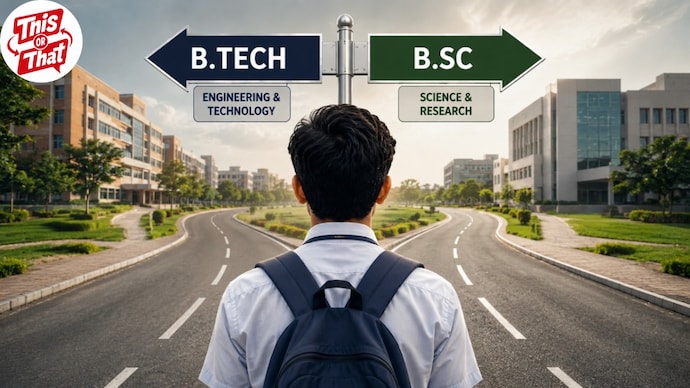
Every year, lakhs of students completing Class 12 in science face the same dilemma – should I pursue a BTech or a BSc? While both degrees can lead to rewarding careers, they are designed for different learning styles, career goals and industries.
The right choice is not about which course is "better", but which one aligns with your interests, strengths and long-term plans. A student who enjoys building technology and solving engineering problems may thrive in a BTech programme, while someone passionate about scientific research, mathematics or fundamental concepts may find a BSc more fulfilling.
Here's a detailed guide to help you decide.
B-TECH OR BSc: UNDERSTANDING THE DIFFERENCE
At first glance, both courses involve science subjects, but their approach is very different.
A Bachelor of Technology (BTech) is a professional engineering degree focused on applying scientific principles to design, develop and build technologies. It prepares students for industry roles through practical learning, laboratories, projects and internships.
A Bachelor of Science (BSc), on the other hand, is an academic degree that focuses on understanding scientific concepts, theories and research. It lays a strong foundation in subjects such as Physics, Chemistry, Mathematics, Biology, Statistics or Computer Science.
B-TECH OR BSc: WHO IS ELIGIBLE?
Students generally need Physics, Chemistry and Mathematics (PCM) in Class 12 to do a BTech. Admission is mostly based on engineering entrance examinations such as JEE Main, state-level entrance tests or university-specific exams.
Eligibility to enroll in a BSc degree depends on the subject. Most universities admit students based on Class 12 marks, although several institutions conduct entrance examinations for admission to specific programmes.
B-TECH OR BSc: PRACTICAL VS THEORETICAL CURRICULUM
One of the biggest differences lies in the way students learn.
The BTech curriculum includes:
- Engineering fundamentals
- Coding and programming (in many branches)
- Design projects
- Industrial training
- Laboratory work
- Internships
- Capstone projects
Students spend a significant amount of time applying concepts to real-world problems.
The BSc curriculum focuses on:
- Scientific theories
- Research methodology
- Laboratory experiments
- Mathematical foundations
- Academic projects
- Subject specialisation
Students gain a deeper understanding of core scientific principles.
B-TECH OR BSc: CAREER OPPORTUNITIES AFTER GRADUATION
BTech graduates can explore careers in:
- Software development
- Artificial intelligence and machine learning
- Data science
- Core engineering sectors
- Manufacturing
- Electronics
- Civil infrastructure
- Automotive industries
- Renewable energy
- Consulting
- Product management
Many companies recruit directly from engineering colleges through campus placements.
For BSc graduates, career options vary widely depending on the specialisation. Students can work in:
- Research laboratories
- Healthcare
- Biotechnology
- Pharmaceuticals
- Environmental science
- Data analytics
- Education
- Banking
- Government organisations
- Scientific institutions
Many BSc graduates also pursue higher studies before entering specialised careers.
B-TECH OR BSc: WHICH DEGREE OFFERS BETTER SALARIES?
Salary depends far more on skills, institution, location and industry than the degree itself.
Top engineering graduates often receive attractive campus offers, especially in software and technology roles. However, BSc graduates who pursue specialised master's programmes or develop expertise in emerging fields such as data science, biotechnology or analytics can also secure highly competitive salaries.
Rather than comparing average salaries, students should focus on long-term career growth.
B-TECH OR BSc: HIGHER EDUCATION OPTIONS
After BTech, students commonly pursue:
- MTech
- MBA
- MS abroad
- Specialised certifications in AI, cybersecurity or cloud computing
After BSc, popular options include:
- MSc
- MCA
- MBA
- Integrated PhD
- Professional certifications
- Research fellowships
A BSc often serves as a stepping stone towards research and academia.
B-TECH OR BSc: WHAT SHOULD STUDENTS CHOOSE?
A BTech may be suitable if you:
- Enjoy mathematics and problem-solving
- Like building products or machines
- Want hands-on technical learning
- Prefer industry-oriented careers
- Are interested in engineering, software or technology
A BSc may be a better fit if you:
- Enjoy understanding scientific concepts in depth
- Like research and experimentation
- Plan to pursue postgraduate studies
- Are interested in academia or scientific careers
- Want flexibility across multiple science disciplines
B-TECH OR BSc: QUICK COMPARISON
| Factor | BTech | BSc |
|---|---|---|
| Duration | 4 years | 3-4 years (depending on programme) |
| Focus | Engineering and technology | Fundamental sciences |
| Learning style | Practical, project-based | Theoretical with laboratory work |
| Admissions | Mostly entrance exams | Merit-based and entrance exams |
| Career path | Industry and engineering | Research, science, analytics, higher studies |
| Higher studies | MTech, MBA, MS | MSc, MCA, MBA, PhD |
Choosing between a BTech and a BSc is less about prestige and more about fit. If you enjoy creating technology, solving engineering challenges and entering the workforce through industry-oriented programmes, BTech may be the right path. If you're driven by curiosity, scientific inquiry and the prospect of research or specialised study, a BSc could offer stronger long-term opportunities.
Before making a decision, students should evaluate their interests, preferred learning style, career aspirations and the subjects they genuinely enjoy. The best degree is the one that aligns with your goals – not simply the one that is more popular.
Every year, lakhs of students completing Class 12 in science face the same dilemma – should I pursue a BTech or a BSc? While both degrees can lead to rewarding careers, they are designed for different learning styles, career goals and industries.
The right choice is not about which course is "better", but which one aligns with your interests, strengths and long-term plans. A student who enjoys building technology and solving engineering problems may thrive in a BTech programme, while someone passionate about scientific research, mathematics or fundamental concepts may find a BSc more fulfilling.
Here's a detailed guide to help you decide.
B-TECH OR BSc: UNDERSTANDING THE DIFFERENCE
At first glance, both courses involve science subjects, but their approach is very different.
A Bachelor of Technology (BTech) is a professional engineering degree focused on applying scientific principles to design, develop and build technologies. It prepares students for industry roles through practical learning, laboratories, projects and internships.
A Bachelor of Science (BSc), on the other hand, is an academic degree that focuses on understanding scientific concepts, theories and research. It lays a strong foundation in subjects such as Physics, Chemistry, Mathematics, Biology, Statistics or Computer Science.
B-TECH OR BSc: WHO IS ELIGIBLE?
Students generally need Physics, Chemistry and Mathematics (PCM) in Class 12 to do a BTech. Admission is mostly based on engineering entrance examinations such as JEE Main, state-level entrance tests or university-specific exams.
Eligibility to enroll in a BSc degree depends on the subject. Most universities admit students based on Class 12 marks, although several institutions conduct entrance examinations for admission to specific programmes.
B-TECH OR BSc: PRACTICAL VS THEORETICAL CURRICULUM
One of the biggest differences lies in the way students learn.
The BTech curriculum includes:
- Engineering fundamentals
- Coding and programming (in many branches)
- Design projects
- Industrial training
- Laboratory work
- Internships
- Capstone projects
Students spend a significant amount of time applying concepts to real-world problems.
The BSc curriculum focuses on:
- Scientific theories
- Research methodology
- Laboratory experiments
- Mathematical foundations
- Academic projects
- Subject specialisation
Students gain a deeper understanding of core scientific principles.
B-TECH OR BSc: CAREER OPPORTUNITIES AFTER GRADUATION
BTech graduates can explore careers in:
- Software development
- Artificial intelligence and machine learning
- Data science
- Core engineering sectors
- Manufacturing
- Electronics
- Civil infrastructure
- Automotive industries
- Renewable energy
- Consulting
- Product management
Many companies recruit directly from engineering colleges through campus placements.
For BSc graduates, career options vary widely depending on the specialisation. Students can work in:
- Research laboratories
- Healthcare
- Biotechnology
- Pharmaceuticals
- Environmental science
- Data analytics
- Education
- Banking
- Government organisations
- Scientific institutions
Many BSc graduates also pursue higher studies before entering specialised careers.
B-TECH OR BSc: WHICH DEGREE OFFERS BETTER SALARIES?
Salary depends far more on skills, institution, location and industry than the degree itself.
Top engineering graduates often receive attractive campus offers, especially in software and technology roles. However, BSc graduates who pursue specialised master's programmes or develop expertise in emerging fields such as data science, biotechnology or analytics can also secure highly competitive salaries.
Rather than comparing average salaries, students should focus on long-term career growth.
B-TECH OR BSc: HIGHER EDUCATION OPTIONS
After BTech, students commonly pursue:
- MTech
- MBA
- MS abroad
- Specialised certifications in AI, cybersecurity or cloud computing
After BSc, popular options include:
- MSc
- MCA
- MBA
- Integrated PhD
- Professional certifications
- Research fellowships
A BSc often serves as a stepping stone towards research and academia.
B-TECH OR BSc: WHAT SHOULD STUDENTS CHOOSE?
A BTech may be suitable if you:
- Enjoy mathematics and problem-solving
- Like building products or machines
- Want hands-on technical learning
- Prefer industry-oriented careers
- Are interested in engineering, software or technology
A BSc may be a better fit if you:
- Enjoy understanding scientific concepts in depth
- Like research and experimentation
- Plan to pursue postgraduate studies
- Are interested in academia or scientific careers
- Want flexibility across multiple science disciplines
B-TECH OR BSc: QUICK COMPARISON
| Factor | BTech | BSc |
|---|---|---|
| Duration | 4 years | 3-4 years (depending on programme) |
| Focus | Engineering and technology | Fundamental sciences |
| Learning style | Practical, project-based | Theoretical with laboratory work |
| Admissions | Mostly entrance exams | Merit-based and entrance exams |
| Career path | Industry and engineering | Research, science, analytics, higher studies |
| Higher studies | MTech, MBA, MS | MSc, MCA, MBA, PhD |
Choosing between a BTech and a BSc is less about prestige and more about fit. If you enjoy creating technology, solving engineering challenges and entering the workforce through industry-oriented programmes, BTech may be the right path. If you're driven by curiosity, scientific inquiry and the prospect of research or specialised study, a BSc could offer stronger long-term opportunities.
Before making a decision, students should evaluate their interests, preferred learning style, career aspirations and the subjects they genuinely enjoy. The best degree is the one that aligns with your goals – not simply the one that is more popular.

