Are Indian universities learning to game global rankings? The QS 2027 questions
Why did several Indian private universities climb sharply in the QS World University Rankings 2027 while many public institutions slipped? An analysis of ranking data, conversations with India Research Watch and responses from QS reveals how key indicators are reshaping the race for global rankings.
Every year, the QS World University Rankings spark the same conversation -- Which IIT climbed? Which university slipped? Has India improved?
This year, however, one question stood out above all the others.
The Indian Institute of Science (IISc) is still widely regarded as India's premier research institution. Yet in recent years, several IITs and private universities have climbed faster in the QS World University Rankings.
Does that mean they have become better universities? Or are they becoming better at the metrics that global rankings reward?
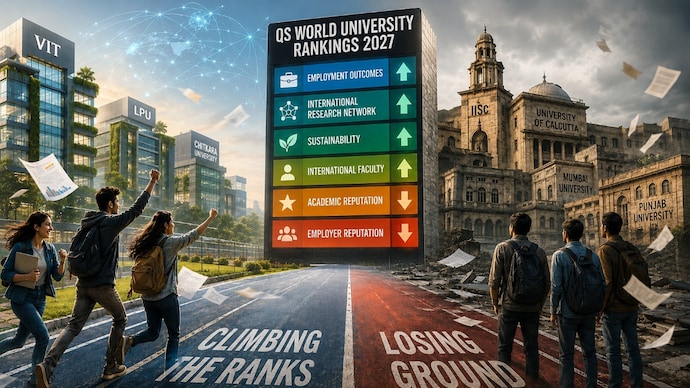
The 2027 rankings reveal some striking patterns. Several private universities made remarkable gains, particularly on indicators such as International Research Network, Sustainability and International Faculty. Many traditional public universities lost ground on these measures, even as IITs and other public institutions surged on Employment Outcomes after a change in QS methodology.
So what exactly are these rankings rewarding?
To find out, India Today Digital went beyond the overall rankings and examined the underlying data. A detailed dashboard built by India Research Watch founder Achal Agrawal compares how Indian institutions performed across every QS indicator between the 2026 and 2027 editions.
Combined with responses from Simona Bizzozero, Communications Director at QS Quacquarelli Symonds, the analysis reveals a story that goes far beyond winners and losers.
It also raises a bigger question: are universities simply improving, or becoming increasingly strategic about the indicators that shape global rankings?
(Note: All institutes marked on the left are the biggest losers in terms of rank in QS 2027 while the ones labelled on the right are the biggest gainers. Green lines represent private universities and blue lines represent public universities.)
LOOK BEYOND THE OVERALL RANK
When Achal Agrawal opened his dashboard during our conversation, he wasn't particularly interested in the overall ranking table.
Instead, he clicked through the indicators one by one: Employment Outcomes, International Research Network, Sustainability, International Faculty, Employer Reputation and Academic Reputation. That is where the biggest movements appeared.
The dashboard revealed a noticeable pattern: many of the biggest gainers were private universities, while several public universities, including the University of Calcutta, the University of Mumbai, Savitribai Phule Pune University and Punjab University, lost ground.
The immediate temptation is to conclude that private universities are simply improving faster.
But indicator-level data suggests the picture is much more complicated.
THE BIGGEST SURPRISE WAS EMPLOYMENT OUTCOMES
One graph in particular caught our attention.
In the previous edition of the rankings, several private universities dominated India's Employment Outcomes indicator. This year, the picture had almost flipped.
Many IITs and public institutions surged while several private universities moved down.
"This is probably the most important parameter for actual students," Agrawal observed. "What people most care about is what are the employment outcomes when they join the college."
The reversal raised an obvious question: did graduate employability really change so dramatically within a year, or had the methodology changed? According to QS, it was the latter.
"This year, we introduced a methodological refinement to prevent institutions with fewer than 500 students from being disproportionately advantaged by the size-adjusted Alumni Impact component of this indicator. This has led to stronger results for a number of institutions with larger student bases,” Simona Bizzozero says.
QS says Employment Outcomes is naturally more volatile because Graduate Employment Rate is influenced by wider economic conditions.
That helps explain why public institutions suddenly gained ground without necessarily experiencing a dramatic transformation in graduate employability over the past year.
IIT Delhi also linked its improved performance to stronger Employer Reputation, saying the indicator, which reflects employers' perception of graduates, improved by 11 places globally.
THE INTERNATIONAL RESEARCH NETWORK BOOM
If Employment Outcomes favoured public institutions this year, another indicator told a very different story -- International Research Network.
According to the QS World University Rankings 2027, several private universities recorded exceptionally large gains this year. Among those he highlighted were Chitkara University, Saveetha, VIT and Lovely Professional University.
One university appeared to have improved by hundreds of places in this single metric alone.
The question, then, was obvious -- what exactly counts as an international research network?
According to QS, the indicator rewards genuine long-term collaborations rather than one-off international papers.
"Improvement in the International Research Network indicator is primarily driven by an increase in the breadth and depth of research partnerships,” Bizzozero says.
The rankings also include an important safeguard.
"We also have a minimum threshold of 3 co-published papers over the course of 5 years for a partnership to be counted. This prevents short-term or less well established partnerships from inflating numbers,” she adds.
That requirement is significant because critics have often argued that universities can artificially expand international collaborations simply by participating in scattered global publications.
QS says sustained collaboration is required before those partnerships contribute to rankings.
CAN RANKING METRICS BE GAMED?
The biggest issue is not whether any university manipulated the rankings, but whether some indicators are inherently easier to optimise than others.
As international collaboration becomes a more valuable ranking metric, it also raises an important question: how do ranking agencies distinguish between genuine long-term research partnerships and collaborations that merely appear international on paper?
Simona Bizzozero says QS relies on Elsevier's Scopus database, which screens for suspicious publication patterns, affiliations and retractions.
QS says it performs additional validation of its own.
"We have guardrails and validation for all our indicators which flag large scale changes in underlying numbers and activity. When these are flagged our team investigates the change and requests extra information from the institution concerned. If the explanation is not accepted the data is rejected,” she says.
That does not eliminate every possible concern, but it does show that unusually large jumps are not automatically accepted without review.
SUSTAINABILITY HAS BECOME A RANKING BATTLEGROUND
Many private universities gained significantly on the Sustainability indicator, while several public universities lost ground.
"The Sustainability indicator is drawn from the final weighted score for the institution from the separate Sustainability ranking, which consists of 50+ indicators grouped into 9 lenses across the 3 categories of environmental impact, social impact and governance (ESG)," Bizzozero explains.
Research also plays an important role.
For example, one indicator measures research aligned with UN Sustainable Development Goals (SDGs), including clean energy, sustainable cities, responsible consumption and climate action.
The trend raises an interesting question -- are some universities becoming more adept at aligning their research and reporting with these categories, while others have made different strategic choices?
Whether that reflects genuine institutional change or better reporting is difficult to determine from the rankings alone. QS itself says institutions pursue different strategies and that it is difficult to generalise across the sector.
WHO COUNTS AS INTERNATIONAL FACULTY?
International Faculty was another metric where private universities appeared to perform strongly.
That prompted a practical question -- who exactly counts as international faculty? Could a visiting professor or an adjunct academic qualify?
QS defines international faculty as foreign nationals contributing to teaching, research or both for at least three months. Citizenship, rather than place of residence, determines whether someone counts as international faculty.
Private universities may simply have greater flexibility in pursuing that strategy than publicly funded institutions, though QS notes that different institutions operate under different policy and governance constraints.
WHY IISc IS AN INTERESTING CASE
Perhaps the most intriguing example in India's rankings landscape is IISc.
Ask almost any scientist in India to name the country's strongest research institution and IISc will almost certainly feature near the top. Its research quality, citations and scientific reputation remain among the best in the country.
Yet the global rankings often show some IITs climbing faster than IISc.
That does not necessarily mean the IITs have overtaken IISc academically. Rather, it highlights that global rankings reward multiple dimensions, including internationalisation, reputation, sustainability and employment outcomes alongside research.
Institutions that improve across several of these indicators simultaneously can rise even if another university remains exceptionally strong in research alone.
In other words, a university is not competing in a single race. It is competing in many races at the same time.
RANKS DON'T ALWAYS TELL THE WHOLE STORY
One surprising insight from Agrawal's dashboard was that some universities saw dramatic changes in rank despite relatively modest score movements.
QS says this is expected because rankings depend not only on an institution's own performance but also on how neighbouring institutions perform. Also, a relatively small improvement in a highly weighted indicator can sometimes produce a larger ranking gain than a substantial improvement in a lower-weighted metric.
That explains why universities can appear to move dramatically even when their underlying performance changes only modestly.
Simona also says that when comparing year-on-year it’s best to compare rank rather than score.
"Scores are generated each edition, so the same score will not always produce the same rank year to year," she says.
THE BIGGER QUESTION FOR STUDENTS
Every rankings season ends with a familiar list of who came first, and who climbed or who fell.
Perhaps students should ask a different question: what exactly is this ranking measuring?
A university strong in research may not perform equally well on internationalisation. Another may invest heavily in sustainability or global partnerships.
None of these strategies are inherently wrong. In fact, many improve universities in meaningful ways.
But the real challenge is remembering that no ranking captures every aspect of higher education.
QS itself acknowledges that institutions pursue different objectives, and those choices inevitably influence how they perform across different indicators.
The lesson from the QS Global University Rankings 2027 is therefore bigger than who moved up or down.
Indian universities are becoming increasingly sophisticated about the global rankings ecosystem. They are building international collaborations, investing in sustainability, strengthening graduate outcomes and expanding their global footprint.
Whether that represents universities becoming better, becoming more strategic, or both, is likely to remain one of the defining debates in higher education for years to come.
Every year, the QS World University Rankings spark the same conversation -- Which IIT climbed? Which university slipped? Has India improved?
This year, however, one question stood out above all the others.
The Indian Institute of Science (IISc) is still widely regarded as India's premier research institution. Yet in recent years, several IITs and private universities have climbed faster in the QS World University Rankings.
Does that mean they have become better universities? Or are they becoming better at the metrics that global rankings reward?
The 2027 rankings reveal some striking patterns. Several private universities made remarkable gains, particularly on indicators such as International Research Network, Sustainability and International Faculty. Many traditional public universities lost ground on these measures, even as IITs and other public institutions surged on Employment Outcomes after a change in QS methodology.
So what exactly are these rankings rewarding?
To find out, India Today Digital went beyond the overall rankings and examined the underlying data. A detailed dashboard built by India Research Watch founder Achal Agrawal compares how Indian institutions performed across every QS indicator between the 2026 and 2027 editions.
Combined with responses from Simona Bizzozero, Communications Director at QS Quacquarelli Symonds, the analysis reveals a story that goes far beyond winners and losers.
It also raises a bigger question: are universities simply improving, or becoming increasingly strategic about the indicators that shape global rankings?
(Note: All institutes marked on the left are the biggest losers in terms of rank in QS 2027 while the ones labelled on the right are the biggest gainers. Green lines represent private universities and blue lines represent public universities.)
LOOK BEYOND THE OVERALL RANK
When Achal Agrawal opened his dashboard during our conversation, he wasn't particularly interested in the overall ranking table.
Instead, he clicked through the indicators one by one: Employment Outcomes, International Research Network, Sustainability, International Faculty, Employer Reputation and Academic Reputation. That is where the biggest movements appeared.
The dashboard revealed a noticeable pattern: many of the biggest gainers were private universities, while several public universities, including the University of Calcutta, the University of Mumbai, Savitribai Phule Pune University and Punjab University, lost ground.
The immediate temptation is to conclude that private universities are simply improving faster.
But indicator-level data suggests the picture is much more complicated.
THE BIGGEST SURPRISE WAS EMPLOYMENT OUTCOMES
One graph in particular caught our attention.
In the previous edition of the rankings, several private universities dominated India's Employment Outcomes indicator. This year, the picture had almost flipped.
Many IITs and public institutions surged while several private universities moved down.
"This is probably the most important parameter for actual students," Agrawal observed. "What people most care about is what are the employment outcomes when they join the college."
The reversal raised an obvious question: did graduate employability really change so dramatically within a year, or had the methodology changed? According to QS, it was the latter.
"This year, we introduced a methodological refinement to prevent institutions with fewer than 500 students from being disproportionately advantaged by the size-adjusted Alumni Impact component of this indicator. This has led to stronger results for a number of institutions with larger student bases,” Simona Bizzozero says.
QS says Employment Outcomes is naturally more volatile because Graduate Employment Rate is influenced by wider economic conditions.
That helps explain why public institutions suddenly gained ground without necessarily experiencing a dramatic transformation in graduate employability over the past year.
IIT Delhi also linked its improved performance to stronger Employer Reputation, saying the indicator, which reflects employers' perception of graduates, improved by 11 places globally.
THE INTERNATIONAL RESEARCH NETWORK BOOM
If Employment Outcomes favoured public institutions this year, another indicator told a very different story -- International Research Network.
According to the QS World University Rankings 2027, several private universities recorded exceptionally large gains this year. Among those he highlighted were Chitkara University, Saveetha, VIT and Lovely Professional University.
One university appeared to have improved by hundreds of places in this single metric alone.
The question, then, was obvious -- what exactly counts as an international research network?
According to QS, the indicator rewards genuine long-term collaborations rather than one-off international papers.
"Improvement in the International Research Network indicator is primarily driven by an increase in the breadth and depth of research partnerships,” Bizzozero says.
The rankings also include an important safeguard.
"We also have a minimum threshold of 3 co-published papers over the course of 5 years for a partnership to be counted. This prevents short-term or less well established partnerships from inflating numbers,” she adds.
That requirement is significant because critics have often argued that universities can artificially expand international collaborations simply by participating in scattered global publications.
QS says sustained collaboration is required before those partnerships contribute to rankings.
CAN RANKING METRICS BE GAMED?
The biggest issue is not whether any university manipulated the rankings, but whether some indicators are inherently easier to optimise than others.
As international collaboration becomes a more valuable ranking metric, it also raises an important question: how do ranking agencies distinguish between genuine long-term research partnerships and collaborations that merely appear international on paper?
Simona Bizzozero says QS relies on Elsevier's Scopus database, which screens for suspicious publication patterns, affiliations and retractions.
QS says it performs additional validation of its own.
"We have guardrails and validation for all our indicators which flag large scale changes in underlying numbers and activity. When these are flagged our team investigates the change and requests extra information from the institution concerned. If the explanation is not accepted the data is rejected,” she says.
That does not eliminate every possible concern, but it does show that unusually large jumps are not automatically accepted without review.
SUSTAINABILITY HAS BECOME A RANKING BATTLEGROUND
Many private universities gained significantly on the Sustainability indicator, while several public universities lost ground.
"The Sustainability indicator is drawn from the final weighted score for the institution from the separate Sustainability ranking, which consists of 50+ indicators grouped into 9 lenses across the 3 categories of environmental impact, social impact and governance (ESG)," Bizzozero explains.
Research also plays an important role.
For example, one indicator measures research aligned with UN Sustainable Development Goals (SDGs), including clean energy, sustainable cities, responsible consumption and climate action.
The trend raises an interesting question -- are some universities becoming more adept at aligning their research and reporting with these categories, while others have made different strategic choices?
Whether that reflects genuine institutional change or better reporting is difficult to determine from the rankings alone. QS itself says institutions pursue different strategies and that it is difficult to generalise across the sector.
WHO COUNTS AS INTERNATIONAL FACULTY?
International Faculty was another metric where private universities appeared to perform strongly.
That prompted a practical question -- who exactly counts as international faculty? Could a visiting professor or an adjunct academic qualify?
QS defines international faculty as foreign nationals contributing to teaching, research or both for at least three months. Citizenship, rather than place of residence, determines whether someone counts as international faculty.
Private universities may simply have greater flexibility in pursuing that strategy than publicly funded institutions, though QS notes that different institutions operate under different policy and governance constraints.
WHY IISc IS AN INTERESTING CASE
Perhaps the most intriguing example in India's rankings landscape is IISc.
Ask almost any scientist in India to name the country's strongest research institution and IISc will almost certainly feature near the top. Its research quality, citations and scientific reputation remain among the best in the country.
Yet the global rankings often show some IITs climbing faster than IISc.
That does not necessarily mean the IITs have overtaken IISc academically. Rather, it highlights that global rankings reward multiple dimensions, including internationalisation, reputation, sustainability and employment outcomes alongside research.
Institutions that improve across several of these indicators simultaneously can rise even if another university remains exceptionally strong in research alone.
In other words, a university is not competing in a single race. It is competing in many races at the same time.
RANKS DON'T ALWAYS TELL THE WHOLE STORY
One surprising insight from Agrawal's dashboard was that some universities saw dramatic changes in rank despite relatively modest score movements.
QS says this is expected because rankings depend not only on an institution's own performance but also on how neighbouring institutions perform. Also, a relatively small improvement in a highly weighted indicator can sometimes produce a larger ranking gain than a substantial improvement in a lower-weighted metric.
That explains why universities can appear to move dramatically even when their underlying performance changes only modestly.
Simona also says that when comparing year-on-year it’s best to compare rank rather than score.
"Scores are generated each edition, so the same score will not always produce the same rank year to year," she says.
THE BIGGER QUESTION FOR STUDENTS
Every rankings season ends with a familiar list of who came first, and who climbed or who fell.
Perhaps students should ask a different question: what exactly is this ranking measuring?
A university strong in research may not perform equally well on internationalisation. Another may invest heavily in sustainability or global partnerships.
None of these strategies are inherently wrong. In fact, many improve universities in meaningful ways.
But the real challenge is remembering that no ranking captures every aspect of higher education.
QS itself acknowledges that institutions pursue different objectives, and those choices inevitably influence how they perform across different indicators.
The lesson from the QS Global University Rankings 2027 is therefore bigger than who moved up or down.
Indian universities are becoming increasingly sophisticated about the global rankings ecosystem. They are building international collaborations, investing in sustainability, strengthening graduate outcomes and expanding their global footprint.
Whether that represents universities becoming better, becoming more strategic, or both, is likely to remain one of the defining debates in higher education for years to come.

