Is the IIT dream changing? Why Gen Z is quitting college over industry mentors
The race to crack IIT is no longer the only path to a dream career. In the age of AI, startups and open-source innovation, Gen Z is increasingly betting that what you build, and who you learn from, can matter as much as where you study.
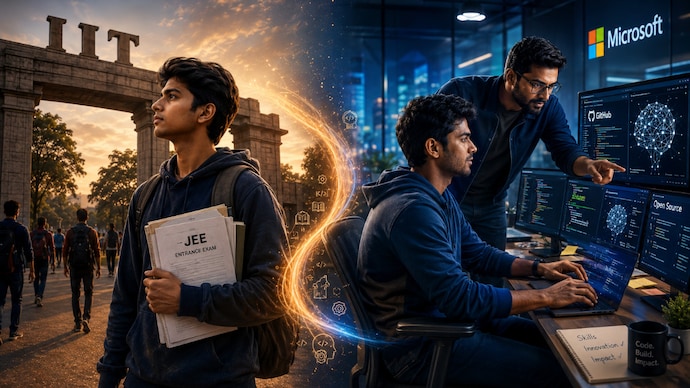
The IIT tag has long been India's most coveted academic badge, promising opportunity, status and a head start in life. But as startup culture grows and the technology industry evolves, many Gen Z students are beginning to question whether an IIT degree alone is enough, or whether industry experience offers a faster path to success.
The debate resurfaced recently after 19-year-old IIT Delhi dropout Ashish Kumar Verma chose to leave the institute and join Microsoft. In a LinkedIn post, he argued that the industry's best classrooms are no longer confined to university campuses.
While such cases remain rare, his decision reflects a broader shift among some young Indians who are prioritising hands-on learning through startup internships, open-source projects and industry mentorship. In today's tech landscape, the ability to build, adapt and learn continuously is becoming just as valuable as any degree.
FROM CLASSROOMS TO STARTUPS
Career coach Pradeep Jain believes the IIT Delhi student's decision reflects a broader shift in how young people perceive education.
"The path from school to work once felt almost automatic. Cracking the IIT entrance exam represented the ultimate academic achievement in India," Pradeep Jain adds.
"But innovation is moving faster than ever, and some students are beginning to ask whether the degree itself is the biggest advantage, or whether learning from the right people matters more," he explains.
For many young developers, success is no longer defined by grades or campus placements. Instead, it is measured by products built, AI projects, startup experience and open-source contributions. With the internet connecting learners directly to global experts, students can now gain practical skills beyond the classroom.
WHEN SKILLS OUTWEIGH DEGREES
The changing mindset extends beyond IIT campuses. A recent report highlighted the story of a 20-year-old who secured a remote role with a San Francisco-based startup paying nearly Rs 70 lakh annually without completing college or holding an IIT or IIM degree.
His success was built on practical skills, a strong public portfolio and consistent execution rather than academic credentials.
In AI hiring, recruiters increasingly want evidence of what candidates can build. A GitHub profile, an AI application with active users or meaningful open-source contributions often demonstrate capability more effectively than a transcript. For a generation that can showcase its work online, portfolios are becoming an increasingly important signal of ability.
THE AI BOOM IS REWRITING THE RULEBOOK
Artificial intelligence has accelerated this shift. Unlike traditional disciplines where textbooks remain relevant for years, AI evolves at an extraordinary pace. New models, frameworks and research papers emerge faster than many university curricula can adapt.
As a result, many students are no longer waiting for classrooms to catch up. They're following AI researchers, experimenting with open-source models, participating in developer communities and learning directly from engineers building cutting-edge products.
Jain believes this has fundamentally changed students' expectations of education.
"The definition of a 'guru' is changing. Professors teach concepts, but mentors show how those concepts survive in the real world. Students aspiring to build AI products increasingly believe that learning from practitioners gives them a competitive advantage," says Jain.
The emphasis is gradually shifting from memorising concepts to solving problems, from attending lectures to shipping code and building products people actually use.
ENTREPRENEURS LEADING THE MOVEMENT
One of the most prominent examples is Dhravya Shah. Before turning 20, he had launched more than 15 open-source projects, sold two companies, raised $3 million for his AI startup Supermemory and earned a US O-1 visa for individuals with extraordinary ability.
Shah has said dropping out was never part of a grand plan. He enjoyed college but realised the opportunity to build his company demanded his full attention. His advice to aspiring technologists is simple: keep building and keep sharing your work.
His journey illustrates how, in the internet era, visibility increasingly comes from what people create—not just the institutions they attend.
THE RISE OF THE MENTOR ECONOMY
Young professionals are increasingly seeking guidance from startup founders, AI engineers and product leaders alongside their formal education. Industry mentors work on live products, understand emerging technologies and offer practical insights into scaling companies, raising capital and solving real-world challenges.
For many students, the attraction isn't that universities have stopped being valuable. Rather, they believe the fastest learning often comes from people solving today's problems instead of teaching yesterday's curriculum.
At the same time, experts caution against interpreting a handful of high-profile dropouts as evidence that elite institutions have lost their relevance.
Ashish Dhawan believes the IIT brand continues to offer enormous value.
"The IIT dream isn't disappearing, it's evolving. Today's students are asking a different question: What's the fastest way to become exceptional at AI, startups or product building? If the answer lies in working alongside a founder or an AI researcher rather than sitting through another semester, some are willing to make that trade-off," says Ashish Dhawan.
However, he stresses that such stories remain exceptions.
"The overwhelming majority of IIT students still complete their degrees because the academic rigour, alumni network and global brand continue to open doors. We hear about the handful who drop out because they're unusual. It's a classic case of survivorship bias," Dhawan adds.
He also points to a broader cultural shift. "Students increasingly value proximity to practitioners over proximity to professors. In fields moving as quickly as generative AI, they believe the half-life of knowledge is measured in months, not semesters," he further explains.
A REDEFINED DREAM
The emergence of a handful of IIT dropouts pursuing unconventional paths should not be mistaken for a rejection of higher education. India's premier institutions continue to provide rigorous academic training, world-class peer networks and unmatched research opportunities. What is changing is how students complement that education.
Many now see learning as something that extends beyond the classroom, through internships, open-source communities, startup ecosystems and mentorship from practitioners working at the frontiers of technology.
As AI continues to reshape the future of work, the question facing ambitious students is no longer simply whether to earn a prestigious degree. It is how to combine that degree with continuous learning, practical experience and access to exceptional mentors.
For most students, the answer will still include graduating from IIT. For a small number, it may involve taking a different path altogether. Either way, success in the AI era is increasingly likely to be defined not only by where they studied, but by what they built, the problems they solved and the people they learnt from along the way.
The IIT tag has long been India's most coveted academic badge, promising opportunity, status and a head start in life. But as startup culture grows and the technology industry evolves, many Gen Z students are beginning to question whether an IIT degree alone is enough, or whether industry experience offers a faster path to success.
The debate resurfaced recently after 19-year-old IIT Delhi dropout Ashish Kumar Verma chose to leave the institute and join Microsoft. In a LinkedIn post, he argued that the industry's best classrooms are no longer confined to university campuses.
While such cases remain rare, his decision reflects a broader shift among some young Indians who are prioritising hands-on learning through startup internships, open-source projects and industry mentorship. In today's tech landscape, the ability to build, adapt and learn continuously is becoming just as valuable as any degree.
FROM CLASSROOMS TO STARTUPS
Career coach Pradeep Jain believes the IIT Delhi student's decision reflects a broader shift in how young people perceive education.
"The path from school to work once felt almost automatic. Cracking the IIT entrance exam represented the ultimate academic achievement in India," Pradeep Jain adds.
"But innovation is moving faster than ever, and some students are beginning to ask whether the degree itself is the biggest advantage, or whether learning from the right people matters more," he explains.
For many young developers, success is no longer defined by grades or campus placements. Instead, it is measured by products built, AI projects, startup experience and open-source contributions. With the internet connecting learners directly to global experts, students can now gain practical skills beyond the classroom.
WHEN SKILLS OUTWEIGH DEGREES
The changing mindset extends beyond IIT campuses. A recent report highlighted the story of a 20-year-old who secured a remote role with a San Francisco-based startup paying nearly Rs 70 lakh annually without completing college or holding an IIT or IIM degree.
His success was built on practical skills, a strong public portfolio and consistent execution rather than academic credentials.
In AI hiring, recruiters increasingly want evidence of what candidates can build. A GitHub profile, an AI application with active users or meaningful open-source contributions often demonstrate capability more effectively than a transcript. For a generation that can showcase its work online, portfolios are becoming an increasingly important signal of ability.
THE AI BOOM IS REWRITING THE RULEBOOK
Artificial intelligence has accelerated this shift. Unlike traditional disciplines where textbooks remain relevant for years, AI evolves at an extraordinary pace. New models, frameworks and research papers emerge faster than many university curricula can adapt.
As a result, many students are no longer waiting for classrooms to catch up. They're following AI researchers, experimenting with open-source models, participating in developer communities and learning directly from engineers building cutting-edge products.
Jain believes this has fundamentally changed students' expectations of education.
"The definition of a 'guru' is changing. Professors teach concepts, but mentors show how those concepts survive in the real world. Students aspiring to build AI products increasingly believe that learning from practitioners gives them a competitive advantage," says Jain.
The emphasis is gradually shifting from memorising concepts to solving problems, from attending lectures to shipping code and building products people actually use.
ENTREPRENEURS LEADING THE MOVEMENT
One of the most prominent examples is Dhravya Shah. Before turning 20, he had launched more than 15 open-source projects, sold two companies, raised $3 million for his AI startup Supermemory and earned a US O-1 visa for individuals with extraordinary ability.
Shah has said dropping out was never part of a grand plan. He enjoyed college but realised the opportunity to build his company demanded his full attention. His advice to aspiring technologists is simple: keep building and keep sharing your work.
His journey illustrates how, in the internet era, visibility increasingly comes from what people create—not just the institutions they attend.
THE RISE OF THE MENTOR ECONOMY
Young professionals are increasingly seeking guidance from startup founders, AI engineers and product leaders alongside their formal education. Industry mentors work on live products, understand emerging technologies and offer practical insights into scaling companies, raising capital and solving real-world challenges.
For many students, the attraction isn't that universities have stopped being valuable. Rather, they believe the fastest learning often comes from people solving today's problems instead of teaching yesterday's curriculum.
At the same time, experts caution against interpreting a handful of high-profile dropouts as evidence that elite institutions have lost their relevance.
Ashish Dhawan believes the IIT brand continues to offer enormous value.
"The IIT dream isn't disappearing, it's evolving. Today's students are asking a different question: What's the fastest way to become exceptional at AI, startups or product building? If the answer lies in working alongside a founder or an AI researcher rather than sitting through another semester, some are willing to make that trade-off," says Ashish Dhawan.
However, he stresses that such stories remain exceptions.
"The overwhelming majority of IIT students still complete their degrees because the academic rigour, alumni network and global brand continue to open doors. We hear about the handful who drop out because they're unusual. It's a classic case of survivorship bias," Dhawan adds.
He also points to a broader cultural shift. "Students increasingly value proximity to practitioners over proximity to professors. In fields moving as quickly as generative AI, they believe the half-life of knowledge is measured in months, not semesters," he further explains.
A REDEFINED DREAM
The emergence of a handful of IIT dropouts pursuing unconventional paths should not be mistaken for a rejection of higher education. India's premier institutions continue to provide rigorous academic training, world-class peer networks and unmatched research opportunities. What is changing is how students complement that education.
Many now see learning as something that extends beyond the classroom, through internships, open-source communities, startup ecosystems and mentorship from practitioners working at the frontiers of technology.
As AI continues to reshape the future of work, the question facing ambitious students is no longer simply whether to earn a prestigious degree. It is how to combine that degree with continuous learning, practical experience and access to exceptional mentors.
For most students, the answer will still include graduating from IIT. For a small number, it may involve taking a different path altogether. Either way, success in the AI era is increasingly likely to be defined not only by where they studied, but by what they built, the problems they solved and the people they learnt from along the way.

