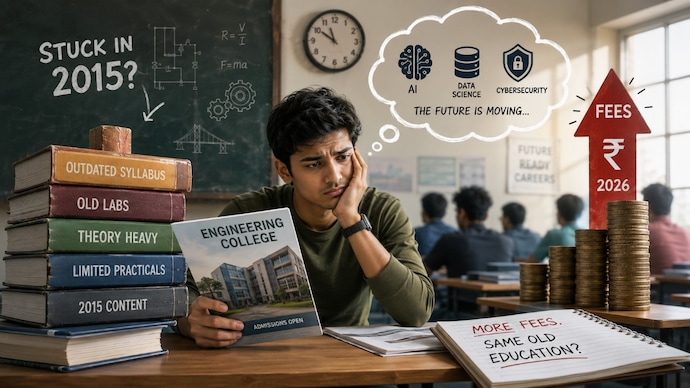
Are engineering colleges selling 2015 courses at 2026 prices?
Engineering colleges have added AI, Data Science, Cybersecurity and other future-focused courses to their brochures. But as fees climb sharply, students and recruiters are questioning whether the classroom has evolved at the same pace as the price tag.


When Rajat (name changed on request) joined a BTech Computer Science programme at a reputed private university in Chennai, his family saw it as a long-term investment.
The degree cost them Rs 16.5 lakh.
But four years later, in 2025, when Rajat entered the job market, he realised that the biggest investment was still ahead.
“I remember walking out of an interview thinking – what did I spend four years learning? The interviewer expected me to know cloud deployment, Git workflows, Docker and CI/CD, but my college curriculum had stopped at basic Java programming and SQL. That's when I realised my degree alone wasn't enough any more,” he says.
The companies he applied to were looking for skills in cloud deployment, Git workflows, Docker, CI/CD pipelines and modern software development practices. However, much of his classroom learning had remained focused on foundational programming concepts and database queries.
After spending Rs 16.5 lakh on his engineering education, Rajat enroled in an online bootcamp costing another Rs 70,000 and spent nearly six months after graduation learning the skills companies were actually testing.
“It felt like I was paying twice for the same education,” he says.
Rajat’s experience represents a larger question confronting India’s engineering education system. Over the last decade, engineering colleges have become significantly more expensive. At the same time, technology has changed faster than many academic systems have been able to respond.
The result is a growing concern among students, parents and recruiters: Are many institutions effectively selling a 2015 education at 2026 prices?
THE PRICE OF AN ENGINEERING DEGREE HAS CHANGED COMPLETELY
In 2015, a four-year BTech Computer Science degree at many mid-tier private engineering colleges typically cost around Rs 5 lakh to Rs 8 lakh in tuition fees.
Today, the same degree at several private institutions can cost anywhere between Rs 14 lakh and Rs 20 lakh. At premium private universities, the overall expense, including hostel, infrastructure and other charges, can cross Rs 25 lakh to Rs 30 lakh.
For middle-class families, engineering has always been more than just a degree. It has been viewed as a pathway towards financial security.
But rising costs have changed the calculation.
If a student spends Rs 15 lakh or more on a degree, families naturally expect the course to provide the skills needed to compete in a changing job market.
The challenge is that the increase in fees has not always been matched by a similar transformation in learning outcomes. The concern is not that colleges have not introduced new courses. Many have.
The question is whether these changes have gone beyond course names and marketing brochures.
.. BUT THE COURSE IS STUCK IN 2015
In 2015, most reputed engineering colleges in India, such as Birla Institute of Technology and Sciences in Pilani, Delhi Technological University and K J Somaiya College of Engineering in Mumbai, stuck to a core curriculum building foundations in Engineering Mathematics, Physics, Programming Fundamentals, Electrical Engineering and Engineering Drawing.
The following years introduced Data Structures, Operating Systems, Database Management Systems, Computer Networks and Compiler Design: subjects that remain the backbone of Computer Science education even today.
While technical education has expanded beyond traditional Computer Science, most engineering colleges still work on the core fundamental structure. They have some specialised BTech programmes, but experts argue that the names may look good on paper, the actual structure remains stagnant.
Here's a look at the new additions to the curriculum in 2026.
Artificial Intelligence and Machine Learning
Data Science
Cyber Security
Robotics and Artificial Intelligence
Computer Science and Design
Internet of Things
Take Visvesvaraya Technological University (VTU) as an example, which has expanded its technology offerings with new-age branches and specialisations. However, its programmes continue to retain a strong traditional foundation built around mathematics, programming, engineering fundamentals and core computer science concepts.
The pattern is visible elsewhere too. For example, Delhi Technological University (earlier known as Delhi College of Engineering) has planned to launch a 'Double Major Track in Economics for BTech students from the 2026–27 academic session, integrating economics with emerging technologies', new BTech courses in Quantum Technology from 2027-28 and more.
Though it has expanded its academic offerings to include emerging technology areas, its Computer Science programme continues to build on the same foundational sequence that has defined engineering education for years: programming, algorithms, operating systems, databases and computer networks, before introducing advanced electives in later semesters.
A similar evolution can be seen at institutions such as BITS Pilani and K J Somaiya College of Engineering. The latter has added new courses such as Artificial Intelligence and Data Science, Computer and Communication Engineering, Computer Science and Business Systems.
BITS Pilani has added new courses which include Design and Analysis of Algorithms, Computer Networks and Object-Oriented Programming, Operating Systems and Computer Architecture, Machine Learning and Cryptography.
While both have introduced newer electives and industry-oriented learning opportunities over time, the academic spine of the degree continues to rest on programming fundamentals, object-oriented programming, data structures, computer architecture and operating systems.
This raises an important question: Are these new programmes a complete redesign of engineering education or are they additional layers placed over an older structure?
Experts say the answer varies across institutions.
A new course title does not automatically mean students are learning industry practices.
The real test lies in whether students are getting exposure to real-world projects, industry tools, internships, updated faculty expertise and practical problem-solving.
The same question applies across engineering institutions, from public universities such as Anna University, Delhi Technological University, Jadavpur University and Savitribai Phule Pune University to private universities such as SRM Institute of Science and Technology, Manipal Institute of Technology and Vellore Institute of Technology.
Many have introduced new-age technology programmes. But the depth of implementation remains the key factor.
THE CURRICULUM CLOCK IS MOVING SLOWER THAN THE TECHNOLOGY CLOCK
The technology industry changes rapidly.
Tools, platforms and workplace expectations can shift within 18 to 24 months. However, university curriculum changes often move through longer approval and affiliation processes. This creates a difficult gap.
A student entering college today may graduate four years later into a workplace where the technology landscape has changed multiple times.
The result is a mismatch.
While companies expect graduates to understand modern development environments, many students say their academic experience remains heavily examination-focused.
The All India Council for Technical Education (AICTE) has previously highlighted the need for stronger industry readiness among engineering graduates, noting that many students require additional training before becoming workplace-ready.
An AICTE report on engineering education also pointed towards employability concerns, citing earlier assessments where only a fraction of engineers was considered ready for specific software and industry roles.
However, industry leaders caution against reducing the issue to only "good colleges versus bad colleges."
“The skill gap is real, but I would hesitate to attribute it to the type of institution alone,” says Santosh Rudrawar, Group CHRO, Sanjay Ghodawat Group.
According to him, talented graduates continue to emerge from both premier and mid-tier institutions. “The larger challenge is that industry is transforming far faster than traditional curricula can evolve,” he says.
Today, employers are looking for more than academic knowledge. “They value learning agility, digital fluency, problem-solving, adaptability and communication as much as academic knowledge,” Rudrawar adds.
WHEN STUDENTS PAY TWICE FOR ONE CAREER
For many students, the gap between a degree and employability has created a second financial burden.
A final-year engineering student from a college affiliated with a major state technical university in Maharashtra realised that her college syllabus alone would not prepare her for technology placements.
Her family then took a personal loan of Rs 75,000 for an external coding bootcamp during her sixth semester.
“College and my bootcamp felt like two parallel worlds. During the day, I studied subjects that were part of the university syllabus. At night, I learned the skills companies were actually testing in placements,” she says.
The pressure was not only academic but financial.
“My parents had to take a Rs 75,000 personal loan for the bootcamp after already paying for my engineering degree, so I constantly felt the pressure to make it worth the sacrifice,” she adds.
This is becoming a familiar pattern.
Students pay for a degree from a college and then pay separately for certifications, coding courses and industry training to bridge the skill gap.
THE EMPLOYMENT TEST: DOES THE DEGREE DELIVER VALUE?
The biggest measure of any education system is whether it prepares students for the workplace.
India continues to produce a large pool of engineering graduates, but employability remains a challenge.
The India Skills Report 2026 placed overall graduate employability at 56.35%, highlighting both improvement and the continuing gap between education and workplace expectations.
The technology hiring landscape has also changed. Companies increasingly look for specialised skills, including AI readiness and digital capabilities, rather than only degrees.
For students carrying education loans, the return-on-investment question becomes even more important.
A graduate who spends Rs 15 lakh or more on an engineering degree and enters the workforce with an entry-level salary faces a very different financial reality compared with a decade ago.
Recruiters say companies are also paying the price of this gap.
Dr Yogish Arora, Director and CEO, HR Anexi, says organisations often have to spend additional time preparing fresh graduates for workplace requirements.
“Companies still pay for yesterday's role while quietly absorbing weeks of retraining before fresh hires can handle client responsibilities. This isn't just a hiring problem; it's a pricing problem,” he says.
THE FUTURE OF ENGINEERING EDUCATION CANNOT JUST BE ABOUT NEW NAMES
The debate around engineering education is not about whether colleges should teach AI, Data Science or emerging technologies.
They should.
The bigger question is whether these additions represent deep academic change or only surface-level updates.
India’s engineering ecosystem still produces talented graduates. The challenge is ensuring that the education students pay lakhs for remains connected to the jobs they eventually enter.
As Santosh Rudrawar puts it, the focus should move beyond whether graduates have “2015 skills” and towards whether institutions are preparing them for tomorrow’s workplace.
That requires stronger industry-academia collaboration, faster curriculum updates and more practical learning.
Because in 2026, students are not just buying a degree. They are buying a promise that the education they receive today will still hold value when they step into the future.
When Rajat (name changed on request) joined a BTech Computer Science programme at a reputed private university in Chennai, his family saw it as a long-term investment.
The degree cost them Rs 16.5 lakh.
But four years later, in 2025, when Rajat entered the job market, he realised that the biggest investment was still ahead.
“I remember walking out of an interview thinking – what did I spend four years learning? The interviewer expected me to know cloud deployment, Git workflows, Docker and CI/CD, but my college curriculum had stopped at basic Java programming and SQL. That's when I realised my degree alone wasn't enough any more,” he says.
The companies he applied to were looking for skills in cloud deployment, Git workflows, Docker, CI/CD pipelines and modern software development practices. However, much of his classroom learning had remained focused on foundational programming concepts and database queries.
After spending Rs 16.5 lakh on his engineering education, Rajat enroled in an online bootcamp costing another Rs 70,000 and spent nearly six months after graduation learning the skills companies were actually testing.
“It felt like I was paying twice for the same education,” he says.
Rajat’s experience represents a larger question confronting India’s engineering education system. Over the last decade, engineering colleges have become significantly more expensive. At the same time, technology has changed faster than many academic systems have been able to respond.
The result is a growing concern among students, parents and recruiters: Are many institutions effectively selling a 2015 education at 2026 prices?
THE PRICE OF AN ENGINEERING DEGREE HAS CHANGED COMPLETELY
In 2015, a four-year BTech Computer Science degree at many mid-tier private engineering colleges typically cost around Rs 5 lakh to Rs 8 lakh in tuition fees.
Today, the same degree at several private institutions can cost anywhere between Rs 14 lakh and Rs 20 lakh. At premium private universities, the overall expense, including hostel, infrastructure and other charges, can cross Rs 25 lakh to Rs 30 lakh.
For middle-class families, engineering has always been more than just a degree. It has been viewed as a pathway towards financial security.
But rising costs have changed the calculation.
If a student spends Rs 15 lakh or more on a degree, families naturally expect the course to provide the skills needed to compete in a changing job market.
The challenge is that the increase in fees has not always been matched by a similar transformation in learning outcomes. The concern is not that colleges have not introduced new courses. Many have.
The question is whether these changes have gone beyond course names and marketing brochures.
.. BUT THE COURSE IS STUCK IN 2015
In 2015, most reputed engineering colleges in India, such as Birla Institute of Technology and Sciences in Pilani, Delhi Technological University and K J Somaiya College of Engineering in Mumbai, stuck to a core curriculum building foundations in Engineering Mathematics, Physics, Programming Fundamentals, Electrical Engineering and Engineering Drawing.
The following years introduced Data Structures, Operating Systems, Database Management Systems, Computer Networks and Compiler Design: subjects that remain the backbone of Computer Science education even today.
While technical education has expanded beyond traditional Computer Science, most engineering colleges still work on the core fundamental structure. They have some specialised BTech programmes, but experts argue that the names may look good on paper, the actual structure remains stagnant.
Here's a look at the new additions to the curriculum in 2026.
Artificial Intelligence and Machine Learning
Data Science
Cyber Security
Robotics and Artificial Intelligence
Computer Science and Design
Internet of Things
Take Visvesvaraya Technological University (VTU) as an example, which has expanded its technology offerings with new-age branches and specialisations. However, its programmes continue to retain a strong traditional foundation built around mathematics, programming, engineering fundamentals and core computer science concepts.
The pattern is visible elsewhere too. For example, Delhi Technological University (earlier known as Delhi College of Engineering) has planned to launch a 'Double Major Track in Economics for BTech students from the 2026–27 academic session, integrating economics with emerging technologies', new BTech courses in Quantum Technology from 2027-28 and more.
Though it has expanded its academic offerings to include emerging technology areas, its Computer Science programme continues to build on the same foundational sequence that has defined engineering education for years: programming, algorithms, operating systems, databases and computer networks, before introducing advanced electives in later semesters.
A similar evolution can be seen at institutions such as BITS Pilani and K J Somaiya College of Engineering. The latter has added new courses such as Artificial Intelligence and Data Science, Computer and Communication Engineering, Computer Science and Business Systems.
BITS Pilani has added new courses which include Design and Analysis of Algorithms, Computer Networks and Object-Oriented Programming, Operating Systems and Computer Architecture, Machine Learning and Cryptography.
While both have introduced newer electives and industry-oriented learning opportunities over time, the academic spine of the degree continues to rest on programming fundamentals, object-oriented programming, data structures, computer architecture and operating systems.
This raises an important question: Are these new programmes a complete redesign of engineering education or are they additional layers placed over an older structure?
Experts say the answer varies across institutions.
A new course title does not automatically mean students are learning industry practices.
The real test lies in whether students are getting exposure to real-world projects, industry tools, internships, updated faculty expertise and practical problem-solving.
The same question applies across engineering institutions, from public universities such as Anna University, Delhi Technological University, Jadavpur University and Savitribai Phule Pune University to private universities such as SRM Institute of Science and Technology, Manipal Institute of Technology and Vellore Institute of Technology.
Many have introduced new-age technology programmes. But the depth of implementation remains the key factor.
THE CURRICULUM CLOCK IS MOVING SLOWER THAN THE TECHNOLOGY CLOCK
The technology industry changes rapidly.
Tools, platforms and workplace expectations can shift within 18 to 24 months. However, university curriculum changes often move through longer approval and affiliation processes. This creates a difficult gap.
A student entering college today may graduate four years later into a workplace where the technology landscape has changed multiple times.
The result is a mismatch.
While companies expect graduates to understand modern development environments, many students say their academic experience remains heavily examination-focused.
The All India Council for Technical Education (AICTE) has previously highlighted the need for stronger industry readiness among engineering graduates, noting that many students require additional training before becoming workplace-ready.
An AICTE report on engineering education also pointed towards employability concerns, citing earlier assessments where only a fraction of engineers was considered ready for specific software and industry roles.
However, industry leaders caution against reducing the issue to only "good colleges versus bad colleges."
“The skill gap is real, but I would hesitate to attribute it to the type of institution alone,” says Santosh Rudrawar, Group CHRO, Sanjay Ghodawat Group.
According to him, talented graduates continue to emerge from both premier and mid-tier institutions. “The larger challenge is that industry is transforming far faster than traditional curricula can evolve,” he says.
Today, employers are looking for more than academic knowledge. “They value learning agility, digital fluency, problem-solving, adaptability and communication as much as academic knowledge,” Rudrawar adds.
WHEN STUDENTS PAY TWICE FOR ONE CAREER
For many students, the gap between a degree and employability has created a second financial burden.
A final-year engineering student from a college affiliated with a major state technical university in Maharashtra realised that her college syllabus alone would not prepare her for technology placements.
Her family then took a personal loan of Rs 75,000 for an external coding bootcamp during her sixth semester.
“College and my bootcamp felt like two parallel worlds. During the day, I studied subjects that were part of the university syllabus. At night, I learned the skills companies were actually testing in placements,” she says.
The pressure was not only academic but financial.
“My parents had to take a Rs 75,000 personal loan for the bootcamp after already paying for my engineering degree, so I constantly felt the pressure to make it worth the sacrifice,” she adds.
This is becoming a familiar pattern.
Students pay for a degree from a college and then pay separately for certifications, coding courses and industry training to bridge the skill gap.
THE EMPLOYMENT TEST: DOES THE DEGREE DELIVER VALUE?
The biggest measure of any education system is whether it prepares students for the workplace.
India continues to produce a large pool of engineering graduates, but employability remains a challenge.
The India Skills Report 2026 placed overall graduate employability at 56.35%, highlighting both improvement and the continuing gap between education and workplace expectations.
The technology hiring landscape has also changed. Companies increasingly look for specialised skills, including AI readiness and digital capabilities, rather than only degrees.
For students carrying education loans, the return-on-investment question becomes even more important.
A graduate who spends Rs 15 lakh or more on an engineering degree and enters the workforce with an entry-level salary faces a very different financial reality compared with a decade ago.
Recruiters say companies are also paying the price of this gap.
Dr Yogish Arora, Director and CEO, HR Anexi, says organisations often have to spend additional time preparing fresh graduates for workplace requirements.
“Companies still pay for yesterday's role while quietly absorbing weeks of retraining before fresh hires can handle client responsibilities. This isn't just a hiring problem; it's a pricing problem,” he says.
THE FUTURE OF ENGINEERING EDUCATION CANNOT JUST BE ABOUT NEW NAMES
The debate around engineering education is not about whether colleges should teach AI, Data Science or emerging technologies.
They should.
The bigger question is whether these additions represent deep academic change or only surface-level updates.
India’s engineering ecosystem still produces talented graduates. The challenge is ensuring that the education students pay lakhs for remains connected to the jobs they eventually enter.
As Santosh Rudrawar puts it, the focus should move beyond whether graduates have “2015 skills” and towards whether institutions are preparing them for tomorrow’s workplace.
That requires stronger industry-academia collaboration, faster curriculum updates and more practical learning.
Because in 2026, students are not just buying a degree. They are buying a promise that the education they receive today will still hold value when they step into the future.

