Rs 2 lakh to 5 crore for one topper? Faculty incentives at JEE, NEET coaching
A report on faculty incentives has renewed focus on how coaching institutes chase top JEE and NEET students. The debate highlights rising acquisition costs, performance-linked payouts and sharply different recruitment models across the sector.
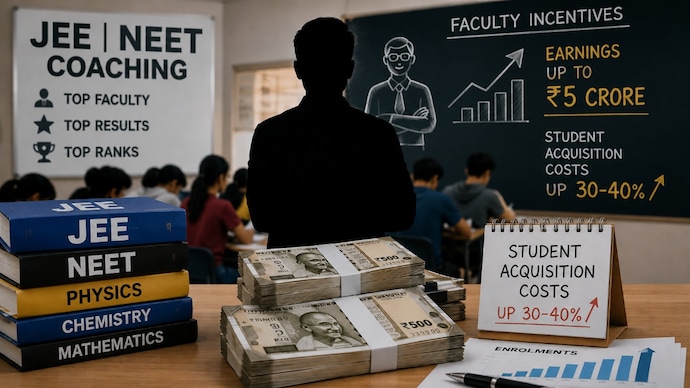
The race to attract top-performing JEE and NEET aspirants has become significantly more expensive for coaching institutes, with student acquisition costs rising by 30-40 per cent over the past five years, according to industry experts. At the same time, faculty who mentor students to top national ranks can earn incentives running into Rs 2 lakh to Rs 5 crore or more, depending on an institute's internal policy and how well the institute is faring in the market.
The issue came into focus after a recent Moneycontrol report said that PhysicsWallah is offering newly hired faculty incentives ranging from Rs 2 lakh to Rs 15 lakh for bringing high-performing students from rival coaching institutes to its offline classroom programmes.
According to the report, the payout is linked to a student's eventual performance in JEE Main, JEE Advanced or NEET, with the highest reward of Rs 15 lakh reserved for students who go on to secure AIR 1. The programme applies to students enrolling in the company's 2027 classroom batches. PhysicsWallah, however, told the publication that it is an "impact-based incentive, not an enrolment-based incentive" and that employee reward programmes are periodically reviewed and updated.
The recent spotlight on faculty incentives has also brought attention to how coaching institutes compete for talented students and experienced teachers. Experts say referral incentives are only one part of a broader student acquisition strategy that includes scholarships, talent identification, mentoring and dedicated outreach teams.
"The coaching industry has had this trend of teacher movement since a long time, possibly beginning in Kota. Similar practice was observed where movement or transfer of students would occur when faculty movement occurred from one institute to another," said Dr Saurabh Kumar, founder and CEO of Shiksha Nation.
Likewise, he added, many of the major coaching brands were built off of attracting qualified instructors and high-performing students from competing institutes.
He said the practice is common among established coaching institutes that compete for both experienced faculty and academically strong students, although individual policies differ.
PERFORMANCE-LINKED INCENTIVES
According to Dr Kumar, coaching institutes largely follow performance-based incentive models rather than fixed payouts. Incentives may be linked to successful admissions through referrals, the academic performance of referred students and, ultimately, how those students perform in competitive examinations such as JEE and NEET.
Some institutes also factor in both the quantity and quality of students brought in by faculty as part of a long-term strategy to strengthen their academic outcomes.
While there is no industry-wide cap on incentives, each coaching institute follows its own HR and incentive policy based on revenue, financial capacity and business strategy.
For faculty whose students secure exceptional national ranks, payouts can range from Rs 1 crore to Rs 5 crore or even more, depending on the institute's benchmarks and the student's achievement.
INVESTMENT OVER ADVERTISING
Dr Kumar said many institutes increasingly see investments in talented students and quality faculty as more effective than conventional advertising.
"The incentive programme can primarily be thought of as a marketing strategy, or part of a strategy for acquiring students. Institutes will invest in attracting high-performing students and faculty to deliver measurable outcomes rather than spending large amounts of money on advertising without any guarantees of success," he said.
He added that coaching institutes often provide financial assistance to academically promising students who may not be able to afford coaching, as investing in high-potential candidates delivers stronger academic outcomes while enhancing an institute's reputation.
TALENT TEAMS AND RISING ACQUISITION COSTS
Most large coaching institutes now have dedicated teams responsible for identifying, evaluating and engaging academically talented students, apart from supporting faculty recruitment.
These Talent Nurture Teams help identify promising candidates, explain academic offerings and assist with admissions. Their role extends beyond faculty hiring to student engagement and talent development.
Depending on the size of the institute, these teams can range from around eight members in smaller coaching centres to 30-40 professionals working across different regions in larger national brands.
Dr Kumar said competition in the JEE and NEET coaching market has pushed institutes to spend more on student acquisition.
"Student acquisition costs have increased on average by 30% to 40% over the last five years, however, the actual percentage increases will vary by institute," he said.
While referral-based student acquisition continues to play an important role, he said digital marketing mainly helps widen the admissions funnel, whereas identifying future rankers still requires direct outreach and personal engagement.
He also stressed that financial incentives alone cannot produce successful students.
"A student may be financially incentivised to pass the exams, but becoming a successful student over time must require sound instructional methodologies and guidelines," he said.
NOT EVERY INSTITUTE FOLLOWS REFERRAL INCENTIVES
However, not all coaching institutes use faculty-led student recruitment.
Another coaching institute who did not wish to be named said the institute does not incentivise faculty for bringing in students.
"It's student recruitment strategy relies on academic integrity, scholarships, admission tests, honest counselling and recommendations from happy students, parents and alumni, but not by faculty. Faculty do not receive incentives for recruiting students," the institute co-founder said.
Instead, the co-founder further said, the institute focuses its investments on merit- and need-based scholarships, hiring qualified faculty, developing quality course content, integrating technology into teaching, mentoring students and providing academic support services to attract and retain students through academic excellence rather than referral-based incentives.
Similarly, Allen Career Institute and Aakash Institute told India Today that they do not have any initiative under which faculty are paid for bringing bright students from other coaching institutes. Both institutes said their student outreach and admissions processes do not involve faculty-linked referral incentive programmes.
The race to attract top-performing JEE and NEET aspirants has become significantly more expensive for coaching institutes, with student acquisition costs rising by 30-40 per cent over the past five years, according to industry experts. At the same time, faculty who mentor students to top national ranks can earn incentives running into Rs 2 lakh to Rs 5 crore or more, depending on an institute's internal policy and how well the institute is faring in the market.
The issue came into focus after a recent Moneycontrol report said that PhysicsWallah is offering newly hired faculty incentives ranging from Rs 2 lakh to Rs 15 lakh for bringing high-performing students from rival coaching institutes to its offline classroom programmes.
According to the report, the payout is linked to a student's eventual performance in JEE Main, JEE Advanced or NEET, with the highest reward of Rs 15 lakh reserved for students who go on to secure AIR 1. The programme applies to students enrolling in the company's 2027 classroom batches. PhysicsWallah, however, told the publication that it is an "impact-based incentive, not an enrolment-based incentive" and that employee reward programmes are periodically reviewed and updated.
The recent spotlight on faculty incentives has also brought attention to how coaching institutes compete for talented students and experienced teachers. Experts say referral incentives are only one part of a broader student acquisition strategy that includes scholarships, talent identification, mentoring and dedicated outreach teams.
"The coaching industry has had this trend of teacher movement since a long time, possibly beginning in Kota. Similar practice was observed where movement or transfer of students would occur when faculty movement occurred from one institute to another," said Dr Saurabh Kumar, founder and CEO of Shiksha Nation.
Likewise, he added, many of the major coaching brands were built off of attracting qualified instructors and high-performing students from competing institutes.
He said the practice is common among established coaching institutes that compete for both experienced faculty and academically strong students, although individual policies differ.
PERFORMANCE-LINKED INCENTIVES
According to Dr Kumar, coaching institutes largely follow performance-based incentive models rather than fixed payouts. Incentives may be linked to successful admissions through referrals, the academic performance of referred students and, ultimately, how those students perform in competitive examinations such as JEE and NEET.
Some institutes also factor in both the quantity and quality of students brought in by faculty as part of a long-term strategy to strengthen their academic outcomes.
While there is no industry-wide cap on incentives, each coaching institute follows its own HR and incentive policy based on revenue, financial capacity and business strategy.
For faculty whose students secure exceptional national ranks, payouts can range from Rs 1 crore to Rs 5 crore or even more, depending on the institute's benchmarks and the student's achievement.
INVESTMENT OVER ADVERTISING
Dr Kumar said many institutes increasingly see investments in talented students and quality faculty as more effective than conventional advertising.
"The incentive programme can primarily be thought of as a marketing strategy, or part of a strategy for acquiring students. Institutes will invest in attracting high-performing students and faculty to deliver measurable outcomes rather than spending large amounts of money on advertising without any guarantees of success," he said.
He added that coaching institutes often provide financial assistance to academically promising students who may not be able to afford coaching, as investing in high-potential candidates delivers stronger academic outcomes while enhancing an institute's reputation.
TALENT TEAMS AND RISING ACQUISITION COSTS
Most large coaching institutes now have dedicated teams responsible for identifying, evaluating and engaging academically talented students, apart from supporting faculty recruitment.
These Talent Nurture Teams help identify promising candidates, explain academic offerings and assist with admissions. Their role extends beyond faculty hiring to student engagement and talent development.
Depending on the size of the institute, these teams can range from around eight members in smaller coaching centres to 30-40 professionals working across different regions in larger national brands.
Dr Kumar said competition in the JEE and NEET coaching market has pushed institutes to spend more on student acquisition.
"Student acquisition costs have increased on average by 30% to 40% over the last five years, however, the actual percentage increases will vary by institute," he said.
While referral-based student acquisition continues to play an important role, he said digital marketing mainly helps widen the admissions funnel, whereas identifying future rankers still requires direct outreach and personal engagement.
He also stressed that financial incentives alone cannot produce successful students.
"A student may be financially incentivised to pass the exams, but becoming a successful student over time must require sound instructional methodologies and guidelines," he said.
NOT EVERY INSTITUTE FOLLOWS REFERRAL INCENTIVES
However, not all coaching institutes use faculty-led student recruitment.
Another coaching institute who did not wish to be named said the institute does not incentivise faculty for bringing in students.
"It's student recruitment strategy relies on academic integrity, scholarships, admission tests, honest counselling and recommendations from happy students, parents and alumni, but not by faculty. Faculty do not receive incentives for recruiting students," the institute co-founder said.
Instead, the co-founder further said, the institute focuses its investments on merit- and need-based scholarships, hiring qualified faculty, developing quality course content, integrating technology into teaching, mentoring students and providing academic support services to attract and retain students through academic excellence rather than referral-based incentives.
Similarly, Allen Career Institute and Aakash Institute told India Today that they do not have any initiative under which faculty are paid for bringing bright students from other coaching institutes. Both institutes said their student outreach and admissions processes do not involve faculty-linked referral incentive programmes.

