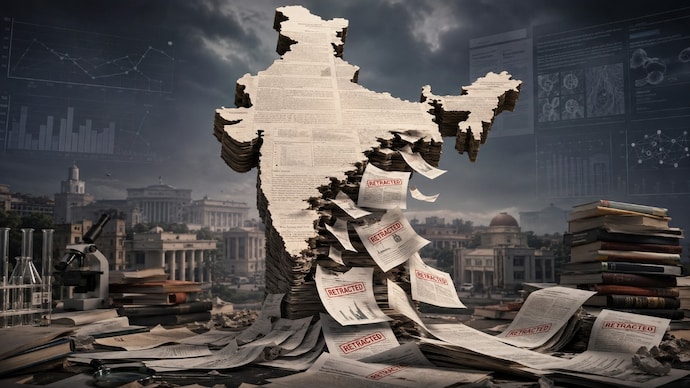
India now dominates global research paper retractions with 6 universities in top 10
India's rise in global research rankings is now shadowed by a sharp spike in paper retractions. With six Indian universities among the world's top 10 for retractions, concerns around plagiarism, fake peer reviews, and flawed incentives are growing, raising questions about credibility, funding, and the future of Indian science.
India has been celebrating its rise as a global research powerhouse. We are publishing more research papers, getting better rankings, and more visibility. On the surface, everything looks like growth and good news for the research fraternity.
But behind that growth is an uncomfortable reality. India is leading a list no country wants to top.
For the first time, six Indian universities feature among the top 10 globally for research paper retractions in 2025. Just five years ago, this space was largely dominated by China. That has now changed.
And the numbers are not small.
INDIA IS SECOND ONLY TO CHINA
India's university rankings reflect a much larger national trend. According to the Retraction Watch database, India has recorded 887 research paper retractions in 2025, making it the second-highest country in the world, behind only China (1,701).
The scale becomes clearer when compared with the rest of the world. The next country after India is Iraq with 429 retractions, followed by Russia (363), Saudi Arabia (343) and the United States (277). In other words, India has more than double the number of retractions recorded by the third-ranked country.
The concern goes beyond absolute numbers. India accounts for about 21 percent of the world's retractions while contributing only around 5 percent of global research publications. Researchers say that imbalance raises serious questions about research quality and integrity as India seeks to establish itself as a global scientific powerhouse.
UNIVERSITIES WITH MOST RETRACTIONS IN 2025
Here are the top 19 universities globally with the highest number of research paper retractions in 2025 as per data from February 2026:
(Source: Retraction Watch database)
| Rank* | University | Country | Retractions |
|---|---|---|---|
| 1 | Anna University, Chennai | India | 161 |
| 2 | Dr APJ Abdul Kalam Technical University | India | 160 |
| 3 | Saveetha Institute (SIMATS) | India | 159 |
| 4 | King Saud University | Saudi Arabia | 116 |
| 5 | JNTU, Hyderabad | India | 104 |
| 6 | Lovely Professional University | India | 98 |
| 7 | Visvesvaraya Technological University | India | 76 |
| 8 | University of Alkafeel | Iraq | 71 |
| 9 | Don State Technical University | Russia | 70 |
| 10 | University of Kufa | Iraq | 62 |
| 11 | The Islamic University, Najaf | Iraq | 50 |
| 12 | VIT Vellore | India | 48 |
| 13 | University of Babylon | Iraq | 46 |
| 14 | Sichuan Normal University | China | 46 |
| 15 | University of Baghdad | Iraq | 45 |
| 16 | King Khalid University | Saudi Arabia | 41 |
| 17 | University of Johannesburg | South Africa | 40 |
| 18 | SRM Institute of Science and Technology | India | 38 |
| 19 | GLA University | India | 38 |
The list shows that India features six times among the top 10 paper retractors in the world, and nine times among the top 19.
It also shows that research paper retractions are not a system-wide problem across all Indian institutions. They are concentrated in a specific set of universities.
India has over 8,900 research institutes, including labs, universities, and specialised centres. However, not all of them actively publish in global journals.
Around 6,000 institutions are connected to research publishing ecosystems, such as journal access networks. But high-volume, consistent publishing is driven by a much smaller group.
As a result, retractions are also largely concentrated within this already limited pool of high-output institutions.
The data in the above table makes this clear: the top three universities alone account for nearly 18 percent of India’s total retractions.
WHAT DO THESE RETRACTIONS REALLY MEAN?
Before jumping to conclusions, there is an important nuance.
As Magdalena Skipper, Editor-in-Chief of Nature, points out, "Retractions happen for a number of reasons those that happen because honest mistakes were made are a sign that the system is working well."
That distinction is important as science is built to self-correct.
But she also adds a warning: misconduct-driven retractions "give science and the scientists a bad name".
And that is where India’s problem seems to lie. Not in retractions alone, but in why they are happening.
THE REAL REASONS BEHIND INDIA'S RETRACTIONS
Data from 2025 shows that many retractions are not innocent errors. They are linked to deeper systemic issues.
Here are the top reasons for research paper retractions in India in 2025 (Data shared by India Research Watch):
| Reason for retraction | Percentage (%) |
|---|---|
| Investigation by journal/publisher | 17.65 |
| Unreliable results/conclusions | 10.46 |
| Referencing/attribution issues | 9.04 |
| AI or computer-generated content | 8.73 |
| Third-party investigation | 7.67 |
| Compromised peer review | 6.29 |
| Paper mills | 5.77 |
| Third-party involvement concerns | 5.73 |
| Authorship/affiliation issues | 3.85 |
| Image/data concerns | ~4.00 (combined) |
This is not just about sloppy work. It includes fake peer reviews, paper mills, AI-generated content, and manipulated data.
In simple terms, the system is being gamed.
THE PUBLISH-OR-PERISH PROBLEM
Ask any academic today and one phrase keeps coming up: publish or perish.
The pressure to publish has become the main currency of success. Promotions, funding, rankings, everything depends on output.
Magdalena Skipper agrees this is a core issue: "Publishing is a crucial part of doing research, but it should not be the only thing that matters. Quality of research output should take priority over quantity every time."
But that is not how the system currently works.
India’s National Institutional Ranking Framework (NIRF) heavily rewards publication counts and citations. This has created a race where quantity often beats quality.
Some private universities have shown explosive growth in publications. At the same time, there are rising concerns about citation manipulation and metric gaming.
The result is predictable – there are more papers, lower scrutiny, and a higher risk of misconduct.
WHEN RANKINGS START DRIVING BEHAVIOUR
The rankings game has created a strange divide.
Private universities are climbing faster, largely driven by research output metrics. Meanwhile, several public institutions known for strong research quality have slipped.
This raises a tough question. Are we rewarding the right things?
As Skipper explains, "Global rankings and publication output are highly visible indicators of performance, but they are proxies, not ends in themselves."
When institutions optimise for metrics, the focus shifts from doing good science to looking good on paper.
And that shift has consequences.
INDIA VS CHINA: A TALE OF TWO APPROACHES
India is not alone in facing this issue. China went through a similar phase.
Between 2021 and 2024, over 17,000 papers with Chinese co-authors were retracted. But China responded with strict reforms.
Researchers are now required to disclose retractions. Institutions must investigate misconduct. Penalties can include salary cuts, demotions, and funding bans.
Transparency became policy.
Skipper believes such steps matter: "Public disclosure of retractions and misconduct investigations can strengthen trust because it signals that issues are being addressed rather than obscured."
India, so far, has taken a softer approach. NIRF penalties exist, but critics say they are too mild to make a real difference.
LOW FUNDING, HIGH OUTPUT: A RISKY COMBINATION
Another layer to this story is money. India spends about 0.65 percent of its GDP on research. The global average is around 2.46 percent.
Despite this, publication numbers are rising sharply.
That mismatch creates pressure.
Skipper puts it bluntly: "Scale without structure and adequate support carries risks. Pressure within the system can lead to shortcuts and perverse incentives."
In other words, if you push for more output without funding labs, training researchers, or building infrastructure, something will give.
And often, it is quality.
WHERE THE PROBLEM IS MOST VISIBLE
Retractions are not spread across all fields equally.
Here are the top domains for research paper retractions in India in 2025 (Data shared by India Research Watch):
| Domain | Percentage (%) |
|---|---|
| Technology | 11.24 |
| Data Science | 10.67 |
| Computer Science | 9.53 |
| Materials Science | 5.05 |
| Neurology | 4.98 |
| Biochemistry | 3.80 |
| Surgery | 3.38 |
| Nanotechnology | 3.27 |
| Environmental Sciences | 2.89 |
| Electrical Engineering | 2.39 |
These are high-growth, high-pressure fields where rapid publishing is common.
They are also areas where global competition is intense.
WHAT’S AT STAKE FOR INDIA
Science runs on trust. When top institutions appear on global retraction lists, the damage goes beyond rankings.
"Loss of trust may have implications for international collaborations, funding allocation and talent attraction," Skipper warns.
But she also adds an important perspective: "A visible retraction can signal failure, or it can signal accountability."
The difference lies in patterns. One-off corrections are normal. But systemic issues are not.
Right now, the concern is that India’s numbers point to something deeper than isolated mistakes.
THE BIGGER QUESTION
India wants to be a global science leader. That ambition is not misplaced.
But leadership in science is not about publishing the most papers. It is about producing work that others trust, build on, and respect.
As Magdalena Skipper says, "Scientific leadership must not be defined by output volume alone. It rests on reliability, credibility and sustained innovation."
India’s research boom is real. But so is its credibility challenge.
And the two are now colliding in a way that cannot be ignored.
India has been celebrating its rise as a global research powerhouse. We are publishing more research papers, getting better rankings, and more visibility. On the surface, everything looks like growth and good news for the research fraternity.
But behind that growth is an uncomfortable reality. India is leading a list no country wants to top.
For the first time, six Indian universities feature among the top 10 globally for research paper retractions in 2025. Just five years ago, this space was largely dominated by China. That has now changed.
And the numbers are not small.
INDIA IS SECOND ONLY TO CHINA
India's university rankings reflect a much larger national trend. According to the Retraction Watch database, India has recorded 887 research paper retractions in 2025, making it the second-highest country in the world, behind only China (1,701).
The scale becomes clearer when compared with the rest of the world. The next country after India is Iraq with 429 retractions, followed by Russia (363), Saudi Arabia (343) and the United States (277). In other words, India has more than double the number of retractions recorded by the third-ranked country.
The concern goes beyond absolute numbers. India accounts for about 21 percent of the world's retractions while contributing only around 5 percent of global research publications. Researchers say that imbalance raises serious questions about research quality and integrity as India seeks to establish itself as a global scientific powerhouse.
UNIVERSITIES WITH MOST RETRACTIONS IN 2025
Here are the top 19 universities globally with the highest number of research paper retractions in 2025 as per data from February 2026:
(Source: Retraction Watch database)
| Rank* | University | Country | Retractions |
|---|---|---|---|
| 1 | Anna University, Chennai | India | 161 |
| 2 | Dr APJ Abdul Kalam Technical University | India | 160 |
| 3 | Saveetha Institute (SIMATS) | India | 159 |
| 4 | King Saud University | Saudi Arabia | 116 |
| 5 | JNTU, Hyderabad | India | 104 |
| 6 | Lovely Professional University | India | 98 |
| 7 | Visvesvaraya Technological University | India | 76 |
| 8 | University of Alkafeel | Iraq | 71 |
| 9 | Don State Technical University | Russia | 70 |
| 10 | University of Kufa | Iraq | 62 |
| 11 | The Islamic University, Najaf | Iraq | 50 |
| 12 | VIT Vellore | India | 48 |
| 13 | University of Babylon | Iraq | 46 |
| 14 | Sichuan Normal University | China | 46 |
| 15 | University of Baghdad | Iraq | 45 |
| 16 | King Khalid University | Saudi Arabia | 41 |
| 17 | University of Johannesburg | South Africa | 40 |
| 18 | SRM Institute of Science and Technology | India | 38 |
| 19 | GLA University | India | 38 |
The list shows that India features six times among the top 10 paper retractors in the world, and nine times among the top 19.
It also shows that research paper retractions are not a system-wide problem across all Indian institutions. They are concentrated in a specific set of universities.
India has over 8,900 research institutes, including labs, universities, and specialised centres. However, not all of them actively publish in global journals.
Around 6,000 institutions are connected to research publishing ecosystems, such as journal access networks. But high-volume, consistent publishing is driven by a much smaller group.
As a result, retractions are also largely concentrated within this already limited pool of high-output institutions.
The data in the above table makes this clear: the top three universities alone account for nearly 18 percent of India’s total retractions.
WHAT DO THESE RETRACTIONS REALLY MEAN?
Before jumping to conclusions, there is an important nuance.
As Magdalena Skipper, Editor-in-Chief of Nature, points out, "Retractions happen for a number of reasons those that happen because honest mistakes were made are a sign that the system is working well."
That distinction is important as science is built to self-correct.
But she also adds a warning: misconduct-driven retractions "give science and the scientists a bad name".
And that is where India’s problem seems to lie. Not in retractions alone, but in why they are happening.
THE REAL REASONS BEHIND INDIA'S RETRACTIONS
Data from 2025 shows that many retractions are not innocent errors. They are linked to deeper systemic issues.
Here are the top reasons for research paper retractions in India in 2025 (Data shared by India Research Watch):
| Reason for retraction | Percentage (%) |
|---|---|
| Investigation by journal/publisher | 17.65 |
| Unreliable results/conclusions | 10.46 |
| Referencing/attribution issues | 9.04 |
| AI or computer-generated content | 8.73 |
| Third-party investigation | 7.67 |
| Compromised peer review | 6.29 |
| Paper mills | 5.77 |
| Third-party involvement concerns | 5.73 |
| Authorship/affiliation issues | 3.85 |
| Image/data concerns | ~4.00 (combined) |
This is not just about sloppy work. It includes fake peer reviews, paper mills, AI-generated content, and manipulated data.
In simple terms, the system is being gamed.
THE PUBLISH-OR-PERISH PROBLEM
Ask any academic today and one phrase keeps coming up: publish or perish.
The pressure to publish has become the main currency of success. Promotions, funding, rankings, everything depends on output.
Magdalena Skipper agrees this is a core issue: "Publishing is a crucial part of doing research, but it should not be the only thing that matters. Quality of research output should take priority over quantity every time."
But that is not how the system currently works.
India’s National Institutional Ranking Framework (NIRF) heavily rewards publication counts and citations. This has created a race where quantity often beats quality.
Some private universities have shown explosive growth in publications. At the same time, there are rising concerns about citation manipulation and metric gaming.
The result is predictable – there are more papers, lower scrutiny, and a higher risk of misconduct.
WHEN RANKINGS START DRIVING BEHAVIOUR
The rankings game has created a strange divide.
Private universities are climbing faster, largely driven by research output metrics. Meanwhile, several public institutions known for strong research quality have slipped.
This raises a tough question. Are we rewarding the right things?
As Skipper explains, "Global rankings and publication output are highly visible indicators of performance, but they are proxies, not ends in themselves."
When institutions optimise for metrics, the focus shifts from doing good science to looking good on paper.
And that shift has consequences.
INDIA VS CHINA: A TALE OF TWO APPROACHES
India is not alone in facing this issue. China went through a similar phase.
Between 2021 and 2024, over 17,000 papers with Chinese co-authors were retracted. But China responded with strict reforms.
Researchers are now required to disclose retractions. Institutions must investigate misconduct. Penalties can include salary cuts, demotions, and funding bans.
Transparency became policy.
Skipper believes such steps matter: "Public disclosure of retractions and misconduct investigations can strengthen trust because it signals that issues are being addressed rather than obscured."
India, so far, has taken a softer approach. NIRF penalties exist, but critics say they are too mild to make a real difference.
LOW FUNDING, HIGH OUTPUT: A RISKY COMBINATION
Another layer to this story is money. India spends about 0.65 percent of its GDP on research. The global average is around 2.46 percent.
Despite this, publication numbers are rising sharply.
That mismatch creates pressure.
Skipper puts it bluntly: "Scale without structure and adequate support carries risks. Pressure within the system can lead to shortcuts and perverse incentives."
In other words, if you push for more output without funding labs, training researchers, or building infrastructure, something will give.
And often, it is quality.
WHERE THE PROBLEM IS MOST VISIBLE
Retractions are not spread across all fields equally.
Here are the top domains for research paper retractions in India in 2025 (Data shared by India Research Watch):
| Domain | Percentage (%) |
|---|---|
| Technology | 11.24 |
| Data Science | 10.67 |
| Computer Science | 9.53 |
| Materials Science | 5.05 |
| Neurology | 4.98 |
| Biochemistry | 3.80 |
| Surgery | 3.38 |
| Nanotechnology | 3.27 |
| Environmental Sciences | 2.89 |
| Electrical Engineering | 2.39 |
These are high-growth, high-pressure fields where rapid publishing is common.
They are also areas where global competition is intense.
WHAT’S AT STAKE FOR INDIA
Science runs on trust. When top institutions appear on global retraction lists, the damage goes beyond rankings.
"Loss of trust may have implications for international collaborations, funding allocation and talent attraction," Skipper warns.
But she also adds an important perspective: "A visible retraction can signal failure, or it can signal accountability."
The difference lies in patterns. One-off corrections are normal. But systemic issues are not.
Right now, the concern is that India’s numbers point to something deeper than isolated mistakes.
THE BIGGER QUESTION
India wants to be a global science leader. That ambition is not misplaced.
But leadership in science is not about publishing the most papers. It is about producing work that others trust, build on, and respect.
As Magdalena Skipper says, "Scientific leadership must not be defined by output volume alone. It rests on reliability, credibility and sustained innovation."
India’s research boom is real. But so is its credibility challenge.
And the two are now colliding in a way that cannot be ignored.

