A Harrapan passport? The curious history of a 4,000-year-old 'passport seal'
If Harappan terracotta seals did function as travel markers, they may represent one of the earliest clues to the passport's long history in the subcontinent. From the Indus world to the Mauryans, the Mughals and the British, the document changed shape – seal, sanad, paper – but its purpose stayed much the same: to identify, permit and watch.
India is currently witnessing a war of words over the passport, the one document considered most important in a foreign country when proving your nationality. People often view the passport as a modern concept that came into existence in the aftermath of World War I. That is largely true when we talk about modern travel, where nation-state boundaries determine movement and geography shapes who can go where.
But leave that aside for a moment and travel back nearly 4,000 years to the early mature phase of the Indus-Saraswati civilisation.
To trace the journey of these “passport seals”, we need to go back in time and explore how movement may have been identified in a world without paper borders. It opens a window into how travel was understood then and how people were recognised across different regions.
A few years ago, a team of Japanese experts studied Harappan sites on a large scale to understand what ancient people were trying to communicate through seals and inscriptions, especially since a large part of Harappan information survives in seal form.
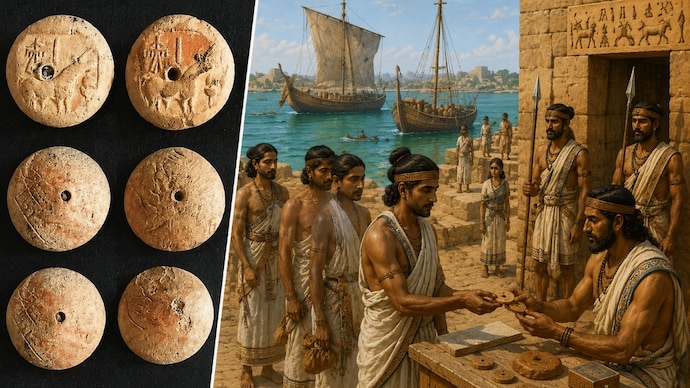
During this work, three unusual round pendants of terracotta were studied from the Gujarat region. Kanmer, a site near Dholavira, had these so-called “passport” seals that offer a glimpse into how movement may have been marked in that period. We will come back to them in a bit.
From Harappan times, it appears that ancient civilisations had a clear sense of who belonged within their networks and who arrived from outside them.
The system seems to have worked with this awareness. We get more clarity in later periods. During the reign of a Persian king, whose reference also appears in the Bible, Nehemiah was given letters of safe passage to travel to Judah.
Far away from Persia, in the subcontinent, similar evidence appears in the Mauryan empire, where travel, migration, and entry were watched more carefully.
This was also the period when the West was more actively connected with the Mauryan state. The Mudrdhyaksha was linked with fees and permissions related to movement, while a chief official oversaw such operations.
The Mauryan spy network was vast, and anyone arriving from a foreign land was expected to remain under watch. Variations of such practices continued for centuries. Returning to the Harappan world, however, passports seem to have held a different place.
Long-distance trade with some of the oldest civilisations made systems of identification important, both for exchange and for control.The
The Indus-Saraswati civilisation was spread across a vast region of the Indian subcontinent, and hundreds of discovered sites reveal a wide trade network stretching to the civilisations of Sumer and even the Nile region.
Three unusual round pendants of baked clay were discovered at Kanmer in Gujarat, near Dholavira, by a Japanese team. Each has a hole in the centre and the impression of an animal resembling a unicorn. The reverse sides carry different Indus script signs.
Because the same animal seal was pressed into all three, Professor Toshiki Osada suggested that “they may have served as a passport for those traveling between different regions.”
From Mohenjo-daro come curious objects that deepen this possibility.
The claim also finds mention in Seals and Sealing in the Ancient World: Case Studies from the Near East, Egypt, the Aegean, and South Asia, where authors Marta Ameri, Sarah Kielt Costello, Gregg Jamison and Sarah Jarmer Scott discuss the discovery of compartmented metal seals (Franke 2010) and terracotta “passports” from Mohenjo-daro - with one side stamped by a compartmented metal seal and the other bearing an Indus seal.
This is where the Harappan story becomes especially interesting. These were not merely decorative objects or trade tokens. If they indeed travelled with people, they may have functioned as markers of access, identity, or passage in an urban world built on exchange.
Ernest Mackay, a British archaeologist, observed that many inhabitants of the Indus Valley appeared to have worn amulets of some kind, and that the so-called seals may have served not only as sealing devices but also as personal objects.
He noted that objects of this type seem to have belonged to everyone, which would suggest some level of mass production. And that raises a simple question: what do you mass-produce if not something that helps mark identity, access, or belonging?
There is an oddly familiar echo of this in a much later account. The Austrian traveller Baron Charles von Hgel wrote in 1845 about visiting Vizadroog, south of Bombay, where the local chief, being unfamiliar with writing, did not sign passports in the conventional sense.
Instead, members of his retinue would carry a piece of soft clay on which a wooden stamp was impressed. That stamped clay would then be shown to guards at the gates as proof of permission to pass.
During the Mughal period in the medieval era, sanads were also issued to individuals arriving from outside. The format changed, the empire changed, and the script changed, but the need to identify a traveller did not disappear.
The Harappan seal, the Mauryan travel official, the Persian letter of safe passage, the Mughal sanad, and the stamped clay at a western Indian port do not belong to the same system, but the underlying story remains the same.
The passport, in its modern form, may be a recent invention. But the need to prove who you are, where you belong, and whether you may pass is far older.
India is currently witnessing a war of words over the passport, the one document considered most important in a foreign country when proving your nationality. People often view the passport as a modern concept that came into existence in the aftermath of World War I. That is largely true when we talk about modern travel, where nation-state boundaries determine movement and geography shapes who can go where.
But leave that aside for a moment and travel back nearly 4,000 years to the early mature phase of the Indus-Saraswati civilisation.
To trace the journey of these “passport seals”, we need to go back in time and explore how movement may have been identified in a world without paper borders. It opens a window into how travel was understood then and how people were recognised across different regions.
A few years ago, a team of Japanese experts studied Harappan sites on a large scale to understand what ancient people were trying to communicate through seals and inscriptions, especially since a large part of Harappan information survives in seal form.
During this work, three unusual round pendants of terracotta were studied from the Gujarat region. Kanmer, a site near Dholavira, had these so-called “passport” seals that offer a glimpse into how movement may have been marked in that period. We will come back to them in a bit.
From Harappan times, it appears that ancient civilisations had a clear sense of who belonged within their networks and who arrived from outside them.
The system seems to have worked with this awareness. We get more clarity in later periods. During the reign of a Persian king, whose reference also appears in the Bible, Nehemiah was given letters of safe passage to travel to Judah.
Far away from Persia, in the subcontinent, similar evidence appears in the Mauryan empire, where travel, migration, and entry were watched more carefully.
This was also the period when the West was more actively connected with the Mauryan state. The Mudrdhyaksha was linked with fees and permissions related to movement, while a chief official oversaw such operations.
The Mauryan spy network was vast, and anyone arriving from a foreign land was expected to remain under watch. Variations of such practices continued for centuries. Returning to the Harappan world, however, passports seem to have held a different place.
Long-distance trade with some of the oldest civilisations made systems of identification important, both for exchange and for control.The
The Indus-Saraswati civilisation was spread across a vast region of the Indian subcontinent, and hundreds of discovered sites reveal a wide trade network stretching to the civilisations of Sumer and even the Nile region.
Three unusual round pendants of baked clay were discovered at Kanmer in Gujarat, near Dholavira, by a Japanese team. Each has a hole in the centre and the impression of an animal resembling a unicorn. The reverse sides carry different Indus script signs.
Because the same animal seal was pressed into all three, Professor Toshiki Osada suggested that “they may have served as a passport for those traveling between different regions.”
From Mohenjo-daro come curious objects that deepen this possibility.
The claim also finds mention in Seals and Sealing in the Ancient World: Case Studies from the Near East, Egypt, the Aegean, and South Asia, where authors Marta Ameri, Sarah Kielt Costello, Gregg Jamison and Sarah Jarmer Scott discuss the discovery of compartmented metal seals (Franke 2010) and terracotta “passports” from Mohenjo-daro - with one side stamped by a compartmented metal seal and the other bearing an Indus seal.
This is where the Harappan story becomes especially interesting. These were not merely decorative objects or trade tokens. If they indeed travelled with people, they may have functioned as markers of access, identity, or passage in an urban world built on exchange.
Ernest Mackay, a British archaeologist, observed that many inhabitants of the Indus Valley appeared to have worn amulets of some kind, and that the so-called seals may have served not only as sealing devices but also as personal objects.
He noted that objects of this type seem to have belonged to everyone, which would suggest some level of mass production. And that raises a simple question: what do you mass-produce if not something that helps mark identity, access, or belonging?
There is an oddly familiar echo of this in a much later account. The Austrian traveller Baron Charles von Hgel wrote in 1845 about visiting Vizadroog, south of Bombay, where the local chief, being unfamiliar with writing, did not sign passports in the conventional sense.
Instead, members of his retinue would carry a piece of soft clay on which a wooden stamp was impressed. That stamped clay would then be shown to guards at the gates as proof of permission to pass.
During the Mughal period in the medieval era, sanads were also issued to individuals arriving from outside. The format changed, the empire changed, and the script changed, but the need to identify a traveller did not disappear.
The Harappan seal, the Mauryan travel official, the Persian letter of safe passage, the Mughal sanad, and the stamped clay at a western Indian port do not belong to the same system, but the underlying story remains the same.
The passport, in its modern form, may be a recent invention. But the need to prove who you are, where you belong, and whether you may pass is far older.

