Newsletters before newspapers: Akhbarat recorded Aurangzeb's many farmans
Preserved Mughal Akhbarat-i Darbar-i Mualla newsletters reveal how Aurangzeb's court recorded daily affairs across the empire. The records show India had a structured news and administrative network before newspapers spread across Europe.
Like Johannes Gutenberg's printing press changed the course of history by revolutionising the spread of information, the Mughal Empire was documenting its world long before newspapers became a fixture in Europe.
While Europe was discovering print journalism, Mughal India already possessed a sophisticated news network. Known as the Akhbarat-i Darbar-i Mualla, from the Persian akhbar, meaning "news", these handwritten court newsletters carried the pulse of an empire.
Penned in Persian on brittle paper, these newsletters were the lifeblood of the Mughal Empire's information network.
Every day, court scribes produced the Akhbarat-i Darbar-i Mualla, a newsletter of the empire that wove together intelligence reports, imperial farmans, military campaigns, diplomatic exchanges, financial accounts, political appointments and the daily proceedings of the Mughal court.
For historians, the Akhbarat-i Darbar-i Mualla have become one of the most valuable sources for understanding the reign of Mughal Emperor Aurangzeb Alamgir, a ruler whose legacy remains deeply contested in Indian history.
Historian Munis D. Faruqui, who has spent years studying these seventeenth-century newsletters, describes the Akhbarat-i Darbar-i Mualla as an unparalleled record of Aurangzeb's reign.
Speaking to the BBC, he noted that the documents contain little evidence of the widespread religious conversions often associated with the emperor's rule.
WHERE CHATTRAPATI SHIVAJI, DURGADAS AND AURANGZEB SHARE THE SAME PAGES
Written in elegant Persian Shikastah script, they capture everything from the Maratha campaigns, the Rajput resistance coming from Marwar and royal decrees to the smallest routines of governance, revealing how one of the world's largest empires survived in the Indian subcontinent functioning day by day.
Personlaities who left an embarking writing on Indian history are part of this newsletter. Chattrapati Shivaji, Durgadas Rathore and many Indian princes it has.
News travelled remarkably fast. Hundreds, perhaps thousands, of copies of the Akhbarat-i Darbar-i Mualla circulated daily between the imperial court and provincial capitals, where they were often read aloud before governors and Rajput rulers.
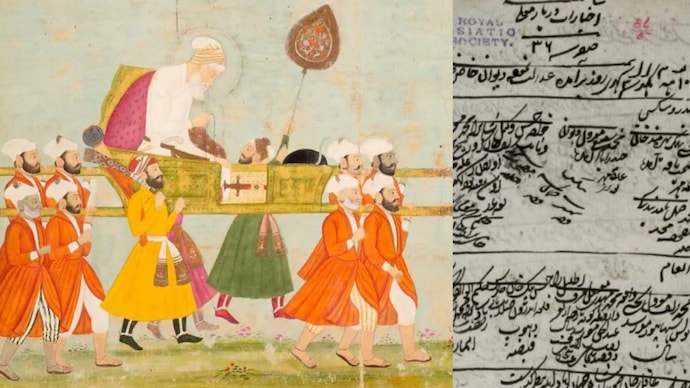
Today, one of the most important collections of the Akhbarat-i Darbar-i Mualla survives in the Royal Asiatic Society in London.
Bound into nine green leather volumes during the nineteenth century, the archive preserves nearly fifty years of Mughal administration between 1660 and 1709.
LOST PRESERVED AND REDISCOVERED
How these manuscripts reached Britain remains a mystery that Britishers took with them.
Most historians trace them to James Tod, an officer of the East India Company and an antiquarian who acquired them in Rajasthan before taking them to England.
Later scholars suggested that the Nagari notes in the margins indicate the manuscripts once belonged to a Rajput court record keeper who regularly received dispatches from the Mughal court.
The Akhbarat-i Darbar-i Mualla survived, but for centuries they remained largely untouched.
Their sheer scale, thousands of unindexed pages, made them almost impossible to navigate. Historian Munis D. Faruqui likened working through them to searching for a needle in a haystack.
Yet that overwhelming detail is precisely what makes the Akhbarat-i Darbar-i Mualla extraordinary.
Unlike royal histories polished years later, they preserve the empire's daily rhythm, recording decisions as they happened rather than as rulers wished them to be remembered.
They also challenge long-held assumptions.
Figures overlooked by traditional histories, including Aurangzeb's daughter Zinat-un-Nisa, emerge as influential political actors, while the imperial harem and eunuch administration appear as powerful centres of governance rather than peripheral institutions.
Today, the Akhbarat-i Darbar-i Mualla survive in archives across London, Kolkata, Bikaner and Sitamau, with historians believing that more manuscripts remain hidden in private collections.
Together, the Akhbarat-i Darbar-i Mualla reveal a remarkable truth: centuries before the newspaper became a recognised institution, the Mughal Empire had already mastered the art of gathering, recording and distributing information.
More than court chronicles and paperwork, the Akhbarat-i Darbar-i Mualla were the nervous system of an empire, proof that history was being written one day at a time.
Like Johannes Gutenberg's printing press changed the course of history by revolutionising the spread of information, the Mughal Empire was documenting its world long before newspapers became a fixture in Europe.
While Europe was discovering print journalism, Mughal India already possessed a sophisticated news network. Known as the Akhbarat-i Darbar-i Mualla, from the Persian akhbar, meaning "news", these handwritten court newsletters carried the pulse of an empire.
Penned in Persian on brittle paper, these newsletters were the lifeblood of the Mughal Empire's information network.
Every day, court scribes produced the Akhbarat-i Darbar-i Mualla, a newsletter of the empire that wove together intelligence reports, imperial farmans, military campaigns, diplomatic exchanges, financial accounts, political appointments and the daily proceedings of the Mughal court.
For historians, the Akhbarat-i Darbar-i Mualla have become one of the most valuable sources for understanding the reign of Mughal Emperor Aurangzeb Alamgir, a ruler whose legacy remains deeply contested in Indian history.
Historian Munis D. Faruqui, who has spent years studying these seventeenth-century newsletters, describes the Akhbarat-i Darbar-i Mualla as an unparalleled record of Aurangzeb's reign.
Speaking to the BBC, he noted that the documents contain little evidence of the widespread religious conversions often associated with the emperor's rule.
WHERE CHATTRAPATI SHIVAJI, DURGADAS AND AURANGZEB SHARE THE SAME PAGES
Written in elegant Persian Shikastah script, they capture everything from the Maratha campaigns, the Rajput resistance coming from Marwar and royal decrees to the smallest routines of governance, revealing how one of the world's largest empires survived in the Indian subcontinent functioning day by day.
Personlaities who left an embarking writing on Indian history are part of this newsletter. Chattrapati Shivaji, Durgadas Rathore and many Indian princes it has.
News travelled remarkably fast. Hundreds, perhaps thousands, of copies of the Akhbarat-i Darbar-i Mualla circulated daily between the imperial court and provincial capitals, where they were often read aloud before governors and Rajput rulers.
Today, one of the most important collections of the Akhbarat-i Darbar-i Mualla survives in the Royal Asiatic Society in London.
Bound into nine green leather volumes during the nineteenth century, the archive preserves nearly fifty years of Mughal administration between 1660 and 1709.
LOST PRESERVED AND REDISCOVERED
How these manuscripts reached Britain remains a mystery that Britishers took with them.
Most historians trace them to James Tod, an officer of the East India Company and an antiquarian who acquired them in Rajasthan before taking them to England.
Later scholars suggested that the Nagari notes in the margins indicate the manuscripts once belonged to a Rajput court record keeper who regularly received dispatches from the Mughal court.
The Akhbarat-i Darbar-i Mualla survived, but for centuries they remained largely untouched.
Their sheer scale, thousands of unindexed pages, made them almost impossible to navigate. Historian Munis D. Faruqui likened working through them to searching for a needle in a haystack.
Yet that overwhelming detail is precisely what makes the Akhbarat-i Darbar-i Mualla extraordinary.
Unlike royal histories polished years later, they preserve the empire's daily rhythm, recording decisions as they happened rather than as rulers wished them to be remembered.
They also challenge long-held assumptions.
Figures overlooked by traditional histories, including Aurangzeb's daughter Zinat-un-Nisa, emerge as influential political actors, while the imperial harem and eunuch administration appear as powerful centres of governance rather than peripheral institutions.
Today, the Akhbarat-i Darbar-i Mualla survive in archives across London, Kolkata, Bikaner and Sitamau, with historians believing that more manuscripts remain hidden in private collections.
Together, the Akhbarat-i Darbar-i Mualla reveal a remarkable truth: centuries before the newspaper became a recognised institution, the Mughal Empire had already mastered the art of gathering, recording and distributing information.
More than court chronicles and paperwork, the Akhbarat-i Darbar-i Mualla were the nervous system of an empire, proof that history was being written one day at a time.

