This Padma Shri scientist proved India carries world's oldest DNA outside Africa
Padma Shri awardee Dr Kumarasamy Thangaraj helped prove that Andaman tribes carry one of the world's oldest human genetic lineages outside Africa. His work changed how scientists understand Indian DNA, medicine, migration and ancestry. Two decades later, GenomeIndia is revealing just how much of India's genetic story the world had overlooked.
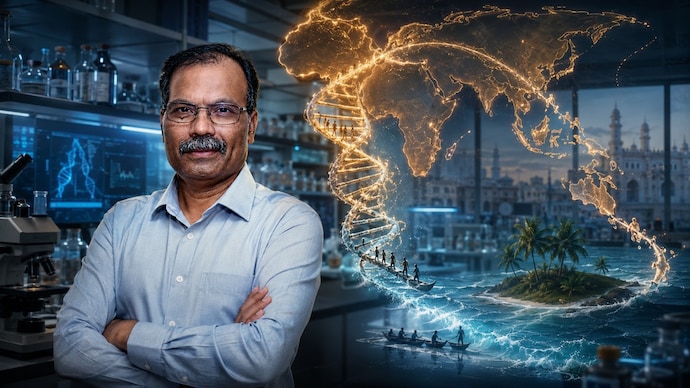
For decades, modern medicine studied humanity through a genetic mirror that barely reflected India.
Most global DNA databases were built largely using European populations. Drug research, disease studies, risk prediction models and even ideas about ancient migration were shaped around genomes that looked nothing like most Indians.
But one scientist working from a government laboratory in Hyderabad spent much of his career challenging that picture.
This year, India awarded the Padma Shri to Dr Kumarasamy Thangaraj, one of the country's leading geneticists, a CSIR Bhatnagar Fellow and former Director of Hyderabad's Centre for DNA Fingerprinting and Diagnostics (CDFD).
What makes his story especially striking is that he built almost his entire scientific career in India. Educated at the University of Madras and trained in Indian institutions, he became living proof that world-class science does not necessarily require an Ivy League degree or a foreign laboratory.
Over the past two decades, his research has helped reshape how scientists understand both humanity's ancient migrations and India's extraordinary genetic diversity. In 2005, his team produced evidence that Indigenous communities in the Andaman Islands carried genetic lineages linked to one of humanity's earliest journeys out of Africa around 65,000 years ago.
Today, as the GenomeIndia project uncovers millions of genetic variants previously missing from global databases, many of the questions Thangaraj spent years asking are finding fresh answers.
And the implications go far beyond history textbooks.
THE DISCOVERY THAT CHANGED A GLOBAL DEBATE
Back in 2005, Dr Thangaraj and his team at the Centre for Cellular and Molecular Biology published a landmark paper in the journal Science.
The study focused on Indigenous Andaman tribes such as the Onge and Jarawa communities. By analysing mitochondrial DNA, which is passed down through the maternal line, researchers found that these groups carried an extraordinarily ancient genetic signature.
At a time when scientists were debating how modern humans spread across the world after leaving Africa, Dr Thangaraj’s conclusion stunned the scientific world.
The ancestors of the Andaman tribes likely belonged to one of the earliest groups of modern humans to leave Africa around 65,000 years ago.
This does not mean these communities are "primitive" or frozen in time. It means their genetic lineage split from other human populations extremely early and remained relatively isolated for thousands of years.
In simple terms, while most of the world’s populations mixed repeatedly through migrations, invasions and intermarriages over millennia, these Andaman island communities preserved some of humanity’s oldest surviving genetic lineages found outside Africa.
That discovery became one of the strongest pieces of evidence supporting the "southern coastal migration" theory. According to this idea, some of the earliest humans leaving Africa travelled along coastlines through Arabia and South Asia before spreading further across Asia and beyond.
And India sat right at the centre of that journey with an extraordinary genetic diversity found across the subcontinent.
The Andaman and Nicobar Islands are not just preserving tribal history; they are preserving a chapter of humanity's history.
THE GENOMEINDIA PROJECT IS PROVING THE POINT
If the Andaman research changed how scientists looked at the past, the GenomeIndia project is changing how they look at the future.
In 2020, India launched the GenomeIndia Project, one of the country's biggest scientific efforts to map its genetic diversity. By sequencing genomes from people across different regions and communities, researchers aimed to build a genetic reference that finally reflects India's population rather than relying on data collected elsewhere.
The project sequenced the genomes of 9,768 individuals from 83 populations across India.
The results were staggering.
Researchers identified nearly 130 million genetic variants in total. More than 44 million of those were absent from major global databases.
Millions of those variants are linked to biological traits, disease risks and drug responses that researchers are only beginning to understand. In effect, a significant part of India's genetic story was missing from international scientific databases.
Imagine trying to write a medical textbook for humanity while leaving out one-sixth of the world's population. That is essentially what happened.
India is home to more than one-sixth of humanity, yet much of the world's genomic science barely accounted for that diversity until recently. For years, Indian populations remained severely underrepresented.
As a result, many genetic studies, disease prediction tools and medical models were built using data that did not adequately reflect Indian biology.
The GenomeIndia findings are now confirming something Thangaraj argued throughout his career: Indian genetic diversity is too large and too unique to be treated as an afterthought.
In many ways, the project is building on questions researchers have been asking for decades: what happens when one of the world's most genetically diverse populations is largely missing from global science?
WHY THIS MATTERS TO EVERY INDIAN
This is where the story stops being about ancestry and starts becoming personal.
Genes influence how people respond to medicines, how diseases develop and how health risks are calculated.
If genetic databases are dominated by European populations, the resulting medical insights may not always work as accurately for Indians.
A treatment strategy, disease prediction model or genetic risk assessment developed using largely European datasets may not always capture the complexities of Indian populations. Researchers believe more representative genomic data could eventually improve personalised medicine, diagnosis and preventive healthcare.
Researchers increasingly believe that India-specific genomic data could improve disease prediction, diagnosis and personalised treatments in the future.
The connection is surprisingly direct.
Ancient migration patterns created unique genetic diversity. That diversity affects modern health. And understanding it could help build better healthcare.
THE NICOBAR PROJECT AND A FRAGILE FUTURE
The same islands that helped scientists uncover one of humanity’s oldest living genetic histories are now facing growing development pressures. The irony is difficult to miss.
The Great Nicobar mega infrastructure project, which includes plans for a transshipment port, airport, township and power projects, has triggered concerns.
The environmental stakes are substantial. Government submissions to Parliament have estimated that up to 9.64 lakh trees could be affected by the project, though more recent official documents put the maximum expected tree felling at around 7.11 lakh trees, to be carried out in phases. The project also involves diversion of over 130 sq km of forest land.
Supporters say safeguards and compensatory measures are in place, while environmentalists and anthropologists worry that large-scale development could impact the island's unique ecosystems and indirectly affect vulnerable Indigenous communities through environmental changes, outside contact and increased movement into ecologically sensitive zones.
There is no simple debate here. Infrastructure and economic development are important goals. But many researchers argue that places holding irreplaceable ecological and human history need especially careful planning.
Because once fragile cultures or isolated populations are disrupted, there is often no way to reverse the damage.
THE BIGGER STORY HIDING INSIDE THIS MOMENT
Thangaraj’s Padma Shri is not just an award for one scientist but represents something larger unfolding in India right now.
The 2005 Andaman discovery, years of research into India's population history, and today's GenomeIndia findings all point in the same direction.
For years, India was often treated as a source of raw data, patients or outsourced labour in global science. But the world underestimated how important India is to understanding humanity.
Now, Indian researchers are increasingly asking fresh questions: Who are we genetically? How did humans migrate? Why do diseases behave differently here? What happens when a billion people are excluded from global medical datasets?
His journey also raises a larger question. If research of this scale and significance can emerge from Indian laboratories, how many more breakthroughs are possible if scientists are given stronger funding, infrastructure and long-term support?
The Padma Shri-winning scientist who helped show that some of humanity's oldest surviving genetic lineages are found in the Andaman Islands is now being vindicated by a new generation of genome research revealing just how underrepresented Indians have been in global science.
His work was never only about tracing ancient migrations. It was about making sure India was treated as far more than a footnote in human history, evolution and medicine, that it was finally visible in the human story.
And as genome science enters a new era, that story is only getting bigger.
For decades, modern medicine studied humanity through a genetic mirror that barely reflected India.
Most global DNA databases were built largely using European populations. Drug research, disease studies, risk prediction models and even ideas about ancient migration were shaped around genomes that looked nothing like most Indians.
But one scientist working from a government laboratory in Hyderabad spent much of his career challenging that picture.
This year, India awarded the Padma Shri to Dr Kumarasamy Thangaraj, one of the country's leading geneticists, a CSIR Bhatnagar Fellow and former Director of Hyderabad's Centre for DNA Fingerprinting and Diagnostics (CDFD).
What makes his story especially striking is that he built almost his entire scientific career in India. Educated at the University of Madras and trained in Indian institutions, he became living proof that world-class science does not necessarily require an Ivy League degree or a foreign laboratory.
Over the past two decades, his research has helped reshape how scientists understand both humanity's ancient migrations and India's extraordinary genetic diversity. In 2005, his team produced evidence that Indigenous communities in the Andaman Islands carried genetic lineages linked to one of humanity's earliest journeys out of Africa around 65,000 years ago.
Today, as the GenomeIndia project uncovers millions of genetic variants previously missing from global databases, many of the questions Thangaraj spent years asking are finding fresh answers.
And the implications go far beyond history textbooks.
THE DISCOVERY THAT CHANGED A GLOBAL DEBATE
Back in 2005, Dr Thangaraj and his team at the Centre for Cellular and Molecular Biology published a landmark paper in the journal Science.
The study focused on Indigenous Andaman tribes such as the Onge and Jarawa communities. By analysing mitochondrial DNA, which is passed down through the maternal line, researchers found that these groups carried an extraordinarily ancient genetic signature.
At a time when scientists were debating how modern humans spread across the world after leaving Africa, Dr Thangaraj’s conclusion stunned the scientific world.
The ancestors of the Andaman tribes likely belonged to one of the earliest groups of modern humans to leave Africa around 65,000 years ago.
This does not mean these communities are "primitive" or frozen in time. It means their genetic lineage split from other human populations extremely early and remained relatively isolated for thousands of years.
In simple terms, while most of the world’s populations mixed repeatedly through migrations, invasions and intermarriages over millennia, these Andaman island communities preserved some of humanity’s oldest surviving genetic lineages found outside Africa.
That discovery became one of the strongest pieces of evidence supporting the "southern coastal migration" theory. According to this idea, some of the earliest humans leaving Africa travelled along coastlines through Arabia and South Asia before spreading further across Asia and beyond.
And India sat right at the centre of that journey with an extraordinary genetic diversity found across the subcontinent.
The Andaman and Nicobar Islands are not just preserving tribal history; they are preserving a chapter of humanity's history.
THE GENOMEINDIA PROJECT IS PROVING THE POINT
If the Andaman research changed how scientists looked at the past, the GenomeIndia project is changing how they look at the future.
In 2020, India launched the GenomeIndia Project, one of the country's biggest scientific efforts to map its genetic diversity. By sequencing genomes from people across different regions and communities, researchers aimed to build a genetic reference that finally reflects India's population rather than relying on data collected elsewhere.
The project sequenced the genomes of 9,768 individuals from 83 populations across India.
The results were staggering.
Researchers identified nearly 130 million genetic variants in total. More than 44 million of those were absent from major global databases.
Millions of those variants are linked to biological traits, disease risks and drug responses that researchers are only beginning to understand. In effect, a significant part of India's genetic story was missing from international scientific databases.
Imagine trying to write a medical textbook for humanity while leaving out one-sixth of the world's population. That is essentially what happened.
India is home to more than one-sixth of humanity, yet much of the world's genomic science barely accounted for that diversity until recently. For years, Indian populations remained severely underrepresented.
As a result, many genetic studies, disease prediction tools and medical models were built using data that did not adequately reflect Indian biology.
The GenomeIndia findings are now confirming something Thangaraj argued throughout his career: Indian genetic diversity is too large and too unique to be treated as an afterthought.
In many ways, the project is building on questions researchers have been asking for decades: what happens when one of the world's most genetically diverse populations is largely missing from global science?
WHY THIS MATTERS TO EVERY INDIAN
This is where the story stops being about ancestry and starts becoming personal.
Genes influence how people respond to medicines, how diseases develop and how health risks are calculated.
If genetic databases are dominated by European populations, the resulting medical insights may not always work as accurately for Indians.
A treatment strategy, disease prediction model or genetic risk assessment developed using largely European datasets may not always capture the complexities of Indian populations. Researchers believe more representative genomic data could eventually improve personalised medicine, diagnosis and preventive healthcare.
Researchers increasingly believe that India-specific genomic data could improve disease prediction, diagnosis and personalised treatments in the future.
The connection is surprisingly direct.
Ancient migration patterns created unique genetic diversity. That diversity affects modern health. And understanding it could help build better healthcare.
THE NICOBAR PROJECT AND A FRAGILE FUTURE
The same islands that helped scientists uncover one of humanity’s oldest living genetic histories are now facing growing development pressures. The irony is difficult to miss.
The Great Nicobar mega infrastructure project, which includes plans for a transshipment port, airport, township and power projects, has triggered concerns.
The environmental stakes are substantial. Government submissions to Parliament have estimated that up to 9.64 lakh trees could be affected by the project, though more recent official documents put the maximum expected tree felling at around 7.11 lakh trees, to be carried out in phases. The project also involves diversion of over 130 sq km of forest land.
Supporters say safeguards and compensatory measures are in place, while environmentalists and anthropologists worry that large-scale development could impact the island's unique ecosystems and indirectly affect vulnerable Indigenous communities through environmental changes, outside contact and increased movement into ecologically sensitive zones.
There is no simple debate here. Infrastructure and economic development are important goals. But many researchers argue that places holding irreplaceable ecological and human history need especially careful planning.
Because once fragile cultures or isolated populations are disrupted, there is often no way to reverse the damage.
THE BIGGER STORY HIDING INSIDE THIS MOMENT
Thangaraj’s Padma Shri is not just an award for one scientist but represents something larger unfolding in India right now.
The 2005 Andaman discovery, years of research into India's population history, and today's GenomeIndia findings all point in the same direction.
For years, India was often treated as a source of raw data, patients or outsourced labour in global science. But the world underestimated how important India is to understanding humanity.
Now, Indian researchers are increasingly asking fresh questions: Who are we genetically? How did humans migrate? Why do diseases behave differently here? What happens when a billion people are excluded from global medical datasets?
His journey also raises a larger question. If research of this scale and significance can emerge from Indian laboratories, how many more breakthroughs are possible if scientists are given stronger funding, infrastructure and long-term support?
The Padma Shri-winning scientist who helped show that some of humanity's oldest surviving genetic lineages are found in the Andaman Islands is now being vindicated by a new generation of genome research revealing just how underrepresented Indians have been in global science.
His work was never only about tracing ancient migrations. It was about making sure India was treated as far more than a footnote in human history, evolution and medicine, that it was finally visible in the human story.
And as genome science enters a new era, that story is only getting bigger.

