Did the Sutlej once feed the lost Saraswati? What scientists discovered over time
Did the Sutlej once flow into the legendary Saraswati River? Scientists have spent decades studying sediments, satellite imagery and ancient river channels to answer that question. Here's what geological research suggests about the Sutlej's ancient path and why it remains central to one of India's biggest historical mysteries.
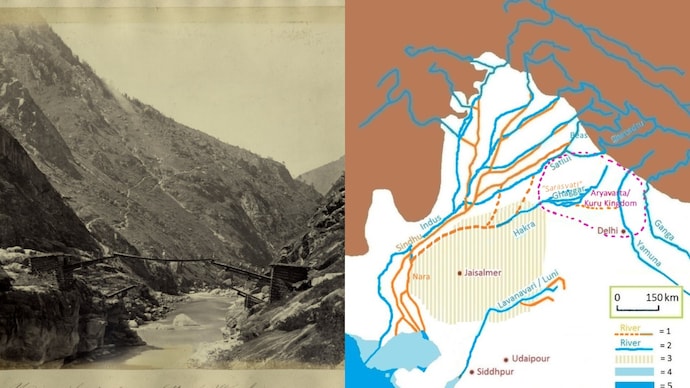
With the film Satluj making headlines, the river Sutlej is back in the spotlight. Its story stretches back thousands of years and leads to one of India's greatest historical mysteries.
Scientists believe the Sutlej did not always flow west into the Indus. Geological evidence suggests it once flowed southeast into the ancient Ghaggar-Hakra river system, a dried river channel that many researchers associate with the legendary Saraswati.
That possibility has turned the Sutlej into a key piece of one of India's greatest historical puzzles.
THE SEARCH FOR INDIA'S LOST RIVER
The Saraswati occupies a special place in ancient Indian literature. The Rig Veda describes it as a mighty river flowing between the Yamuna and the Sutlej before disappearing into the desert.
For centuries, historians debated whether it referred to a real river, a symbolic one or several rivers remembered together.
Then satellite imagery revealed the traces of an enormous dried river channel stretching through Haryana, Punjab and Rajasthan into present-day Pakistan. Scientists call this the Ghaggar Hakra palaeochannel.
Think of it as the dried-up bed of a river that once carried much more water than it does today. Scientists are trying to answer two big questions: Which rivers once fed it? And is this the Saraswati described in the Rig Veda? So far, there is no scientific consensus.
Importantly, the Ghaggar Hakra and the Saraswati are not considered the same thing by default. The Ghaggar Hakra is a geological feature that can be studied. Whether it is the Saraswati described in ancient texts remains one of the biggest debates in South Asian archaeology and geology.
HOW THE SUTLEJ BECAME PART OF THE STORY
Rivers are not fixed forever. Over thousands of years, earthquakes, floods and natural changes in the landscape can cause them to carve entirely new paths.
Scientists studying ancient river deposits found clues that the Sutlej once supplied water to the Ghaggar Hakra system.
To reach that conclusion, researchers analysed sediments, zircon minerals carried by the river, mapped buried channels using satellite imagery and dated ancient deposits using techniques such as optically stimulated luminescence, which estimates when sediments were last exposed to sunlight.
The evidence points to a dramatic natural change. Between roughly 15,000 and 8,000 years ago, the Sutlej gradually shifted westwards into the Indus basin, following the route it still takes today.
WHY THIS MATTERS FOR THE INDUS VALLEY CIVILISATION
The story becomes even more fascinating because hundreds of settlements from the Indus Valley Civilisation have been discovered along the now dry Ghaggar Hakra channel.
This matters because where a river flows often determines where people settle. Ancient cities usually grew close to reliable sources of water.
If the Sutlej had once flowed there, did those cities grow beside a great Himalayan river?
Recent studies suggest probably not. By the time the civilisation reached its peak around 2600 BCE, the Sutlej had likely already changed course. Many researchers now believe these settlements relied mainly on seasonal rivers, monsoon rainfall and local water sources rather than a perennial river fed by the Himalayas.
A MYSTERY THAT STILL CONTINUES
Current geological evidence suggests the Sutlej likely flowed into the ancient Ghaggar Hakra system thousands of years ago before naturally changing course. That much is increasingly supported by earth science.
But the bigger question remains unanswered. Was the Ghaggar Hakra the Saraswati celebrated in the Rig Veda, or was the ancient text referring to a different river altogether?
For now, the Sutlej's ancient journey continues to connect geology, archaeology and mythology, reminding us that even rivers can rewrite history long after they have changed course.
With the film Satluj making headlines, the river Sutlej is back in the spotlight. Its story stretches back thousands of years and leads to one of India's greatest historical mysteries.
Scientists believe the Sutlej did not always flow west into the Indus. Geological evidence suggests it once flowed southeast into the ancient Ghaggar-Hakra river system, a dried river channel that many researchers associate with the legendary Saraswati.
That possibility has turned the Sutlej into a key piece of one of India's greatest historical puzzles.
THE SEARCH FOR INDIA'S LOST RIVER
The Saraswati occupies a special place in ancient Indian literature. The Rig Veda describes it as a mighty river flowing between the Yamuna and the Sutlej before disappearing into the desert.
For centuries, historians debated whether it referred to a real river, a symbolic one or several rivers remembered together.
Then satellite imagery revealed the traces of an enormous dried river channel stretching through Haryana, Punjab and Rajasthan into present-day Pakistan. Scientists call this the Ghaggar Hakra palaeochannel.
Think of it as the dried-up bed of a river that once carried much more water than it does today. Scientists are trying to answer two big questions: Which rivers once fed it? And is this the Saraswati described in the Rig Veda? So far, there is no scientific consensus.
Importantly, the Ghaggar Hakra and the Saraswati are not considered the same thing by default. The Ghaggar Hakra is a geological feature that can be studied. Whether it is the Saraswati described in ancient texts remains one of the biggest debates in South Asian archaeology and geology.
HOW THE SUTLEJ BECAME PART OF THE STORY
Rivers are not fixed forever. Over thousands of years, earthquakes, floods and natural changes in the landscape can cause them to carve entirely new paths.
Scientists studying ancient river deposits found clues that the Sutlej once supplied water to the Ghaggar Hakra system.
To reach that conclusion, researchers analysed sediments, zircon minerals carried by the river, mapped buried channels using satellite imagery and dated ancient deposits using techniques such as optically stimulated luminescence, which estimates when sediments were last exposed to sunlight.
The evidence points to a dramatic natural change. Between roughly 15,000 and 8,000 years ago, the Sutlej gradually shifted westwards into the Indus basin, following the route it still takes today.
WHY THIS MATTERS FOR THE INDUS VALLEY CIVILISATION
The story becomes even more fascinating because hundreds of settlements from the Indus Valley Civilisation have been discovered along the now dry Ghaggar Hakra channel.
This matters because where a river flows often determines where people settle. Ancient cities usually grew close to reliable sources of water.
If the Sutlej had once flowed there, did those cities grow beside a great Himalayan river?
Recent studies suggest probably not. By the time the civilisation reached its peak around 2600 BCE, the Sutlej had likely already changed course. Many researchers now believe these settlements relied mainly on seasonal rivers, monsoon rainfall and local water sources rather than a perennial river fed by the Himalayas.
A MYSTERY THAT STILL CONTINUES
Current geological evidence suggests the Sutlej likely flowed into the ancient Ghaggar Hakra system thousands of years ago before naturally changing course. That much is increasingly supported by earth science.
But the bigger question remains unanswered. Was the Ghaggar Hakra the Saraswati celebrated in the Rig Veda, or was the ancient text referring to a different river altogether?
For now, the Sutlej's ancient journey continues to connect geology, archaeology and mythology, reminding us that even rivers can rewrite history long after they have changed course.

