Women and the pocket gap: How fashion shrank storage and sold handbags
Women once carried essentials in hidden waist-tied pockets, but changing fashion gradually made them disappear. Today's tiny or fake pockets are not random. Design trends, cost cutting, and gendered choices shaped this shift, leaving many women still relying on handbags instead of functional clothing.
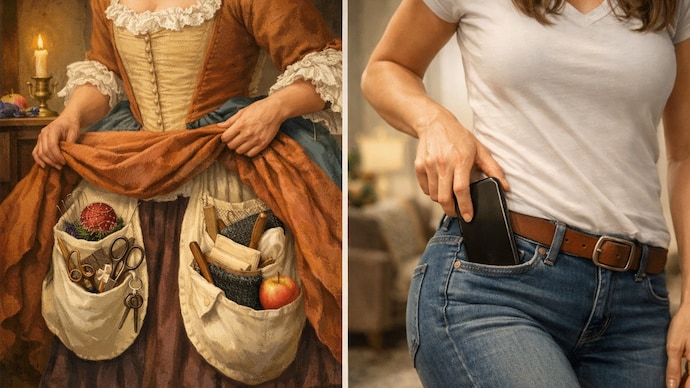
You slip your phone into your jeans pocket. It sticks out. You sit down, it digs in. You stand up, it falls out.
It feels like bad design. Or worse, deliberate design.
Somewhere along the way, a neat theory has taken hold online. That women lost their pockets because society wanted to silence them. No pockets, no notes, no rebellion. It sounds neat, even convincing.
But the real story is messier, older, and in many ways, more revealing.
WHEN WOMEN HAD BIGGER POCKETS THAN MEN
Step back a few centuries, and the idea that women never had pockets falls apart instantly.
In the 1600s, pockets were not stitched into clothes at all. They were separate garments, tied around the waist and worn between layers like petticoats and skirts. Hidden from view, they were surprisingly large.
Women could carry coins, keys, sewing kits, letters, even snacks. You could walk past someone and never know they were carrying half their life under their clothes.
You can still see examples preserved in collections like the Victoria and Albert Museum, where these pockets appear less like accessories and more like personal storage systems.
There was something else these pockets offered. Privacy. They were hidden, controlled by the wearer, and not easily accessed by others.
For a long stretch of history, women were not short of pockets. They just wore them differently.
FASHION CHANGED EVERYTHING
The real shift came slowly, almost unnoticed at first.
By the early 1800s, fashion turned towards slim, high-waisted dresses inspired by classical Greek styles. These Regency-era gowns were lighter and seen as freeing compared to heavily layered clothing. But they came with a trade-off.
There was simply no room for bulky, hidden pockets.
So pockets shrank. And then they moved outside.
Women began carrying small handbags called reticules, pinned or tied visibly to their outfits. You can spot them in collections like the Metropolitan Museum of Art.
As the 1800s progressed into the Victorian era, fashion pushed even tighter silhouettes, with slim skirts and cinched waists. Pockets became smaller or disappeared again. At the same time, something interesting happened.
Some women resisted.
Reform movements like the Rational Dress Society began arguing for more practical clothing. Dress patterns even started including optional pockets for those who wanted them, quietly linking practicality with independence.
By 1910, that push became more visible. The so-called suffragette suit appeared, reportedly featuring multiple functional pockets. It was a small but striking shift. Clothing was starting to carry meaning beyond style.
Then came the 1920s. After World War I, women stepped into public life in new ways. They adopted looser, menswear-inspired clothing. And with that came something simple but powerful.
Pockets returned.
This did not fully overturn the trend, but it showed that function could come back when the silhouette allowed it.
By 1933, even mainstream fashion media like Women's Wear Daily was asking a bold question: would women start wearing trousers?
The answer came in waves, not all at once.
THE MYTHS THAT WON’T GO AWAY
The internet loves a clean explanation. Reality rarely offers one.
The idea that suffragettes were denied pockets to stop them from organising has no historical backing. Historians studying groups like the Women’s Social and Political Union have found no evidence linking clothing design to suppression in this way.
Women still carried items. They used tie-on pockets, bags, and other methods.
There is also no record of any organised “anti-pocket” movement driven by fears of women carrying herbs or charms. And while access to public space has long been unequal, there is no proof that removing pockets was designed to keep women confined at home.
Enough real restrictions existed without needing to invent new ones.
SO WHY DON’T WOMEN’S CLOTHES HAVE POCKETS NOW
The modern phase of this story is just as revealing.
By the mid-20th century, fashion had once again turned towards structure and presentation. In 1954, designer Christian Dior famously remarked that men have pockets to carry things, while women’s clothing is often about decoration. The line stayed because it captured a truth many recognised.
Through the 1970s and 1980s, pockets made a partial comeback, especially with more practical clothing styles. But by the 1990s, another shift took over. Designer handbags rose sharply in popularity, and carrying items outside clothing became the norm again.
Today, the problem is everywhere.
Pick up a pair of women’s jeans and compare them to men’s. The difference is obvious. Smaller pockets. Shallower cuts. Sometimes no pockets at all, just stitched outlines pretending to be real.
A study by The Pudding found that women’s jean pockets can be nearly half the size of men’s, often too small to hold a standard smartphone.
The reasons are not dramatic, but they add up.
Fitted designs prioritise clean lines. Pockets can bunch fabric and alter the shape. Manufacturing costs also matter. Adding deep, durable pockets requires more fabric and more work. In fast fashion, where margins are tight, these details are often cut.
But there is a deeper force shaping all this. Women’s silhouettes are expected to stay slim, smooth, almost weightless. Who decided that bulk is unattractive on women? That idea comes from long-standing patriarchal norms that have shaped what is seen as desirable.
Fashion has often leaned into these ideas, focusing on how women’s bodies look rather than how their clothes function, leaving little room for practicality or real agency.
Then there is habit. For decades, women’s clothing has been designed with the expectation that a bag will do the carrying.
The result shows up in everyday life. Travelling, commuting, even stepping out for a short errand often means carrying something extra. A phone, keys, wallet. Things that could fit in a pocket, but often do not.
THE POCKET GAP WE STILL LIVE WITH
A pocket is a small thing, until you don’t have one.
Clothing does more than cover the body. It decides what you can carry, where you can go, and how freely you move. Over time, those choices add up.
Women once tied their pockets under their skirts, hidden but full of daily life. Then fashion took them away, brought them back, and reshaped them again.
Today, the question is no longer about what happened.
It is about why, after all this time, something so simple still feels out of reach.
You slip your phone into your jeans pocket. It sticks out. You sit down, it digs in. You stand up, it falls out.
It feels like bad design. Or worse, deliberate design.
Somewhere along the way, a neat theory has taken hold online. That women lost their pockets because society wanted to silence them. No pockets, no notes, no rebellion. It sounds neat, even convincing.
But the real story is messier, older, and in many ways, more revealing.
WHEN WOMEN HAD BIGGER POCKETS THAN MEN
Step back a few centuries, and the idea that women never had pockets falls apart instantly.
In the 1600s, pockets were not stitched into clothes at all. They were separate garments, tied around the waist and worn between layers like petticoats and skirts. Hidden from view, they were surprisingly large.
Women could carry coins, keys, sewing kits, letters, even snacks. You could walk past someone and never know they were carrying half their life under their clothes.
You can still see examples preserved in collections like the Victoria and Albert Museum, where these pockets appear less like accessories and more like personal storage systems.
There was something else these pockets offered. Privacy. They were hidden, controlled by the wearer, and not easily accessed by others.
For a long stretch of history, women were not short of pockets. They just wore them differently.
FASHION CHANGED EVERYTHING
The real shift came slowly, almost unnoticed at first.
By the early 1800s, fashion turned towards slim, high-waisted dresses inspired by classical Greek styles. These Regency-era gowns were lighter and seen as freeing compared to heavily layered clothing. But they came with a trade-off.
There was simply no room for bulky, hidden pockets.
So pockets shrank. And then they moved outside.
Women began carrying small handbags called reticules, pinned or tied visibly to their outfits. You can spot them in collections like the Metropolitan Museum of Art.
As the 1800s progressed into the Victorian era, fashion pushed even tighter silhouettes, with slim skirts and cinched waists. Pockets became smaller or disappeared again. At the same time, something interesting happened.
Some women resisted.
Reform movements like the Rational Dress Society began arguing for more practical clothing. Dress patterns even started including optional pockets for those who wanted them, quietly linking practicality with independence.
By 1910, that push became more visible. The so-called suffragette suit appeared, reportedly featuring multiple functional pockets. It was a small but striking shift. Clothing was starting to carry meaning beyond style.
Then came the 1920s. After World War I, women stepped into public life in new ways. They adopted looser, menswear-inspired clothing. And with that came something simple but powerful.
Pockets returned.
This did not fully overturn the trend, but it showed that function could come back when the silhouette allowed it.
By 1933, even mainstream fashion media like Women's Wear Daily was asking a bold question: would women start wearing trousers?
The answer came in waves, not all at once.
THE MYTHS THAT WON’T GO AWAY
The internet loves a clean explanation. Reality rarely offers one.
The idea that suffragettes were denied pockets to stop them from organising has no historical backing. Historians studying groups like the Women’s Social and Political Union have found no evidence linking clothing design to suppression in this way.
Women still carried items. They used tie-on pockets, bags, and other methods.
There is also no record of any organised “anti-pocket” movement driven by fears of women carrying herbs or charms. And while access to public space has long been unequal, there is no proof that removing pockets was designed to keep women confined at home.
Enough real restrictions existed without needing to invent new ones.
SO WHY DON’T WOMEN’S CLOTHES HAVE POCKETS NOW
The modern phase of this story is just as revealing.
By the mid-20th century, fashion had once again turned towards structure and presentation. In 1954, designer Christian Dior famously remarked that men have pockets to carry things, while women’s clothing is often about decoration. The line stayed because it captured a truth many recognised.
Through the 1970s and 1980s, pockets made a partial comeback, especially with more practical clothing styles. But by the 1990s, another shift took over. Designer handbags rose sharply in popularity, and carrying items outside clothing became the norm again.
Today, the problem is everywhere.
Pick up a pair of women’s jeans and compare them to men’s. The difference is obvious. Smaller pockets. Shallower cuts. Sometimes no pockets at all, just stitched outlines pretending to be real.
A study by The Pudding found that women’s jean pockets can be nearly half the size of men’s, often too small to hold a standard smartphone.
The reasons are not dramatic, but they add up.
Fitted designs prioritise clean lines. Pockets can bunch fabric and alter the shape. Manufacturing costs also matter. Adding deep, durable pockets requires more fabric and more work. In fast fashion, where margins are tight, these details are often cut.
But there is a deeper force shaping all this. Women’s silhouettes are expected to stay slim, smooth, almost weightless. Who decided that bulk is unattractive on women? That idea comes from long-standing patriarchal norms that have shaped what is seen as desirable.
Fashion has often leaned into these ideas, focusing on how women’s bodies look rather than how their clothes function, leaving little room for practicality or real agency.
Then there is habit. For decades, women’s clothing has been designed with the expectation that a bag will do the carrying.
The result shows up in everyday life. Travelling, commuting, even stepping out for a short errand often means carrying something extra. A phone, keys, wallet. Things that could fit in a pocket, but often do not.
THE POCKET GAP WE STILL LIVE WITH
A pocket is a small thing, until you don’t have one.
Clothing does more than cover the body. It decides what you can carry, where you can go, and how freely you move. Over time, those choices add up.
Women once tied their pockets under their skirts, hidden but full of daily life. Then fashion took them away, brought them back, and reshaped them again.
Today, the question is no longer about what happened.
It is about why, after all this time, something so simple still feels out of reach.

