KVs make one Sanskrit section mandatory in Classes 6 and 9 from 2026
The Kendriya Vidyalaya Sangathan has made a key change in its language policy for the 2026-27 academic session. All KV schools will now be required to maintain at least one Sanskrit section in Classes 6 and 9 under the third-language framework.
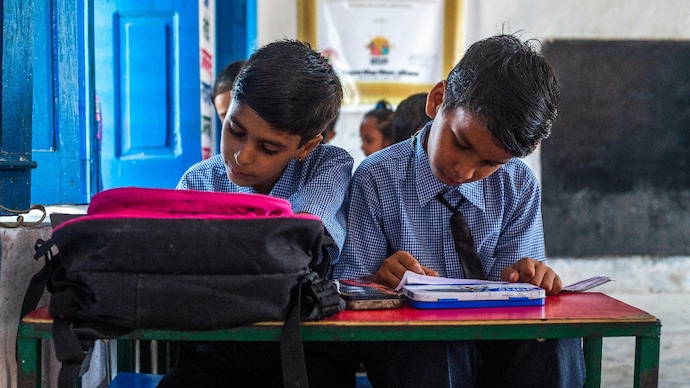
The Kendriya Vidyalaya Sangathan (Kendriya Vidyalaya Sangathan) has made it compulsory for all its schools to maintain at least one Sanskrit section in Classes 6 and 9.
The decision will be implemented from the 2026-27 academic session under the third-language framework (R3), as outlined in an official circular issued on May 29.
HOW THE LANGUAGE RULE WORKS
According to the circular, the third language for students must be either Sanskrit or a regional or state language from the list of scheduled languages. This will be in addition to R1 (Hindi) and R2 (English).
A senior official explained, "Students can opt for either Sanskrit or the regional language based on their preference. The requirement is only that there should be at least one Sanskrit section in every school to facilitate the children of transferable employees."
The KVS has also directed schools to complete the process of collecting language preferences from students and parents for the R3 framework.
DATA, PORTALS AND CLASSROOM STRUCTURE
Schools have been asked to upload student preferences for Sanskrit and regional languages separately on the Samagam portal. This data will be used to reassess staffing and section requirements at the school level.
The circular further states, "Students opting for the same R3 language must be kept in same section for the smooth conduct of classes."
Section formation will depend on enrolment:
Single section schools may split Sanskrit and regional language batches if at least 15 students opt in
- advertisement
Two-section schools may have one Sanskrit and one regional-language section
Three-section schools will decide distribution based on demand
Every school must still ensure at least one Sanskrit section per class
ALIGNING WITH NEP 2020
The move aligns with broader reforms under the National Education Policy (National Education Policy 2020) and the National Curriculum Framework for School Education 2023.
The Central Board of Secondary Education (Central Board of Secondary Education) has also introduced parallel changes, making three languages compulsory for Class 9 students from July 1, including at least two Indian languages.
Foreign languages can be chosen only as an additional option, and no board exam will be conducted for the third language at Class 10 level.
Till dedicated textbooks are introduced, Class 9 students will continue using Class 8 R3 textbooks for the 2026-27 session.
(With PTI inputs)
The Kendriya Vidyalaya Sangathan (Kendriya Vidyalaya Sangathan) has made it compulsory for all its schools to maintain at least one Sanskrit section in Classes 6 and 9.
The decision will be implemented from the 2026-27 academic session under the third-language framework (R3), as outlined in an official circular issued on May 29.
HOW THE LANGUAGE RULE WORKS
According to the circular, the third language for students must be either Sanskrit or a regional or state language from the list of scheduled languages. This will be in addition to R1 (Hindi) and R2 (English).
A senior official explained, "Students can opt for either Sanskrit or the regional language based on their preference. The requirement is only that there should be at least one Sanskrit section in every school to facilitate the children of transferable employees."
The KVS has also directed schools to complete the process of collecting language preferences from students and parents for the R3 framework.
DATA, PORTALS AND CLASSROOM STRUCTURE
Schools have been asked to upload student preferences for Sanskrit and regional languages separately on the Samagam portal. This data will be used to reassess staffing and section requirements at the school level.
The circular further states, "Students opting for the same R3 language must be kept in same section for the smooth conduct of classes."
Section formation will depend on enrolment:
Single section schools may split Sanskrit and regional language batches if at least 15 students opt in
Two-section schools may have one Sanskrit and one regional-language section
Three-section schools will decide distribution based on demand
Every school must still ensure at least one Sanskrit section per class
ALIGNING WITH NEP 2020
The move aligns with broader reforms under the National Education Policy (National Education Policy 2020) and the National Curriculum Framework for School Education 2023.
The Central Board of Secondary Education (Central Board of Secondary Education) has also introduced parallel changes, making three languages compulsory for Class 9 students from July 1, including at least two Indian languages.
Foreign languages can be chosen only as an additional option, and no board exam will be conducted for the third language at Class 10 level.
Till dedicated textbooks are introduced, Class 9 students will continue using Class 8 R3 textbooks for the 2026-27 session.
(With PTI inputs)

