Inside Jamia protest: AMU, JNU, Umar Khalid and the fight for student unions
What began on October 11 as a demand for student union elections and detained protesters' release has escalated into a Jamia standoff. With classes online until November 24, India Today goes to the ground to understand students' demands and the deadlock.
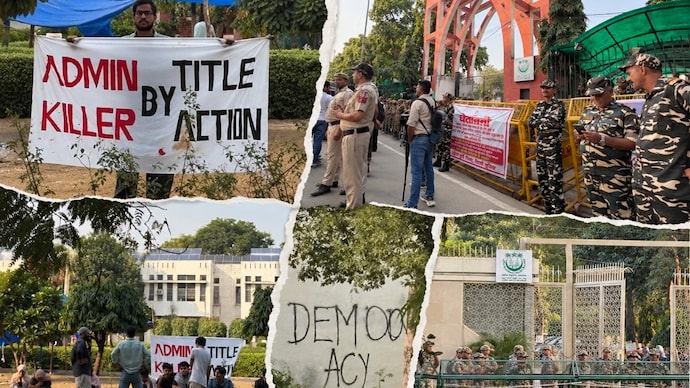
When I walked into Jamia Millia Islamia on Wednesday, I stepped onto a campus where a demand for something as fundamental as student representation had turned into a prolonged standoff with the administration.
Students want their union back. Jamia has not held student union elections since 2006, and what might ordinarily have been a debate over campus democracy has escalated into hunger strikes, police deployment, disciplinary action, and disrupted classes.
As I followed the developments on campus, the focus extended beyond the timeline for student union elections to the terms of the proposed agreement between students and the administration. With differences persisting over the process, questions remain about resolving the dispute and resuming regular academic activities.
At Gate No. 7, near the administrative block, students continued their protest, demanding a students' union, elections and the release of detained protesters. They have also sought the proctor's resignation, accusing him, in conversations with India Today, of following instructions rather than exercising independent judgment.
Their argument extends beyond Jamia. If Jawaharlal Nehru University (JNU) and Aligarh Muslim University (AMU) have student unions, they ask, why should Jamia remain without one? Protesters have also voiced support for student unions and elections at IITs and private universities across the country.
The demand is rooted in a long-standing grievance. Jamia has gone without student union elections since 2006, leaving students without an elected union for nearly two decades. The current agitation has included two hunger strikes that began on October 11, with protesters gathering near the statue of Mirza Ghalib to press for the restoration of student representation.
But the path to a resolution has proved far from straightforward.
On October 26, students again found themselves at odds with the administration led by Vice-Chancellor Professor Mazhar Asif. Although a draft committee had been formed and December 20 set as a deadline in the proposed arrangement, protesters said their concerns remained unresolved.
They wanted an official notification guaranteeing the election process, along with an assurance that elections would not be held up by further approval requirements once the deadline passed.
The agreement and the dispute surrounding it soon became another flashpoint. The truce proved short-lived, with students questioning the circumstances in which the agreement had been signed. According to the protesters, the student who signed it on October 26 had spent several days participating in the agitation and was exhausted.
The disagreement has left the central question unanswered: can the administration and the protesting students reach a settlement that offers a clear, credible path to elections, rather than another temporary pause in the agitation?
(Here’s an evening at Jamia Millia Islamia, where the campus atmosphere reflects the growing tensions over the student union elections.)
Many protesters, they said, had been passing their nights in the open, exposed to mosquitoes and the weather. On the evening of October 27, hostel residents in hundreds marched through the campus with torches in solidarity.
Thereafter, fewer reports of vandalism appeared in the media.
THE SURVIVAL IN CAMPUS
In an exclusive conversation with India Today, a PhD scholar explained why he had joined the movement, which includes members of the All India Students’ Association (AISA) and the National Students’ Union of India (NSUI).
He spoke for the rights of minorities, as the institution widely represents them, and alleged that the current establishment is neglecting them.
Students at the protest site spoke of shortages of food, water, clothing and medicines. They said food was being brought in discreetly after the imposition of prohibitory orders under Section 163 of the BNSS.
Nivelle, a master’s student, said students were pooling their resources to sustain the agitation. “Students are coming together in solidarity, doing crowdfunding, and whatever little they have, they are directing towards the cause of the protest and our demands,” he said.
Lubaib, a PhD scholar at Jamia and part of the protest, alleged that the university had stopped supplies, saying, “The supplies have been completely stopped by the institute maybe to let us starve and die.”
Mantasha Irfan, a Jamia student and an AISA member, told us that women at the protest site lacked basic necessities. “We don't have pads, we don't have clothes because we have been caged by Delhi police and central forces,” Irfan said.
Barricades and police deployments were visible around several gates, including Gates 7, 8 and 13, as well as the Centenary Gate.
Some students, including members of AISA, were detained after attempting to enter the area, according to the protest account.
(A video of Gulistan-e-Ghalib, also known as Ghalib’s Garden, a memorial garden and building complex located on the campus of Jamia Millia Islamia.)
Meanwhile, the Jamia administration has moved classes online. In its latest announcement, Jamia extended online classes until November 24, while odd-semester examinations were also shifted online. Physical classes can only come back after January 12 next year.
The Department of Political Science, ordinarily a place for studying the workings of power. Gulistan-e-Ghalib, usually associated with the quiet of literature, stands amid a campus conversation that has turned from Ghalib to the demands of the present.
THE ADMINISTRATION'S POSITION
The administration, for its part, has defended its handling of the protest. Speaking to India Today, Jamia Millia Islamia’s official spokesperson said that senior teachers had met the students to hear their demands, but questioned their conduct.
“Very senior teachers from the institute voluntarily went out to talk to students to listen to their demands, whether they were complicit or not. For three to four hours, the teachers sat with the students, and despite that, this attitude had been shown by the students: vandalism, agitation, and mocking the professors. Is it justified?” she said.
The campus, meanwhile, has grown quiet. The paths on a century-old campus once filled with students now see fewer people, though staff continue their work.
The shift to online classes has raised concerns among students whose courses require practical training. Many living in paying guest accommodation and rented rooms have had little choice but to adjust to the change.
A first-year student of food production said, “It’s not good at all. My course is food production, all practical-based, and how can it be done online? There is no sense. I am already losing my precious time of studies.”
INSPIRED BY AMU AND JNU
Lubaib said the protesters drew inspiration from the student movements at AMU and JNU. Referring to developments at Aligarh, he said, “A few days back AMU was able to finally get what the students of a great institute deserve. They now have a union; elections will be held. Why can it not happen at Jamia? Our demand resonates with what Aligarh Muslim University was able to achieve.”
The example of AMU, he suggested, had strengthened the resolve of those who wanted a union and elections at Jamia.
The Jantar Mantar protest associated with CJP, which the students cite as an influence, has also shaped the thinking of some Jamia protesters.
The anti-CAA-NRC protests of 2019–20, too, remain a source of inspiration for some, including a young woman who spoke of the movement’s influence on her own resolve.
The same student referred to Umar Khalid and Neha Bora as influences. “Umar Khalid, Neha Bora have their imprints on me. The path they showed to us now is helping in taking our fight forward, and we shall not stop till our demands are met,” the student said.
The India Today team attempted to speak to officers leading the Delhi Police companies deployed in the area. The officers declined to comment, saying, “We are not authorised to utter a word here. We are only following our instructions.”
No further official clarification was shared with the team regarding the deployment. At the time of reporting, no statement from the Delhi Police or the Union Home Ministry had been made available to us addressing the application of BNSS 163 in the locality.
The Ministry of Education, which oversees the broader framework within which Jamia operates, had also not issued a statement available to the team on the students’ concerns and the disruption to their studies.
At Gate No. 7, the tent remains a visible reminder of the dispute. The university’s ordinary life has not disappeared, but it has been interrupted: students continue their studies online, residents have shown solidarity, and protesters remain divided from the administration over the way forward.
For now, the central question remains the one that brought students to the gate in the first place: when, and on what terms, will their demands for representation be answered?

