Krishna means river, not religion: NCERT denies bias in Class 6 Kannada textbook
NCERT has rejected allegations of religious and dietary bias in its Class 6 Kannada textbook, clarifying that "Krishna" refers to the river and not religion. The council said the book promotes balanced nutrition and inclusive learning aligned with NEP 2020.
The National Council of Educational Research and Training (NCERT) on Thursday rejected allegations that its newly released Class 6 Kannada R3 language textbook carries religious and dietary bias, saying criticism over both the book’s title and its treatment of food content is “baseless” and contrary to the actual text.
In a formal clarification, the curriculum body responded to concerns raised in sections of the media regarding the textbook’s title — Krishna — and claims that it promotes vegetarianism while excluding non-vegetarian food practices.
TITLE KRISHNA REFERS TO RIVER, NOT RELIGION
Addressing the first objection, NCERT said the title Krishna refers to the Krishna River and is in line with its established naming convention for R3 language textbooks, all of which are named after Indian rivers.
The council said the Hindi textbook is titled Ganga, the English textbook Kaveri, and the Urdu textbook Jamuna — a transliterated form of Yamuna. The Kannada textbook, it said, was similarly named after the Krishna River, which has deep geographical and cultural relevance to Karnataka.
NCERT said the naming approach aligns with the National Education Policy (NEP) 2020 and the National Curriculum Framework for School Education (NCF-SE) 2023, both of which emphasise contextual and culturally rooted learning.
NO BIAS IN FOOD CHAPTER
NCERT also dismissed allegations that the textbook promotes vegetarianism at the expense of non-vegetarian food traditions.
According to the council, the issue is addressed in Chapter 6, Health is Wealth, which introduces students to the idea of a balanced diet, along with exercise and cleanliness, as essential components of good health.
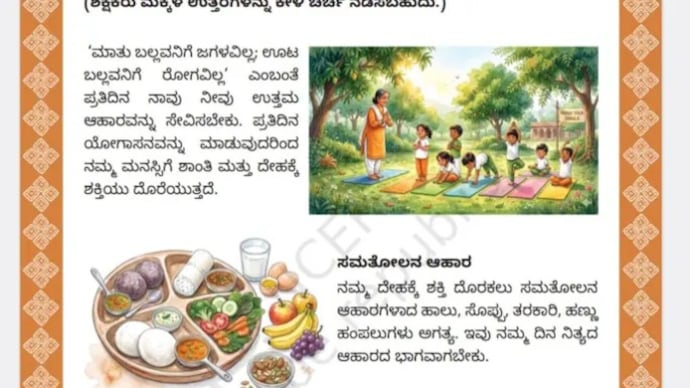
The chapter includes a section titled Balanced Diet on page 63, which explains that the body requires milk, green leafy vegetables, fruits, and other food items as part of everyday nutrition. NCERT noted that the accompanying illustration on the same page depicts both vegetarian and non-vegetarian food items.
The chapter also references traditional healthy foods from different Indian states, linking nutrition education to the country’s diverse food practices. Students are also asked, “What is a balanced diet?” — a question NCERT said reinforces an inclusive understanding of food rather than privileging any one dietary practice.
“Nowhere in the textbook is vegetarianism explained or justified, nor is non-vegetarian food opposed,” NCERT said in its statement, adding that the objective of the lesson is simply to build awareness about healthy eating.
CLARIFICATION COMES AMID WIDER TEXTBOOK SCRUTINY
The clarification comes amid heightened public scrutiny of changes in school curricula, with NCERT and other educational bodies increasingly facing questions over the ideological framing of textbook content.
By citing specific chapters, page references, and illustrations from the textbook, NCERT appeared to make a pointed attempt to counter what it described as misleading interpretations ahead of the academic session.
The council said it remains committed to producing “high-quality and inclusive” learning material and welcomed constructive feedback from stakeholders as it continues to develop textbooks in line with NEP 2020 and NCF-SE 2023.
The National Council of Educational Research and Training (NCERT) on Thursday rejected allegations that its newly released Class 6 Kannada R3 language textbook carries religious and dietary bias, saying criticism over both the book’s title and its treatment of food content is “baseless” and contrary to the actual text.
In a formal clarification, the curriculum body responded to concerns raised in sections of the media regarding the textbook’s title — Krishna — and claims that it promotes vegetarianism while excluding non-vegetarian food practices.
TITLE KRISHNA REFERS TO RIVER, NOT RELIGION
Addressing the first objection, NCERT said the title Krishna refers to the Krishna River and is in line with its established naming convention for R3 language textbooks, all of which are named after Indian rivers.
The council said the Hindi textbook is titled Ganga, the English textbook Kaveri, and the Urdu textbook Jamuna — a transliterated form of Yamuna. The Kannada textbook, it said, was similarly named after the Krishna River, which has deep geographical and cultural relevance to Karnataka.
NCERT said the naming approach aligns with the National Education Policy (NEP) 2020 and the National Curriculum Framework for School Education (NCF-SE) 2023, both of which emphasise contextual and culturally rooted learning.
NO BIAS IN FOOD CHAPTER
NCERT also dismissed allegations that the textbook promotes vegetarianism at the expense of non-vegetarian food traditions.
According to the council, the issue is addressed in Chapter 6, Health is Wealth, which introduces students to the idea of a balanced diet, along with exercise and cleanliness, as essential components of good health.
The chapter includes a section titled Balanced Diet on page 63, which explains that the body requires milk, green leafy vegetables, fruits, and other food items as part of everyday nutrition. NCERT noted that the accompanying illustration on the same page depicts both vegetarian and non-vegetarian food items.
The chapter also references traditional healthy foods from different Indian states, linking nutrition education to the country’s diverse food practices. Students are also asked, “What is a balanced diet?” — a question NCERT said reinforces an inclusive understanding of food rather than privileging any one dietary practice.
“Nowhere in the textbook is vegetarianism explained or justified, nor is non-vegetarian food opposed,” NCERT said in its statement, adding that the objective of the lesson is simply to build awareness about healthy eating.
CLARIFICATION COMES AMID WIDER TEXTBOOK SCRUTINY
The clarification comes amid heightened public scrutiny of changes in school curricula, with NCERT and other educational bodies increasingly facing questions over the ideological framing of textbook content.
By citing specific chapters, page references, and illustrations from the textbook, NCERT appeared to make a pointed attempt to counter what it described as misleading interpretations ahead of the academic session.
The council said it remains committed to producing “high-quality and inclusive” learning material and welcomed constructive feedback from stakeholders as it continues to develop textbooks in line with NEP 2020 and NCF-SE 2023.

