Sanitary pad checks, bra inspections: NEET students share shocking frisking stories
After a Re-NEET candidate alleged she was asked to lower her pants to prove she was wearing a sanitary pad, dozens of students flooded social media comments with similar accounts. Their stories raise troubling questions about exam security, personal dignity, and the mental health impact of invasive frisking practices.
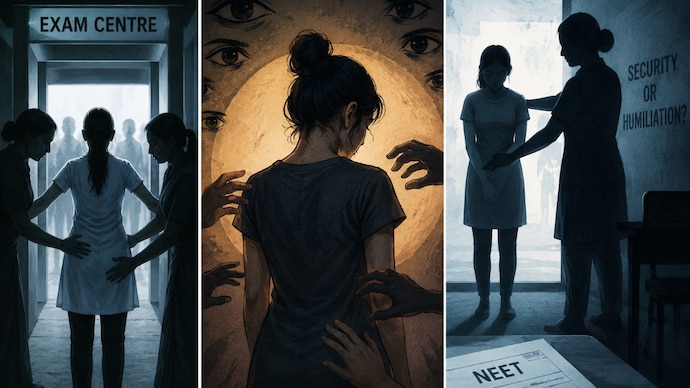
When Hrishika Pal sat down for her Re-NEET examination, she should have been thinking about biology formulas, chemistry reactions and the future she had spent years preparing for.
Instead, she says she was trying to process what had just happened at the security checkpoint.
In a social media post that has now triggered widespread outrage, Hrishika alleged that she was asked whether she was on her period during frisking at her examination centre at Malda Bibhutibhusan High School, West Bengal.
After she answered yes, she says a female staff member instructed her to lower her pants so her sanitary pad could be inspected.
"I felt shocked, embarrassed and powerless to refuse because, like any candidate, I feared that non-compliance could affect my entry into the examination hall," she wrote.
The controversy first gained attention after doctor and educator Dr Nachiket Bhatia highlighted the account of a Re-NEET candidate from West Bengal on social media. But after Hrishika herself shared the experience on Instagram, the post quickly went viral.
And what happened next showed it wasn’t an isolated event.
Beneath her post, hundreds of comments have now transformed the story from one student's account into a wider conversation about where examination security ends and personal dignity begins.
She added in her post that she was sharing the experience because she wanted answers.
"Was this procedure officially permitted? Are other students experiencing the same thing? If this is considered normal, then there needs to be a serious discussion about where we draw the line between security and personal dignity,” she wrote.
In the caption accompanying her post, Hrishika also stated that she had spoken to several female candidates from other Re-NEET centres and found that many had not experienced similar checks.
"I spoke to several female candidates who appeared for Re-NEET at different examination centres. None of them were asked whether they were on their periods, nor were they subjected to this kind of inspection,” she wrote.
She added that, based on what she observed, the checks at her centre appeared to be directed specifically at students who disclosed that they were menstruating.
"From what I observed at my centre, these checks appeared to be carried out specifically on students who said they were menstruating,” she wrote.
THE COMMENTS SUGGEST A MUCH LARGER ISSUE
What makes this story difficult to ignore is the volume of similar accounts that followed.
Dozens of commenters claimed they had faced comparable experiences during NEET, Re-NEET, CUET, SSC and other examinations.
One student wrote: "Yesterday with me same thing happened... my centre was Beleghata Santi Sangha Girls' School. Even I told them I am feeling uncomfortable still they wanted me to lower my pants."
Another claimed: "It happened with me too and even many of my friends, they had put their hands inside not only clothes but also undergarments both above and below."
A candidate alleged: "The way they were touching my breasts... I was literally stunned."
One commenter claimed: "I was forced to remove my inner garment because it had hook at the back."
Another wrote: "At my centre the female staff was putting her hands inside the bra to check the female candidates."
One candidate said: "A police officer (female) literally groped my breasts in the name of checking."
Several comments specifically linked the frisking to menstruation.
"Last year I was on my periods during NEET and my centre was Sahapur high school, Malda. I was asked the same question."
Another wrote: "Girl same thing happened to me too. They ask whether am i on my periods or not."
One commenter alleged that staff checked whether she was "truly bleeding or not".
Another said: "Today I was also in my periods and they check it like hath se check."
One of the most striking comments came from a student who wrote: "My body and mind FROZE before my exam."
THE INVISIBLE COST OF HUMILIATION
The discussion is not only about privacy. It is also about psychology.
Research in trauma psychology shows that experiences involving forced exposure, unwanted touching, loss of bodily autonomy and public humiliation can trigger acute stress responses. These responses can include dissociation, panic, racing thoughts, emotional numbness, trembling, memory lapses and difficulty concentrating.
For students sitting one of the most competitive examinations in the country, those reactions can directly affect performance.
Many candidates in the comments described feeling "violated", "embarrassed", "traumatised", "disgusted" and "unsafe".
One student wrote: "I was more concerned about covering my chest than focusing on attempting the paper properly."
Another said: "I felt so nasty during the whole exam."
A third wrote: "How is someone supposed to give their best in the most important exam of their life right after such an incident happens to them?"
The impact could be even greater for students with a history of sexual harassment, molestation, assault or other forms of trauma.
Mental health experts often note that situations involving unexpected touching of intimate areas, being ordered to remove clothing, or being placed in a powerless position by authority figures can trigger memories associated with previous trauma.
The body does not always distinguish between a past traumatic experience and a present situation that feels similar. For some survivors, the reaction can be immediate.
Heart rate rises. Attention narrows. The brain shifts from problem-solving mode to survival mode.
That is the exact opposite of the mental state required for a high-stakes exam.
WHERE SHOULD THE LINE BE?
Interestingly, not all candidates reported similar experiences.
Several women commented that they were on their periods during NEET or Re-NEET and were never questioned about menstruation.
Others said they underwent routine pat-down checks that felt professional and respectful.
That contrast may be the most important clue in the entire story.
If some centres managed security checks without candidates feeling humiliated, why did others reportedly cross boundaries that students describe as invasive?
Nobody is arguing against security.
But many students are asking the same question.
If airports, courts, government buildings and even international borders can conduct security screening without requiring candidates to expose intimate parts of their bodies, where exactly should the line be drawn in the name of examination security?
When Hrishika Pal sat down for her Re-NEET examination, she should have been thinking about biology formulas, chemistry reactions and the future she had spent years preparing for.
Instead, she says she was trying to process what had just happened at the security checkpoint.
In a social media post that has now triggered widespread outrage, Hrishika alleged that she was asked whether she was on her period during frisking at her examination centre at Malda Bibhutibhusan High School, West Bengal.
After she answered yes, she says a female staff member instructed her to lower her pants so her sanitary pad could be inspected.
"I felt shocked, embarrassed and powerless to refuse because, like any candidate, I feared that non-compliance could affect my entry into the examination hall," she wrote.
The controversy first gained attention after doctor and educator Dr Nachiket Bhatia highlighted the account of a Re-NEET candidate from West Bengal on social media. But after Hrishika herself shared the experience on Instagram, the post quickly went viral.
And what happened next showed it wasn’t an isolated event.
Beneath her post, hundreds of comments have now transformed the story from one student's account into a wider conversation about where examination security ends and personal dignity begins.
She added in her post that she was sharing the experience because she wanted answers.
"Was this procedure officially permitted? Are other students experiencing the same thing? If this is considered normal, then there needs to be a serious discussion about where we draw the line between security and personal dignity,” she wrote.
In the caption accompanying her post, Hrishika also stated that she had spoken to several female candidates from other Re-NEET centres and found that many had not experienced similar checks.
"I spoke to several female candidates who appeared for Re-NEET at different examination centres. None of them were asked whether they were on their periods, nor were they subjected to this kind of inspection,” she wrote.
She added that, based on what she observed, the checks at her centre appeared to be directed specifically at students who disclosed that they were menstruating.
"From what I observed at my centre, these checks appeared to be carried out specifically on students who said they were menstruating,” she wrote.
THE COMMENTS SUGGEST A MUCH LARGER ISSUE
What makes this story difficult to ignore is the volume of similar accounts that followed.
Dozens of commenters claimed they had faced comparable experiences during NEET, Re-NEET, CUET, SSC and other examinations.
One student wrote: "Yesterday with me same thing happened... my centre was Beleghata Santi Sangha Girls' School. Even I told them I am feeling uncomfortable still they wanted me to lower my pants."
Another claimed: "It happened with me too and even many of my friends, they had put their hands inside not only clothes but also undergarments both above and below."
A candidate alleged: "The way they were touching my breasts... I was literally stunned."
One commenter claimed: "I was forced to remove my inner garment because it had hook at the back."
Another wrote: "At my centre the female staff was putting her hands inside the bra to check the female candidates."
One candidate said: "A police officer (female) literally groped my breasts in the name of checking."
Several comments specifically linked the frisking to menstruation.
"Last year I was on my periods during NEET and my centre was Sahapur high school, Malda. I was asked the same question."
Another wrote: "Girl same thing happened to me too. They ask whether am i on my periods or not."
One commenter alleged that staff checked whether she was "truly bleeding or not".
Another said: "Today I was also in my periods and they check it like hath se check."
One of the most striking comments came from a student who wrote: "My body and mind FROZE before my exam."
THE INVISIBLE COST OF HUMILIATION
The discussion is not only about privacy. It is also about psychology.
Research in trauma psychology shows that experiences involving forced exposure, unwanted touching, loss of bodily autonomy and public humiliation can trigger acute stress responses. These responses can include dissociation, panic, racing thoughts, emotional numbness, trembling, memory lapses and difficulty concentrating.
For students sitting one of the most competitive examinations in the country, those reactions can directly affect performance.
Many candidates in the comments described feeling "violated", "embarrassed", "traumatised", "disgusted" and "unsafe".
One student wrote: "I was more concerned about covering my chest than focusing on attempting the paper properly."
Another said: "I felt so nasty during the whole exam."
A third wrote: "How is someone supposed to give their best in the most important exam of their life right after such an incident happens to them?"
The impact could be even greater for students with a history of sexual harassment, molestation, assault or other forms of trauma.
Mental health experts often note that situations involving unexpected touching of intimate areas, being ordered to remove clothing, or being placed in a powerless position by authority figures can trigger memories associated with previous trauma.
The body does not always distinguish between a past traumatic experience and a present situation that feels similar. For some survivors, the reaction can be immediate.
Heart rate rises. Attention narrows. The brain shifts from problem-solving mode to survival mode.
That is the exact opposite of the mental state required for a high-stakes exam.
WHERE SHOULD THE LINE BE?
Interestingly, not all candidates reported similar experiences.
Several women commented that they were on their periods during NEET or Re-NEET and were never questioned about menstruation.
Others said they underwent routine pat-down checks that felt professional and respectful.
That contrast may be the most important clue in the entire story.
If some centres managed security checks without candidates feeling humiliated, why did others reportedly cross boundaries that students describe as invasive?
Nobody is arguing against security.
But many students are asking the same question.
If airports, courts, government buildings and even international borders can conduct security screening without requiring candidates to expose intimate parts of their bodies, where exactly should the line be drawn in the name of examination security?

