Back to the Stone Age: The ancient metaphor behind Trump's modern war threat
Donald Trump has threatened to push Iran "back to the Stone Age", a striking choice of words for a region that once cradled the world's earliest civilisations. But what does that phrase actually mean in modern warfare? Why the Stone Age, and not any other point in history? And what does this language reveal about how wars are imagined today?
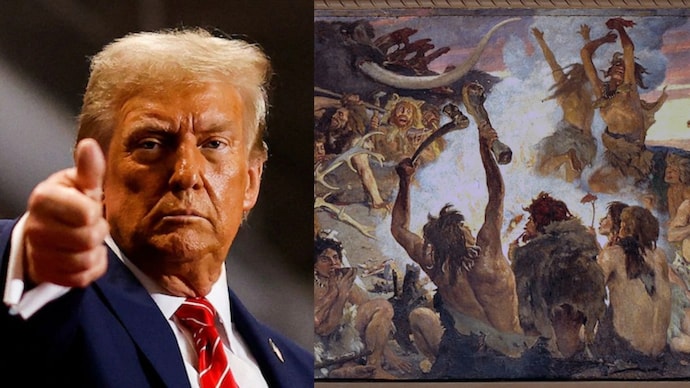
US President Donald Trump has revived a phrase that feels both ancient and unsettling. Speaking about Iran, he said the United States would step back only after the country had been pushed “into the Stone Age” long enough to stop it from building nuclear weapons.
The words sound primitive, but in modern warfare they carry a precise meaning. This is not about caves or stone tools. It is about overwhelming force, targeting infrastructure, power systems, military bases and nuclear facilities so extensively that a country cannot recover quickly.
In effect, it signals something more than a military strike. It points to the idea of setting a nation back by decades.
That is what makes the phrase so striking.
Because Iran lies in a region that once gave rise to some of the world’s earliest civilisations, where cities, systems and organised life first began to take shape.
To threaten to send it “back to the Stone Age” is not just a warning of war.
It is a warning of collapse.
And it is here that the historical irony becomes impossible to ignore.
The Sumerian civilisation, which arose in the broader Mesopotamian world across much of present-day West Asia, marked one of the earliest known phases of organised urban existence. Here, some of humanity’s first experiments with settlement, administration, surplus, and record-keeping began to take visible form.
Shaped by developments that began in the later Stone Age and matured through the first settled communities, this region contributed to the transition from survival to society. In that sense, it gave the ancient world some of its earliest civilisational templates, making the phrase “Stone Age” feel historically crude when used for a land so deeply tied to the origins of organised human life.
WHAT DOES 'STONE AGE' ACTUALLY MEAN?
The land that is now Iran, shaped by Persian culture, has remained inhabited for thousands of years and has seen continuous phases of human development.
Long before the rise of European societies, and far earlier than the modern history of the United States, this region was already part of an evolving human landscape where early forms of settlement and culture were taking root.
Its story stretches back to the Stone Age, a period roughly between 300,000 BCE and 3000 BCE, when early human ancestors primarily used tools made of stone.
This long phase of history is broadly divided into three stages, each marking a shift in how humans lived, adapted, and organised their lives over time.
Historians usually divide it into three broad phases:
Palaeolithic (Old Stone Age)
Mesolithic (Middle Stone Age)
Neolithic (New Stone Age)
This was the period when human life slowly began to change in a big way. For a long time, people survived by hunting animals and gathering whatever nature offered. But over time, some communities began moving towards farming and food production.
The Stone Age was also not a world of modern humans alone.
People of that time shared the planet with other human species that are now extinct, such as the Neanderthals and Denisovans. It was a long phase in human history when the foundations of settled life and, much later, early civilisations began to emerge.
In the earlier parts of this age, most people lived in caves, rock shelters, or simple huts.
They were mostly hunters and gatherers, moving from one place to another in search of food and safety. Farming, trade, and organised settlement were still limited for much of this period.
The tools they used were basic but important. Stone and bone tools, along with rough axes and sharp-edged implements, were used for hunting birds and animals, cutting meat, and carrying out daily survival tasks.
Humans were also constantly on the move. Groups migrated across different parts of the world over thousands of years. While Africa and West Asia remained major centres of early human life, regions such as Europe and the Far East gradually began to see new settlements and movement of people.
THE REGION WHERE CITIES WERE BORN
The irony is difficult to miss. The region that is today discussed in the language of missiles, nuclear capability and military strikes is also one of the places where settled human civilisation first began to take shape.
In Mesopotamia, between the Tigris and Euphrates rivers, the Sumerians built some of the world’s earliest known cities around 4500 to 3000 BCE. Places like Ur and Uruk were not just settlements, but early urban centres where humans began organising life in a new way.
They developed irrigation systems, managed resources, built institutions and are widely credited with one of the earliest writing systems, cuneiform. This civilisational belt lay close to the wider region that would later become associated with ancient Persia.
To the west, along the Nile, ancient Egypt was also taking shape.
There, life was organised around the river, farming cycles, state authority and systems of record-keeping. Egypt showed how a civilisation could be built not only through power, but through control over water, land and labour.
Further east, the Indus Valley Civilisation emerged in the northwestern part of the Indian subcontinent around 2600 BCE.
Cities like Harappa and Mohenjo-daro were marked by planning, drainage systems, standardised brick structures and long-distance trade. This was one of the earliest examples of an organised urban civilisation in South Asia.
Whether one looks at the Sumerian civilisation or the broader Mesopotamian history, this region witnessed human advancement much earlier than many others.
\That is what makes the US President’s remark about pushing such a country “back to the Stone Age” appear even more unsettling, especially for a land with such a long civilisational memory.
In an era of AI and precision warfare, the language hasn’t evolved nearly as much. Because the most powerful threat still isn’t to win a war, it is to wipe a civilisation off the map.
US President Donald Trump has revived a phrase that feels both ancient and unsettling. Speaking about Iran, he said the United States would step back only after the country had been pushed “into the Stone Age” long enough to stop it from building nuclear weapons.
The words sound primitive, but in modern warfare they carry a precise meaning. This is not about caves or stone tools. It is about overwhelming force, targeting infrastructure, power systems, military bases and nuclear facilities so extensively that a country cannot recover quickly.
In effect, it signals something more than a military strike. It points to the idea of setting a nation back by decades.
That is what makes the phrase so striking.
Because Iran lies in a region that once gave rise to some of the world’s earliest civilisations, where cities, systems and organised life first began to take shape.
To threaten to send it “back to the Stone Age” is not just a warning of war.
It is a warning of collapse.
And it is here that the historical irony becomes impossible to ignore.
The Sumerian civilisation, which arose in the broader Mesopotamian world across much of present-day West Asia, marked one of the earliest known phases of organised urban existence. Here, some of humanity’s first experiments with settlement, administration, surplus, and record-keeping began to take visible form.
Shaped by developments that began in the later Stone Age and matured through the first settled communities, this region contributed to the transition from survival to society. In that sense, it gave the ancient world some of its earliest civilisational templates, making the phrase “Stone Age” feel historically crude when used for a land so deeply tied to the origins of organised human life.
WHAT DOES 'STONE AGE' ACTUALLY MEAN?
The land that is now Iran, shaped by Persian culture, has remained inhabited for thousands of years and has seen continuous phases of human development.
Long before the rise of European societies, and far earlier than the modern history of the United States, this region was already part of an evolving human landscape where early forms of settlement and culture were taking root.
Its story stretches back to the Stone Age, a period roughly between 300,000 BCE and 3000 BCE, when early human ancestors primarily used tools made of stone.
This long phase of history is broadly divided into three stages, each marking a shift in how humans lived, adapted, and organised their lives over time.
Historians usually divide it into three broad phases:
Palaeolithic (Old Stone Age)
Mesolithic (Middle Stone Age)
Neolithic (New Stone Age)
This was the period when human life slowly began to change in a big way. For a long time, people survived by hunting animals and gathering whatever nature offered. But over time, some communities began moving towards farming and food production.
The Stone Age was also not a world of modern humans alone.
People of that time shared the planet with other human species that are now extinct, such as the Neanderthals and Denisovans. It was a long phase in human history when the foundations of settled life and, much later, early civilisations began to emerge.
In the earlier parts of this age, most people lived in caves, rock shelters, or simple huts.
They were mostly hunters and gatherers, moving from one place to another in search of food and safety. Farming, trade, and organised settlement were still limited for much of this period.
The tools they used were basic but important. Stone and bone tools, along with rough axes and sharp-edged implements, were used for hunting birds and animals, cutting meat, and carrying out daily survival tasks.
Humans were also constantly on the move. Groups migrated across different parts of the world over thousands of years. While Africa and West Asia remained major centres of early human life, regions such as Europe and the Far East gradually began to see new settlements and movement of people.
THE REGION WHERE CITIES WERE BORN
The irony is difficult to miss. The region that is today discussed in the language of missiles, nuclear capability and military strikes is also one of the places where settled human civilisation first began to take shape.
In Mesopotamia, between the Tigris and Euphrates rivers, the Sumerians built some of the world’s earliest known cities around 4500 to 3000 BCE. Places like Ur and Uruk were not just settlements, but early urban centres where humans began organising life in a new way.
They developed irrigation systems, managed resources, built institutions and are widely credited with one of the earliest writing systems, cuneiform. This civilisational belt lay close to the wider region that would later become associated with ancient Persia.
To the west, along the Nile, ancient Egypt was also taking shape.
There, life was organised around the river, farming cycles, state authority and systems of record-keeping. Egypt showed how a civilisation could be built not only through power, but through control over water, land and labour.
Further east, the Indus Valley Civilisation emerged in the northwestern part of the Indian subcontinent around 2600 BCE.
Cities like Harappa and Mohenjo-daro were marked by planning, drainage systems, standardised brick structures and long-distance trade. This was one of the earliest examples of an organised urban civilisation in South Asia.
Whether one looks at the Sumerian civilisation or the broader Mesopotamian history, this region witnessed human advancement much earlier than many others.
\That is what makes the US President’s remark about pushing such a country “back to the Stone Age” appear even more unsettling, especially for a land with such a long civilisational memory.
In an era of AI and precision warfare, the language hasn’t evolved nearly as much. Because the most powerful threat still isn’t to win a war, it is to wipe a civilisation off the map.

