How the Ivy League was born: The fascinating history of America's elite universities
The Ivy League began as an athletic grouping among historic northeastern universities, not an academic alliance. Its evolution from sports label to prestige marker still shapes how the world views elite US education.
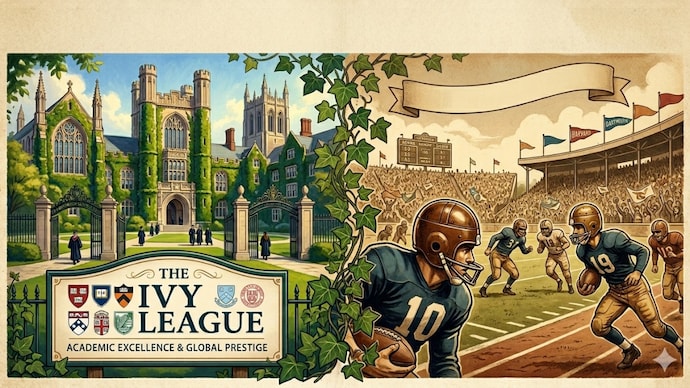
When conversations drift toward studying abroad, one phrase almost inevitably enters the room: the Ivy League.
For decades, these eight American universities have occupied a near-mythical place in the global imagination. To students, they represent academic excellence. To parents, they symbolise opportunity. To the wider world, they evoke images of ivy-covered buildings, centuries-old traditions, groundbreaking discoveries, and alumni who have gone on to shape politics, business, science, and culture.
The Ivy League has become more than a collection of universities; it is a global brand. For many ambitious students, an acceptance letter from one of these institutions is seen not merely as admission to a university, but as an entry into an exclusive network of influence, prestige, and possibility.
Yet the story of the Ivy League is far more surprising than many realise.
The origins of the term can be traced back to October 1933, when sportswriter Stanley Woodward used the phrase “ivy colleges” while describing a group of historic northeastern institutions that regularly competed against one another in athletics. What started as a casual reference to universities whose buildings were literally covered in ivy slowly evolved into something much larger. Over time, an athletic association transformed into a powerful symbol of educational prestige, one recognised far beyond the borders of the United States.
Today, the words “Ivy League” instantly conjure images of elite education and fierce competition. But before it became synonymous with academic excellence, it was simply a sporting label attached to a handful of old universities with shared traditions and rivalries.
So how did an athletic grouping become the most famous name in higher education? Before diving into that fascinating history, here is a closer look at the eight institutions that together form the Ivy League today.
THE EIGHT IVY LEAGUE UNIVERSITIES
| Name of the institute | Establishment year | QS World University Ranking 2026 |
| Harvard University | 1636 | 5th |
| Yale University | 1701 | 21th |
| University of Pennsylvania | 1740 | 15th |
| Princeton University | 1746 | 25th |
| Columbia University | 1754 | 38th |
| Brown University | 1764 | 69th |
| Dartmouth College | 1769 | 247th |
| Cornell University | 1865 | 16th |
THE CURIOUS ORIGINS OF THE IVE LEAGUE
The term "Ivy League" emerged from a combination of campus tradition and sports journalism.
The "ivy" portion is believed to have originated from a popular 19th-century tradition known as "planting the ivy." At many American colleges, graduating seniors would plant ivy on campus grounds as a symbol of endurance, growth, and a lasting connection to their alma mater. The custom became so widespread that many institutions celebrated an annual "Ivy Day."
The word "league," meanwhile, entered the picture through sportswriter Stanley Woodward, who used the phrase "ivy colleges" in an article published in the New York Herald Tribune on October 16, 1933. The label was initially intended to describe a collection of prestigious northeastern universities that regularly competed against one another in athletics.
FROM FOOTBALL TO A FORMAL LEAGUE
The concept quickly gained momentum. In 1936, The Daily Princetonian reprinted a Cornell Sun editorial advocating the creation of an "Ivy League" consisting of Cornell, Yale, Princeton, Dartmouth, Columbia, Pennsylvania, and Harvard. Brown was notably absent from the original proposal.
A decade later, in September 1946, administrators of the eight institutions formalised their cooperation through what became known as the Ivy Group Agreement. Their concern was not academic rankings but the growing commercialisation of college sports, particularly football.
As college athletics increasingly attracted national attention and television audiences, the universities sought to establish a different model. They wanted their institutions to remain places where athletes were students first and competitors second. The goal was to ensure that sports remained part of a broader educational experience rather than a professional enterprise driven by recruitment and financial incentives.
The agreement emphasised that student-athletes should be admitted based on academic merit and participate in sports as part of their overall education, rather than being recruited solely for their athletic abilities.
THE EVOLUTION OF THE IVY LEAGUE
In 1954, the agreement was expanded to cover all intercollegiate sports. Two years later, during the 1956–57 academic year, the Ivy League officially began operating as an athletic conference.
Ironically, a league created to regulate college sports would eventually become synonymous with academic prestige around the world.
Today, the term "Ivy League" evokes images of historic campuses, highly selective admissions processes, groundbreaking research, and influential alumni networks. Yet its roots lie not in classrooms or laboratories, but on football fields and in a centuries-old tradition of planting ivy.
The legacy of those athletic and cultural connections continues today. Every year, typically in late March or early April, Ivy League institutions celebrate "Ivy Day" by releasing their undergraduate admission decisions—an event eagerly awaited by thousands of students across the globe hoping to join one of higher education's most exclusive clubs.
When conversations drift toward studying abroad, one phrase almost inevitably enters the room: the Ivy League.
For decades, these eight American universities have occupied a near-mythical place in the global imagination. To students, they represent academic excellence. To parents, they symbolise opportunity. To the wider world, they evoke images of ivy-covered buildings, centuries-old traditions, groundbreaking discoveries, and alumni who have gone on to shape politics, business, science, and culture.
The Ivy League has become more than a collection of universities; it is a global brand. For many ambitious students, an acceptance letter from one of these institutions is seen not merely as admission to a university, but as an entry into an exclusive network of influence, prestige, and possibility.
Yet the story of the Ivy League is far more surprising than many realise.
The origins of the term can be traced back to October 1933, when sportswriter Stanley Woodward used the phrase “ivy colleges” while describing a group of historic northeastern institutions that regularly competed against one another in athletics. What started as a casual reference to universities whose buildings were literally covered in ivy slowly evolved into something much larger. Over time, an athletic association transformed into a powerful symbol of educational prestige, one recognised far beyond the borders of the United States.
Today, the words “Ivy League” instantly conjure images of elite education and fierce competition. But before it became synonymous with academic excellence, it was simply a sporting label attached to a handful of old universities with shared traditions and rivalries.
So how did an athletic grouping become the most famous name in higher education? Before diving into that fascinating history, here is a closer look at the eight institutions that together form the Ivy League today.
THE EIGHT IVY LEAGUE UNIVERSITIES
| Name of the institute | Establishment year | QS World University Ranking 2026 |
| Harvard University | 1636 | 5th |
| Yale University | 1701 | 21th |
| University of Pennsylvania | 1740 | 15th |
| Princeton University | 1746 | 25th |
| Columbia University | 1754 | 38th |
| Brown University | 1764 | 69th |
| Dartmouth College | 1769 | 247th |
| Cornell University | 1865 | 16th |
THE CURIOUS ORIGINS OF THE IVE LEAGUE
The term "Ivy League" emerged from a combination of campus tradition and sports journalism.
The "ivy" portion is believed to have originated from a popular 19th-century tradition known as "planting the ivy." At many American colleges, graduating seniors would plant ivy on campus grounds as a symbol of endurance, growth, and a lasting connection to their alma mater. The custom became so widespread that many institutions celebrated an annual "Ivy Day."
The word "league," meanwhile, entered the picture through sportswriter Stanley Woodward, who used the phrase "ivy colleges" in an article published in the New York Herald Tribune on October 16, 1933. The label was initially intended to describe a collection of prestigious northeastern universities that regularly competed against one another in athletics.
FROM FOOTBALL TO A FORMAL LEAGUE
The concept quickly gained momentum. In 1936, The Daily Princetonian reprinted a Cornell Sun editorial advocating the creation of an "Ivy League" consisting of Cornell, Yale, Princeton, Dartmouth, Columbia, Pennsylvania, and Harvard. Brown was notably absent from the original proposal.
A decade later, in September 1946, administrators of the eight institutions formalised their cooperation through what became known as the Ivy Group Agreement. Their concern was not academic rankings but the growing commercialisation of college sports, particularly football.
As college athletics increasingly attracted national attention and television audiences, the universities sought to establish a different model. They wanted their institutions to remain places where athletes were students first and competitors second. The goal was to ensure that sports remained part of a broader educational experience rather than a professional enterprise driven by recruitment and financial incentives.
The agreement emphasised that student-athletes should be admitted based on academic merit and participate in sports as part of their overall education, rather than being recruited solely for their athletic abilities.
THE EVOLUTION OF THE IVY LEAGUE
In 1954, the agreement was expanded to cover all intercollegiate sports. Two years later, during the 1956–57 academic year, the Ivy League officially began operating as an athletic conference.
Ironically, a league created to regulate college sports would eventually become synonymous with academic prestige around the world.
Today, the term "Ivy League" evokes images of historic campuses, highly selective admissions processes, groundbreaking research, and influential alumni networks. Yet its roots lie not in classrooms or laboratories, but on football fields and in a centuries-old tradition of planting ivy.
The legacy of those athletic and cultural connections continues today. Every year, typically in late March or early April, Ivy League institutions celebrate "Ivy Day" by releasing their undergraduate admission decisions—an event eagerly awaited by thousands of students across the globe hoping to join one of higher education's most exclusive clubs.

