Gram Chikitsalay vs Panchayat: Why they feel same same, but different
Viewers quickly compared Gram Chikitsalay with Panchayat as another outsider-in-a-village story. The similarities end there, with one show centred on governance and the other on rural healthcare.
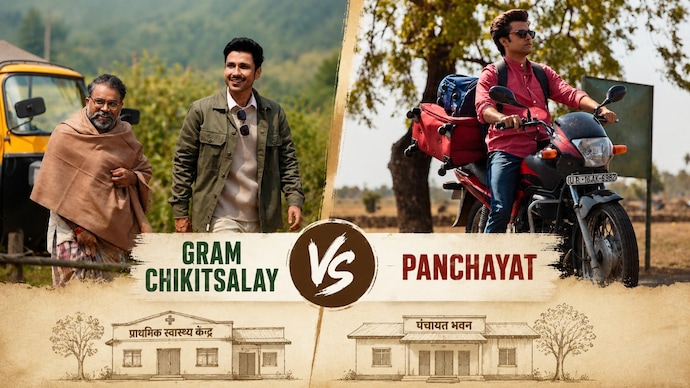
The moment TVF's Gram Chikitsalay arrived on screens, viewers began calling it Panchayat 2.0. A young urban professional lands in a rural setting, struggles to fit in, deals with quirky locals, and slowly becomes part of the community. Sounds familiar, doesn't it?
And yet, after two seasons of Gram Chikitsalay, it is becoming increasingly clear that while the two shows share the same DNA, they are trying to tell very different stories.
At first glance, both shows revolve around fish-out-of-water protagonists. In Panchayat, Abhishek Tripathi (Jitendra Kumar) is an engineering graduate who reluctantly takes up a secretary's job in Phulera because he has no better option. Our Sachiv ji (Abhishek) constantly dreams of leaving the village behind and finding a more fulfilling career.
Dr Prabhat Sinha (Amol Parashar) in Gram Chikitsalay is also an outsider. But unlike Abhishek, he chooses to be there. Coming from a privileged background, he willingly takes up the challenge of improving healthcare in rural India. And that single difference changes everything.
Abhishek is trying to escape village life. Prabhat is trying to improve it.
Governance versus healthcare
The biggest distinction between the two shows lies in their major concerns.
Panchayat is ultimately about governance. Roads, toilets, elections, bureaucracy, local politics and public administration form the backbone of the narrative. The village is almost a character in itself. Although fictional, the village of Phulera is quite famous now - from the Panchayat office, water tank to Pradhan's house, these are all familiar scenes.
Gram Chikitsalay, meanwhile, focusses on healthcare. Its battles are different. The show explores poor medical infrastructure, lack of medicines, superstition, mental health stigma and the distrust many villagers have towards formal healthcare systems.
While Panchayat asks how a village functions, Gram Chikitsalay asks why people continue to trust a local quack over a qualified doctor.
Both protagonists are idealists, but they operate differently. Abhishek survives by adapting. Over the seasons, he learns to navigate village politics and local relationships.
Prabhat, on the other hand, is quite stubborn, not willing to compromise. He refuses to use shortcuts and remains committed to doing things the right way, even when that makes his life harder. His biggest rival is not a politician or a bureaucrat, it is Chetak Kumar (Vinay Pathak), the beloved local healer whose remedies range from havans to toddy-based treatments.
Ironically, the villagers trust Chetak more than the government doctor of the primary health centre.
TVF's secret ingredient remains unchanged
Where the two shows become almost identical is in their emotional philosophy. TVF has built an entire brand around telling stories about ordinary people. It does not rely on larger-than-life heroes or unrealistic fantasies. Instead, it focusses on everyday aspirations.
Whether it is Aspirants, Sandeep Bhaiya, SK Sir Ki Class, Kota Factory, Panchayat or Gram Chikitsalay, the formula remains consistent. The characters worry about job security, family expectations, financial problems, social acceptance and self-worth. Their dreams are modest but are very relatable.
This is why audiences connect so strongly with TVF shows. Viewers are not watching them to escape reality, they are watching because they recognise or perhaps see themselves in it.
Why Panchayat still feels bigger
There is one area where Panchayat continues to enjoy an advantage. Phulera feels lived-in. Over four seasons, characters like Prahlad, Vikas, Banrakas and Manju Devi have become household names. The emotional investment is deeper because viewers have spent years with them. No wonder, even PM Modi is talking about it.
Gram Chikitsalay is still building that ecosystem. While characters such as Govind, Bhutani and Gargi have found their footing, the world of Bhatkandi is still evolving. The show has the warmth, humour and realism that audiences expect from TVF. What it lacks, for now, is the cultural footprint that Panchayat has earned over time.
Calling Gram Chikitsalay a copy of Panchayat is perhaps the easiest criticism to make, but it is also the most superficial. Yes, both these shows feature outsiders navigating rural India. Both are grounded in realism and both favour empathy over melodrama. But their ambitions are different.
One explores the workings of local governance. The other examines the realities of rural healthcare.
If Panchayat is about learning to belong, Gram Chikitsalay is about learning to care. And in an OTT landscape which is crowded with crime thrillers, gangsters and conspiracies, there is room for both.
The moment TVF's Gram Chikitsalay arrived on screens, viewers began calling it Panchayat 2.0. A young urban professional lands in a rural setting, struggles to fit in, deals with quirky locals, and slowly becomes part of the community. Sounds familiar, doesn't it?
And yet, after two seasons of Gram Chikitsalay, it is becoming increasingly clear that while the two shows share the same DNA, they are trying to tell very different stories.
At first glance, both shows revolve around fish-out-of-water protagonists. In Panchayat, Abhishek Tripathi (Jitendra Kumar) is an engineering graduate who reluctantly takes up a secretary's job in Phulera because he has no better option. Our Sachiv ji (Abhishek) constantly dreams of leaving the village behind and finding a more fulfilling career.
Dr Prabhat Sinha (Amol Parashar) in Gram Chikitsalay is also an outsider. But unlike Abhishek, he chooses to be there. Coming from a privileged background, he willingly takes up the challenge of improving healthcare in rural India. And that single difference changes everything.
Abhishek is trying to escape village life. Prabhat is trying to improve it.
Governance versus healthcare
The biggest distinction between the two shows lies in their major concerns.
Panchayat is ultimately about governance. Roads, toilets, elections, bureaucracy, local politics and public administration form the backbone of the narrative. The village is almost a character in itself. Although fictional, the village of Phulera is quite famous now - from the Panchayat office, water tank to Pradhan's house, these are all familiar scenes.
Gram Chikitsalay, meanwhile, focusses on healthcare. Its battles are different. The show explores poor medical infrastructure, lack of medicines, superstition, mental health stigma and the distrust many villagers have towards formal healthcare systems.
While Panchayat asks how a village functions, Gram Chikitsalay asks why people continue to trust a local quack over a qualified doctor.
Both protagonists are idealists, but they operate differently. Abhishek survives by adapting. Over the seasons, he learns to navigate village politics and local relationships.
Prabhat, on the other hand, is quite stubborn, not willing to compromise. He refuses to use shortcuts and remains committed to doing things the right way, even when that makes his life harder. His biggest rival is not a politician or a bureaucrat, it is Chetak Kumar (Vinay Pathak), the beloved local healer whose remedies range from havans to toddy-based treatments.
Ironically, the villagers trust Chetak more than the government doctor of the primary health centre.
TVF's secret ingredient remains unchanged
Where the two shows become almost identical is in their emotional philosophy. TVF has built an entire brand around telling stories about ordinary people. It does not rely on larger-than-life heroes or unrealistic fantasies. Instead, it focusses on everyday aspirations.
Whether it is Aspirants, Sandeep Bhaiya, SK Sir Ki Class, Kota Factory, Panchayat or Gram Chikitsalay, the formula remains consistent. The characters worry about job security, family expectations, financial problems, social acceptance and self-worth. Their dreams are modest but are very relatable.
This is why audiences connect so strongly with TVF shows. Viewers are not watching them to escape reality, they are watching because they recognise or perhaps see themselves in it.
Why Panchayat still feels bigger
There is one area where Panchayat continues to enjoy an advantage. Phulera feels lived-in. Over four seasons, characters like Prahlad, Vikas, Banrakas and Manju Devi have become household names. The emotional investment is deeper because viewers have spent years with them. No wonder, even PM Modi is talking about it.
Gram Chikitsalay is still building that ecosystem. While characters such as Govind, Bhutani and Gargi have found their footing, the world of Bhatkandi is still evolving. The show has the warmth, humour and realism that audiences expect from TVF. What it lacks, for now, is the cultural footprint that Panchayat has earned over time.
Calling Gram Chikitsalay a copy of Panchayat is perhaps the easiest criticism to make, but it is also the most superficial. Yes, both these shows feature outsiders navigating rural India. Both are grounded in realism and both favour empathy over melodrama. But their ambitions are different.
One explores the workings of local governance. The other examines the realities of rural healthcare.
If Panchayat is about learning to belong, Gram Chikitsalay is about learning to care. And in an OTT landscape which is crowded with crime thrillers, gangsters and conspiracies, there is room for both.

