Misogyny, abuse, clicks: How the Pranit More row exposes stand-up comedy's crisis
The controversy around comedian Pranit More's viral crowd-work clip should spark a larger debate about the state of stand-up comedy. As misogyny, profanity and shock value increasingly drive engagement, are jokes being replaced by content designed purely for clicks?
Not everything that gets a laugh is a joke. And not everything that goes viral is comedy.
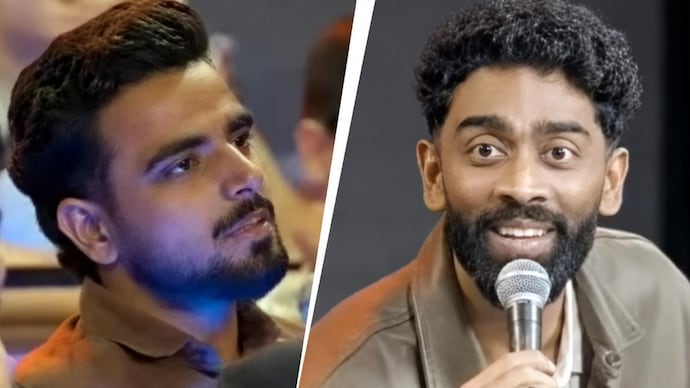
Stand-up comedian Pranit More's latest crowd-work clip, intended as a comic moment, turned into a nightmare for many viewers. In the viral video, a 23-year-old Gurugram man claims that after spending Rs 370 on biryani for a woman, he expected something in return. When she later asked him to drop her off at home, he joked that he still needed to "recover" his money from her. The audience burst into laughter, but once the clip went viral, it left many wondering: when did comedy stop being about humour and start becoming content designed for clicks, reactions and engagement?
On the surface, it may look like any other dating joke, but the question is, what was so funny about it?
In an age driven by clicks and virality, comedy created primarily for traction often prioritises shock value over humour. The goal is no longer to craft a clever punchline or offer a fresh observation, but to generate reactions and engagement.
A random man describing his intimate moments with his girlfriend became a centre of comedy and all that for some clicks?
With remarks like "I was charged up" and "we started kissing, but there was no fun in it, I wanted more," one is left wondering: where exactly was the humour?
More importantly, why was the anecdote presented as a joke in the first place, and why did it draw so much laughter from the room?
The man's attitude and casual approach were treated as normal, with many people laughing along. That is where the real problem became clear. The joke had gone so far beyond its limits that it no longer felt like something worth laughing at. Instead, it seemed more like content created to grab attention and spark reactions than genuine comedy.
What makes the ‘so-called joke’ troubling is the implication that paying for a meal entitles someone to something in return. The expectation was far more unsettling.
When the pursuit of being clickbait takes over humour, the line between comedy and content becomes increasingly blurred.
What passes off as comedy these days? Scroll through social media or watch a stand-up special, and chances are you'll find expletives doing much of the heavy lifting. Every set seems to come with cuss words, every crowd-work clip feels like a roast, and the underlying assumption appears to be that bluntness equals honesty and profanity equals humour.
But does comedy really need abuse to be funny? Or is it simply an easy shortcut?
When Javed Akhtar defined comedy
At the heart of the ongoing controversy, Javed Akhtar’s analogy perfectly captures the core mechanics of modern stand-up comedy.
The veteran lyricist and screenwriter once offered a memorable answer to the above question. During a conversation with comedian and actor Biswa Kalyan Rath last year, Akhtar shared his thoughts on the increasing use of swear words in comedy.
When asked whether swearing had a place in humour, he responded with an analogy that was both simple and sharp. "I’ll tell you one thing. In Odisha, Bihar, and Mexico, and anywhere in the world where there is poverty, people eat a lot of chillies because the food is bland. So, to add some flavour, they eat chilli."
He then compared expletives to that extra spice. "Swearing is the chilli of language. If you can speak well and are witty enough, you don’t need this chilli. If the conversation is bland, you’ll throw in some swear words just to give it some energy," he said.
For Akhtar, the point was never that swear words should be banned from comedy. It was that strong writing, sharp observation and genuine wit should be enough to make people laugh without constantly relying on profanity as a punchline - the same few things that are missing from stand-up acts these days.
Akhtar's point becomes even more relevant in today's context where Pranit's crowd-work was never merely the language used on stage, but the kind of humour being rewarded. When a joke depends on entitlement, misogyny or humiliation rather than wit and observation, the debate shifts from profanity to responsibility.
The sentiments were echoed by influencer-actor Kusha Kapila, who reacted strongly to the videos from the show and argued that comedy cannot be used as a shield for behaviour that many found disturbing.
She suggested that this particular incident crossed a line, turning what was meant to be humorous into something disturbing. Kapila also called on men to speak up when they encounter such behaviour, arguing that challenging problematic remarks should not be seen as taking sides but as a basic moral responsibility. Which brings us to a bigger question: when do we decide that the joke is actually hitting below the belt?
While we still discuss the difference between content and comedy, we need to know the two in depth and where the line does get thin. Comedy and content are not the same thing, even though the internet often treats them as interchangeable.
Comedy is built around observation, timing, surprise, and insight. A good joke reveals something about society, human behaviour or our own contradictions. It may offend, provoke or challenge audiences, but its primary objective is still laughter. Content, on the other hand, operates on a different economy. It is just to get eyeballs. The goal is not necessarily to make people laugh. It is to make them react just to get some numbers.
That is why many argue that responsibility does not end with the person who made the remark. It extends to the people who choose to package it as entertainment. In Pranit More’s case, his reaction to the Gurugram man’s remarks and the continuation reminded people that Indian stand-up is actually facing a quality crisis.
He was on stage. He had the mic. He had the power. He could’ve stopped the misogyny right there. He could’ve shut down the “wasool toh karunga” nonsense. However, he chose to play along and also reward the same nonsense later with money, merely for some clicks and content. This is not the first time such an incident has sparked debate about what constitutes below-the-belt comedy.
Earlier controversies involving comedians like Samay Raina, Ranveer Allahbadia and Kunal Kamra have also left many wondering about the direction comedy is taking in the age of social media. It makes us wonder what comedy was in the era when humour often emerged from everyday observations, relatable experiences and left people in splits.
Perhaps the real issue is not whether a joke crossed the line. The bigger question is whether the line between comedy and content is disappearing altogether. Because when audiences leave a clip feeling angry, uncomfortable or disturbed but struggle to identify the joke itself, it raises an uncomfortable possibility: maybe the joke was never even the point.
Maybe the virality was.
Not everything that gets a laugh is a joke. And not everything that goes viral is comedy.
Stand-up comedian Pranit More's latest crowd-work clip, intended as a comic moment, turned into a nightmare for many viewers. In the viral video, a 23-year-old Gurugram man claims that after spending Rs 370 on biryani for a woman, he expected something in return. When she later asked him to drop her off at home, he joked that he still needed to "recover" his money from her. The audience burst into laughter, but once the clip went viral, it left many wondering: when did comedy stop being about humour and start becoming content designed for clicks, reactions and engagement?
On the surface, it may look like any other dating joke, but the question is, what was so funny about it?
In an age driven by clicks and virality, comedy created primarily for traction often prioritises shock value over humour. The goal is no longer to craft a clever punchline or offer a fresh observation, but to generate reactions and engagement.
A random man describing his intimate moments with his girlfriend became a centre of comedy and all that for some clicks?
With remarks like "I was charged up" and "we started kissing, but there was no fun in it, I wanted more," one is left wondering: where exactly was the humour?
More importantly, why was the anecdote presented as a joke in the first place, and why did it draw so much laughter from the room?
The man's attitude and casual approach were treated as normal, with many people laughing along. That is where the real problem became clear. The joke had gone so far beyond its limits that it no longer felt like something worth laughing at. Instead, it seemed more like content created to grab attention and spark reactions than genuine comedy.
What makes the ‘so-called joke’ troubling is the implication that paying for a meal entitles someone to something in return. The expectation was far more unsettling.
When the pursuit of being clickbait takes over humour, the line between comedy and content becomes increasingly blurred.
What passes off as comedy these days? Scroll through social media or watch a stand-up special, and chances are you'll find expletives doing much of the heavy lifting. Every set seems to come with cuss words, every crowd-work clip feels like a roast, and the underlying assumption appears to be that bluntness equals honesty and profanity equals humour.
But does comedy really need abuse to be funny? Or is it simply an easy shortcut?
When Javed Akhtar defined comedy
At the heart of the ongoing controversy, Javed Akhtar’s analogy perfectly captures the core mechanics of modern stand-up comedy.
The veteran lyricist and screenwriter once offered a memorable answer to the above question. During a conversation with comedian and actor Biswa Kalyan Rath last year, Akhtar shared his thoughts on the increasing use of swear words in comedy.
When asked whether swearing had a place in humour, he responded with an analogy that was both simple and sharp. "I’ll tell you one thing. In Odisha, Bihar, and Mexico, and anywhere in the world where there is poverty, people eat a lot of chillies because the food is bland. So, to add some flavour, they eat chilli."
He then compared expletives to that extra spice. "Swearing is the chilli of language. If you can speak well and are witty enough, you don’t need this chilli. If the conversation is bland, you’ll throw in some swear words just to give it some energy," he said.
For Akhtar, the point was never that swear words should be banned from comedy. It was that strong writing, sharp observation and genuine wit should be enough to make people laugh without constantly relying on profanity as a punchline - the same few things that are missing from stand-up acts these days.
Akhtar's point becomes even more relevant in today's context where Pranit's crowd-work was never merely the language used on stage, but the kind of humour being rewarded. When a joke depends on entitlement, misogyny or humiliation rather than wit and observation, the debate shifts from profanity to responsibility.
The sentiments were echoed by influencer-actor Kusha Kapila, who reacted strongly to the videos from the show and argued that comedy cannot be used as a shield for behaviour that many found disturbing.
She suggested that this particular incident crossed a line, turning what was meant to be humorous into something disturbing. Kapila also called on men to speak up when they encounter such behaviour, arguing that challenging problematic remarks should not be seen as taking sides but as a basic moral responsibility. Which brings us to a bigger question: when do we decide that the joke is actually hitting below the belt?
While we still discuss the difference between content and comedy, we need to know the two in depth and where the line does get thin. Comedy and content are not the same thing, even though the internet often treats them as interchangeable.
Comedy is built around observation, timing, surprise, and insight. A good joke reveals something about society, human behaviour or our own contradictions. It may offend, provoke or challenge audiences, but its primary objective is still laughter. Content, on the other hand, operates on a different economy. It is just to get eyeballs. The goal is not necessarily to make people laugh. It is to make them react just to get some numbers.
That is why many argue that responsibility does not end with the person who made the remark. It extends to the people who choose to package it as entertainment. In Pranit More’s case, his reaction to the Gurugram man’s remarks and the continuation reminded people that Indian stand-up is actually facing a quality crisis.
He was on stage. He had the mic. He had the power. He could’ve stopped the misogyny right there. He could’ve shut down the “wasool toh karunga” nonsense. However, he chose to play along and also reward the same nonsense later with money, merely for some clicks and content. This is not the first time such an incident has sparked debate about what constitutes below-the-belt comedy.
Earlier controversies involving comedians like Samay Raina, Ranveer Allahbadia and Kunal Kamra have also left many wondering about the direction comedy is taking in the age of social media. It makes us wonder what comedy was in the era when humour often emerged from everyday observations, relatable experiences and left people in splits.
Perhaps the real issue is not whether a joke crossed the line. The bigger question is whether the line between comedy and content is disappearing altogether. Because when audiences leave a clip feeling angry, uncomfortable or disturbed but struggle to identify the joke itself, it raises an uncomfortable possibility: maybe the joke was never even the point.
Maybe the virality was.

