Are Botox strips worth the hype?
Unveiling the truth behind Botox strips and their real impact.
This is shifting the conversation toward faster, low-effort solutions with minimal discomfort.
The latest viral trend getting popularity is wrinkle patches, popularly called ‘Botox strips’. They’re marketed as an easy way to smooth fine lines overnight.
But do these patches actually deliver results, or are they just another DIY beauty fad? We asked a dermatologist to help us understand what’s driving the hype, and what’s really behind their sudden popularity, and are they an alternative to Botox?
First let’s understand how we get wrinkles. Wrinkles form when the skin looses moisture and collagen. Also, repeated facial movements like smiling and frowning lead to temporary lines. And over time, these lines become permanent. Also, constant exposure to sun, dehydration, and uneven sleep weaken the skin’s structure.
Now, these wrinkle patches, aka Botox strips, work on the principle of physically holding skin to prevent muscle movement, but how?
HOW DO THEY WORK?
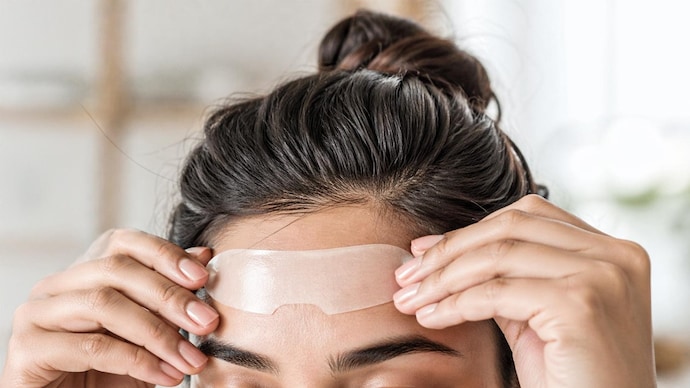
These patches are stick-ons and work by reducing the appearance of fine lines. They are usually available to be applied on the forehead for frown lines and on smile lines and are made from medical-grade weighted paper or flexible silicone polymers treated with a hypoallergenic, pressure-sensitive adhesive.
They look almost similar to under-eye patches. But wrinkle patches work by restricting the movement where they're applied.
Delhi-based dermatologist and founder of Isya Aesthetics, Dr Kiran Sethi highlighted that although they are marketed under the "Botox" moniker for branding purposes, these patches are not a pharmacological equivalent to botulinum toxin (Botox) and do not inhibit neurotransmitter release.
They hold the skin in a flattened, tension-free state, which allows the skin to redistribute and recover from repetitive compressive stress while potentially increasing hydration. In a nutshell, "They offer mechanical support of the dermis, providing a short-term reduction in the appearance of wrinkles, but are not a physiological fix," she added.
“Their primary utility lies in preventing skin creasing during sleep or active facial expression while the patch is physically attached to the surface."
Dr. Sethi noted that “they are best used as a supportive dermatological regimen rather than a stand-alone corrective treatment."
In India, one-time use wrinkle patches cost between Rs 400 and Rs 500 (for a pack of 12). Reusable patches cost between Rs 2500 and Rs 3000 (per pack of six). One-time patches are better over reusable ones, dermatologists say.
CAN THEY BE USED LONG-TERM?
They can be used long-term as long as there is no skin sensitivity. Also, they do hold a promise to soften existing lines. According to Dr Sethi, these patches serve as a non-invasive, somewhat preventative tool and train the wearer to be more conscious of repetitive facial expressions.
“While they are generally safe for extended use, provided the patient does not exhibit sensitivity to the adhesive, they lack the cumulative benefits or efficacy of injectable Botox," said Dr Sethi.
While they may not act like Botox, it’s a low-cost technique that does hold some promise to reduce fine lines.
This is shifting the conversation toward faster, low-effort solutions with minimal discomfort.
The latest viral trend getting popularity is wrinkle patches, popularly called ‘Botox strips’. They’re marketed as an easy way to smooth fine lines overnight.
But do these patches actually deliver results, or are they just another DIY beauty fad? We asked a dermatologist to help us understand what’s driving the hype, and what’s really behind their sudden popularity, and are they an alternative to Botox?
First let’s understand how we get wrinkles. Wrinkles form when the skin looses moisture and collagen. Also, repeated facial movements like smiling and frowning lead to temporary lines. And over time, these lines become permanent. Also, constant exposure to sun, dehydration, and uneven sleep weaken the skin’s structure.
Now, these wrinkle patches, aka Botox strips, work on the principle of physically holding skin to prevent muscle movement, but how?
HOW DO THEY WORK?
These patches are stick-ons and work by reducing the appearance of fine lines. They are usually available to be applied on the forehead for frown lines and on smile lines and are made from medical-grade weighted paper or flexible silicone polymers treated with a hypoallergenic, pressure-sensitive adhesive.
They look almost similar to under-eye patches. But wrinkle patches work by restricting the movement where they're applied.
Delhi-based dermatologist and founder of Isya Aesthetics, Dr Kiran Sethi highlighted that although they are marketed under the "Botox" moniker for branding purposes, these patches are not a pharmacological equivalent to botulinum toxin (Botox) and do not inhibit neurotransmitter release.
They hold the skin in a flattened, tension-free state, which allows the skin to redistribute and recover from repetitive compressive stress while potentially increasing hydration. In a nutshell, "They offer mechanical support of the dermis, providing a short-term reduction in the appearance of wrinkles, but are not a physiological fix," she added.
“Their primary utility lies in preventing skin creasing during sleep or active facial expression while the patch is physically attached to the surface."
Dr. Sethi noted that “they are best used as a supportive dermatological regimen rather than a stand-alone corrective treatment."
In India, one-time use wrinkle patches cost between Rs 400 and Rs 500 (for a pack of 12). Reusable patches cost between Rs 2500 and Rs 3000 (per pack of six). One-time patches are better over reusable ones, dermatologists say.
CAN THEY BE USED LONG-TERM?
They can be used long-term as long as there is no skin sensitivity. Also, they do hold a promise to soften existing lines. According to Dr Sethi, these patches serve as a non-invasive, somewhat preventative tool and train the wearer to be more conscious of repetitive facial expressions.
“While they are generally safe for extended use, provided the patient does not exhibit sensitivity to the adhesive, they lack the cumulative benefits or efficacy of injectable Botox," said Dr Sethi.
While they may not act like Botox, it’s a low-cost technique that does hold some promise to reduce fine lines.

