Did we get Haldighati winner wrong for 450 years?
It is commonly accepted that Akbar won the Battle of Haldighati. But did Maharana Pratap win the war? A fresh reading of the 450-year-old battle amid US President Donald Trump's repeated claims that the US won the war against Iran.
Only days ago, US President Donald Trump declared victory in the war with Iran. Tehran declared victory as well. Before the smoke had cleared, both governments were competing to define what they had achieved from the war. Military campaigns end when the fighting stops, but the struggle over their meaning begins immediately.
Four hundred and fifty years after the Battle of Haldighati (1576), that struggle has never ended.
Every anniversary of the battle between the forces of Akbar and Maharana Pratap brings back the same question: Who won? Yet the debate still rests largely on accounts written by Timurid court chroniclers. Their livelihood depended upon imperial favour, not historical detachment. Dynasties disappear. Court histories often survive long enough to become accepted as fact.
For generations, imperial claims have been mistaken for historical evidence.
The question of who won the war itself has also been wrong.
The issue is not who occupied the battlefield when the fighting ended. The issue is whether Akbar accomplished the purpose for which he invaded Mewar.
Haldighati was Akbar's campaign. Its outcome must therefore be judged against Akbar’s objectives, not Maharana Pratap's. To understand the battle, we must begin several years before it was fought.
THE MAKING OF A WAR THAT DIPLOMACY COULD NOT PREVENT
By the early 1570s, almost every major Rajput kingdom had entered the Timurid political order through alliance, negotiation, coercion or conquest. Mewar alone refused. The Sisodias (the ruling dynasty of Mewar) regarded sovereignty not as a privilege bestowed by an emperor but as an inheritance held in trust from their ancestors.
Chittorgarh fell in 1568 after one of the bloodiest sieges in Indian history. On the eve of Holi, the flames of Jauhar consumed hundreds of women and girls who chose death over captivity. At dawn, the Rajputs donned saffron robes and, under Mewar's jagirdar, Patta Chundawat, opened the gates for the Sakha, the final charge from which none expected to return.
Contemporary Persian chronicles record that Akbar himself narrowly escaped death several times during the siege. By nightfall, Chittor had fallen. Akbar's army cut down nearly 30,000 civilians after the fortress fell, not because they had defeated an army, but because they refused to bow. Many women and children were enslaved, and temples were desecrated by imperial orders. Mewar lost much of its eastern dominions, but not its will. The Sisodias withdrew into the Aravallis, where the mountains became stronger than the fortresses they had lost.
Some argue that the siege of Chittorgarh was driven by political rather than religious considerations. Akbar’s own words leave little room for such an interpretation. In the Fathnama, issued on 9 March 1568, he declared:
So far as it lies within our power, we remain engaged in jihad. By the grace of Allah, the giver of victory, we have captured many forts and towns from the Kafirs and established Islam in them. With our blood-stained sword, we have wiped out the marks of unbelief, destroyed their temples in those places, and demolished temples throughout Hindustan.
Years had passed since Chittorgarh, yet Akbar still sought what force had failed to secure: Mewar's submission. He tried diplomacy before the war. Akbar's favoured servant, Jalal Khan Qurchi, returned empty-handed. So did Raja Man Singh, Raja Bhagwant Das and Raja Todar Mal. Every envoy carried the same proposal. Every envoy returned with the same answer. Mewar would not bow.
The stakes went far beyond Rajput pride. Whoever controlled Mewar commanded the mountain corridors linking northern India with Gujarat, the empire's richest commercial province. This was a contest for trade routes, strategy and imperial dominance.
Abu'l Fazl later claimed that Maharana Pratap accepted Akbar's robe of honour and even sent Amar Singh to the Timurid court. The contemporary record tells a different story. Badayuni is silent. So is Nizamuddin Ahmad. More decisive still, Jahangir himself records in the Tuzk-e-Jahangiri that Mewar's heir first appeared at the Timurid court only after the treaty of 1615. Abu'l Fazl's account strengthens imperial prestige, not the evidence.
By the time the armies faced each other at Haldighati, diplomacy had already suffered four humiliating failures. The battle was Akbar's last argument.
HOW BATTLE OF HALDIGHATI BECAME AKBAR'S LAST ARGUMENT
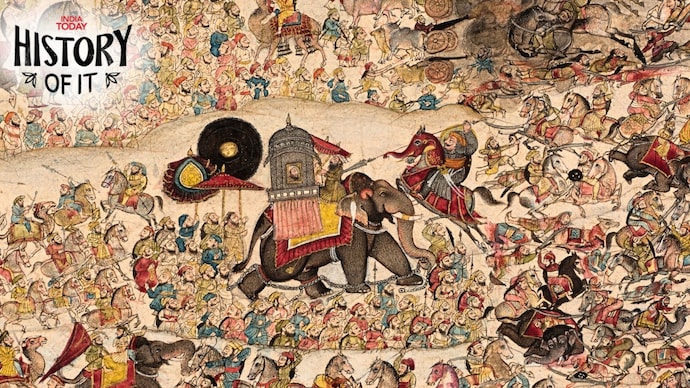
The Rajput assault struck with terrifying force, throwing the Timurid ranks into confusion. Then Raja Man Singh drove his elephant into the thick of the fighting, rallying soldiers on the verge of collapse. Husain Khan, commander of the imperial elephant corps, followed. Soon elephants crashed into one another, tusks locked against armour, while dust swallowed banners, men and horses alike beneath the weight of the struggle.
A Timurid elephant charged Maharana Pratap's own. The impact killed Pratap's mahout instantly. Deprived of its handler, the elephant drifted into Timurid hands. In sixteenth-century warfare, perception often mattered as much as reality. Many would have believed their ruler had fallen or been captured.
Then came the charge that defined Haldighati.
Maharana Pratap caught sight of Raja Man Singh and, mounted on Chetak, carved a path through the fighting. As he reached the commander's elephant, Chetak reared onto its forehead, lifting his master high enough to strike. Pratap hurled his spear with tremendous force. At the last instant, Man Singh dropped into the howdah. The spear missed him and struck the elephant instead, sending the wounded animal crashing away with its commander.
The attempt failed, but its purpose was unmistakable. Maharana had risked everything to kill the commander of the invading army. During the assault, Chetak suffered a deep wound to one foreleg, almost certainly from the sword fastened to the elephant's tusk. Lame and bleeding, he still carried his master out of the encirclement as Timurid horsemen and archers closed in. Even Persian chroniclers writing for the victors acknowledged that Maharana Pratap escaped through exceptional courage and skill.
WHAT REALLY HAPPENED AT THE END OF HALDIGHATI?
It is here that history begins to yield to memory.
According to some later Rajput tradition, the wounded Maharana was pursued by two Timurid officers until his estranged brother, Shakti Singh, turned on the pursuers, killed them, sought forgiveness, gave Pratap his own horse and watched Chetak collapse after one final leap across a stream.
Although it is a powerful story, it may also be unhistorical.
The first detailed account appears only in the Raj Prashasti, composed generations after Haldighati. Raj Ratnakar, written around the same period, says nothing of it. The contemporary Khyats, the Jagannath Rai inscription and the Raj Prakash are equally silent. Neither Badayuni nor any Persian chronicler places Shakti Singh in the Timurid army. The available evidence instead suggests that he may have died during the fall of Chittorgarh in 1568. Had he rescued Maharana Pratap before thousands of witnesses, the silence of every contemporary source would be difficult to explain.
Memory honours heroes. History demands evidence. Sometimes they walk together. More often, they part company.
By then, Maharana Pratap had left the battlefield. His withdrawal was unavoidable, but it shook the Rajput ranks. Even so, Mewar's foremost warriors refused to break. Jhala Bida had already laid down his life after assuming Rana's royal insignia with the purpose of disguise. Ram Shah Tanwar and his sons fell where they fought. Hakim Khan Sur, Kisan Singh, Shankar Das Rathore, Rawat Netsi and countless others held their ground, sacrificing themselves to buy their sovereign time. Their resistance slowed the Timurid advance, but by noon organised fighting had ended.
Measured by the battlefield alone, the result is clear. The Timurids held the field and Maharana Pratap had withdrawn.
THE BATTLE WAS OVER BUT THE CAMPAIGN HAD ONLY BEGUN
Yet the campaign was never about occupying a few acres of blood-soaked ground. Akbar had marched to compel Maharana Pratap's submission, absorb Mewar into the Timurid Empire and secure the strategic corridor to Gujarat.
That objective remained as distant at sunset as it had been at dawn.
Man Singh left the field believing victory was his. Before the first night had passed, it began slipping away. Bhil warriors descended upon the withdrawing Timurid columns, ambushing supply parties, severing communications and turning every march through the Aravallis into a contest for survival. The invaders had won the battlefield, but not Mewar. The hills, forests and narrow passes remained in Sisodia hands.
Maharana Pratap escaped and his kingdom survived. His government remained intact, and no treaty was signed. No submission followed and the road to Gujarat remained insecure for the Timurids.
In reality, Haldighati did not end the war. It exposed the limits of Timurid victory. Akbar had won the field but failed to secure the purpose for which he had invaded Mewar. His long struggle to subdue the kingdom was only beginning.
HOW THE ARAVALLIS TURNED IMPERIAL VICTORY INTO A WAR OF ATTRITION
Soon after Haldighati, Raja Man Singh entered Gogunda (now a Tehsil in Udaipur district) and occupied the deserted town with little resistance. On paper, the campaign appeared won. In reality, the Timurid army had marched into a trap. Grain disappeared, supply lines collapsed and soldiers survived on animal flesh and wild mangoes. Banjara caravans refused to risk the roads, while Rajput bands and Bhil archers turned every convoy into an ambush.
Akbar understood the difference between occupying a town and subduing a kingdom. When Man Singh returned to court, neither he nor Asaf Khan received the honours reserved for commanders who had fulfilled an emperor's purpose. The battlefield had been won. Mewar had not.
Maharana Pratap refused to measure the war by a single day's fighting. Within weeks, copper-plate grants were again being issued from Kumbhalgarh. Administration resumed across central Mewar, loyal chiefs received fresh grants and revenue was once again collected. Those inscriptions speak more convincingly than any court chronicle. Obviously, conquered kings do not issue land grants.
The war itself had changed. Maharana Pratap abandoned set-piece battles and forced the empire to fight on ground of his choosing. Mountain passes became frontiers, forests became fortresses and Bhil settlements became a network of scouts and messengers. Every road to the Timurid garrisons lay under constant watch.
He then struck where every empire is weakest: its lifelines. Rajput detachments seized the heights overlooking the roads to Timurid outposts, while Banjara traders were prevented from provisioning imperial camps. The routes linking Gogunda with Ajmer grew increasingly dangerous. Every march demanded an armed escort. Every sack of grain became a military objective and the soldiers who believed Haldighati had ended the war soon discovered that hunger could prove deadlier than the Rajput sword.
Maharana Pratap answered defeat with diplomacy. He sought to unite the neighbouring rulers who watched Akbar's advance with growing alarm. Narayan Das of Idar, despite having earlier accepted Timurid authority, rebelled. Rao Surtan of Sirohi aligned himself with Mewar, while Taj Khan of Jalore appeard to have entered the same understanding. In Marwar, Rao Chandrasen Rathore continued his relentless resistance, stretching Timurid resources across yet another frontier.
Akbar moved quickly to break the alliance before it could mature. Separate expeditions marched against Idar, Sirohi and Jalore, forcing one ally after another into submission. Yet the heart of the problem remained unchanged. Maharana Pratap was still free, and Mewar still stood outside Timurid control.
WHEN AKBAR HIMSELF TOOK THE BATTLEFIELF
Barely four months after Haldighati, in October 1576, Akbar assumed personal command of the campaign. No clearer admission of the battle's limitations exists. Emperors do not lead fresh expeditions into lands they believe they have already conquered. As the Timurid army advanced through Mewar, reconnaissance parties rode ahead each day, wary of ambush in every narrow pass. These were the precautions of an army entering a hostile country, not marching through its own province.
Akbar reoccupied Gogunda, strengthened his garrisons and established new posts at Haldighati, Pindwara, Mohi, Madariya and Udaipur. The design was simple: seal the entrances to the Aravallis, isolate Pratap and force him into submission.
Pratap refused to oblige.
He abandoned the kind of war Akbar was prepared to fight and chose one the empire could never decisively win.
Whenever Timurid columns pushed into the Aravallis, Maharana Pratap simply vanished into the hills. Guided by the Bhils through forests, ravines and hidden passes unknown to imperial scouts, he denied the enemy the battle it sought. The Timurids occupied deserted villages and abandoned outposts, only to discover that territory without the loyalty of its people was little more than empty ground. The moment they marched on, Rajput bands emerged from the hills, struck isolated garrisons and reclaimed what had been lost.
The empire was forced to conquer the same region again and again.
The war gradually became one of endurance rather than decisive battle. Every advance demanded another garrison, another convoy, another guarded road and another stream of reinforcements. Every occupation was temporary. Every withdrawal restored Mewar's presence. Akbar ruled one of the wealthiest empires of his age, but even great empires bleed when every mile gained must be won twice.
MAHARANA PRATAP'S GREATEST VICTORY WAS SURVIVING TO FIGHT AGAIN
In 1577, Akbar entrusted Shahbaz Khan with the task that had frustrated every commander before him: the capture of Kumbhalgarh Fort. Rising above the Aravallis, its immense walls wound across the hills like a stone serpent, guarding one of the strongest fortresses in India.
The siege dragged on for months. Assault after assault failed. Only when provisions ran dangerously low did Maharana Pratap make the decision that defined his generalship. Under the cover of darkness, he slipped out of the fortress, leaving Bhan to command its defence. Kumbhalgarh resisted until 3 April 1578 before finally falling to Shahbaz Khan.
Yet he had only captured the fortress. The Sisodias remained beyond his reach and control.
As later chroniclers observed, the bird had already flown. Many have mistaken Pratap's withdrawal for weakness. It was, in fact, the decision that preserved Mewar. Too many rulers chose a glorious death upon their ramparts, only to leave leaderless kingdoms behind them. Pratap chose survival over spectacle. Fortresses could be rebuilt. Lost territory could be recovered. A dead ruler could wage no war.
From the western hills, he rebuilt what Haldighati had not destroyed. Then fortune turned. His trusted minister, Bhama Shah, returned from Malwa with immense wealth acquired through successful campaigns. Those resources revived the Sisodia treasury, raised fresh troops and restored Mewar's capacity to fight. At the very moment the Timurids believed Pratap had been broken, he was preparing to strike again.
The opportunity came at Dewair. There, Kunwar Amar Singh announced himself as his father's worthy heir. In the heat of battle, he drove his spear through the Timurid commander, Sultan Khan, killing him with a single thrust. The imperial garrison collapsed, and Dewair returned to Sisodia control. British army officer and scholar Colonel James Tod later called it the "Marathon of Mewar". The analogy belongs to another age, but its central point remains. Dewair shifted the initiative.
Akbar responded in the only way he could. Shahbaz Khan returned, followed by fresh commanders and fresh armies. Villages were burned, forts changed hands and new garrisons spread across Mewar. Yet every campaign ended where the last had ended. Territory could be occupied. Maharana Pratap could not.
AKBAR ABANDONED WAR WITHOUT ATTAINING OBJECTIVE, SO DID TRUMP
By 1585, the cost had become impossible to ignore. Unrest on the empire's north-western frontier demanded Akbar's attention, while years of campaigning in Mewar had consumed soldiers, treasure and time far beyond anything the kingdom's size seemed to justify. Quietly, and without the triumph proclaimed in imperial chronicles, the emperor turned his attention elsewhere.
Maharana Pratap needed no treaty to know the outcome. Akbar had failed to secure the very objectives for which he had marched into Mewar.
For four and a half centuries, India has argued over who won Haldighati. That debate may itself be the Timurid court's greatest triumph. It has confined the war to a single afternoon while burying the decade that followed beneath imperial applause.
Similarly, now in 2026, as Washington and Tehran declared victory simultaneously, it's interesting to note that the ceasefire might not end the fighting, as many experts have held. Ceasefires like these rarely end the argument over who won.
Four and a half centuries after Haldighati, that argument still shapes how the campaign is remembered now. For generations, the debate has revolved around who held the battlefield at sunset. But, wars are not judged by battlefield possession alone. They are judged by whether they achieve the political objectives for which they are fought.
Akbar marched to compel Maharana Pratap's submission. It never came.
The battlefield of Haldighati belonged to Akbar. The war did not.
Perhaps the wrong question has been asked for 450 years.
The question was never who stood on the field at sunset.
It was, who achieved the purpose for which the war was fought.
(Aabhas Maldahiyar is the author of Babur: The Quest for Hindustan.)
Only days ago, US President Donald Trump declared victory in the war with Iran. Tehran declared victory as well. Before the smoke had cleared, both governments were competing to define what they had achieved from the war. Military campaigns end when the fighting stops, but the struggle over their meaning begins immediately.
Four hundred and fifty years after the Battle of Haldighati (1576), that struggle has never ended.
Every anniversary of the battle between the forces of Akbar and Maharana Pratap brings back the same question: Who won? Yet the debate still rests largely on accounts written by Timurid court chroniclers. Their livelihood depended upon imperial favour, not historical detachment. Dynasties disappear. Court histories often survive long enough to become accepted as fact.
For generations, imperial claims have been mistaken for historical evidence.
The question of who won the war itself has also been wrong.
The issue is not who occupied the battlefield when the fighting ended. The issue is whether Akbar accomplished the purpose for which he invaded Mewar.
Haldighati was Akbar's campaign. Its outcome must therefore be judged against Akbar’s objectives, not Maharana Pratap's. To understand the battle, we must begin several years before it was fought.
THE MAKING OF A WAR THAT DIPLOMACY COULD NOT PREVENT
By the early 1570s, almost every major Rajput kingdom had entered the Timurid political order through alliance, negotiation, coercion or conquest. Mewar alone refused. The Sisodias (the ruling dynasty of Mewar) regarded sovereignty not as a privilege bestowed by an emperor but as an inheritance held in trust from their ancestors.
Chittorgarh fell in 1568 after one of the bloodiest sieges in Indian history. On the eve of Holi, the flames of Jauhar consumed hundreds of women and girls who chose death over captivity. At dawn, the Rajputs donned saffron robes and, under Mewar's jagirdar, Patta Chundawat, opened the gates for the Sakha, the final charge from which none expected to return.
Contemporary Persian chronicles record that Akbar himself narrowly escaped death several times during the siege. By nightfall, Chittor had fallen. Akbar's army cut down nearly 30,000 civilians after the fortress fell, not because they had defeated an army, but because they refused to bow. Many women and children were enslaved, and temples were desecrated by imperial orders. Mewar lost much of its eastern dominions, but not its will. The Sisodias withdrew into the Aravallis, where the mountains became stronger than the fortresses they had lost.
Some argue that the siege of Chittorgarh was driven by political rather than religious considerations. Akbar’s own words leave little room for such an interpretation. In the Fathnama, issued on 9 March 1568, he declared:
So far as it lies within our power, we remain engaged in jihad. By the grace of Allah, the giver of victory, we have captured many forts and towns from the Kafirs and established Islam in them. With our blood-stained sword, we have wiped out the marks of unbelief, destroyed their temples in those places, and demolished temples throughout Hindustan.
Years had passed since Chittorgarh, yet Akbar still sought what force had failed to secure: Mewar's submission. He tried diplomacy before the war. Akbar's favoured servant, Jalal Khan Qurchi, returned empty-handed. So did Raja Man Singh, Raja Bhagwant Das and Raja Todar Mal. Every envoy carried the same proposal. Every envoy returned with the same answer. Mewar would not bow.
The stakes went far beyond Rajput pride. Whoever controlled Mewar commanded the mountain corridors linking northern India with Gujarat, the empire's richest commercial province. This was a contest for trade routes, strategy and imperial dominance.
Abu'l Fazl later claimed that Maharana Pratap accepted Akbar's robe of honour and even sent Amar Singh to the Timurid court. The contemporary record tells a different story. Badayuni is silent. So is Nizamuddin Ahmad. More decisive still, Jahangir himself records in the Tuzk-e-Jahangiri that Mewar's heir first appeared at the Timurid court only after the treaty of 1615. Abu'l Fazl's account strengthens imperial prestige, not the evidence.
By the time the armies faced each other at Haldighati, diplomacy had already suffered four humiliating failures. The battle was Akbar's last argument.
HOW BATTLE OF HALDIGHATI BECAME AKBAR'S LAST ARGUMENT
The Rajput assault struck with terrifying force, throwing the Timurid ranks into confusion. Then Raja Man Singh drove his elephant into the thick of the fighting, rallying soldiers on the verge of collapse. Husain Khan, commander of the imperial elephant corps, followed. Soon elephants crashed into one another, tusks locked against armour, while dust swallowed banners, men and horses alike beneath the weight of the struggle.
A Timurid elephant charged Maharana Pratap's own. The impact killed Pratap's mahout instantly. Deprived of its handler, the elephant drifted into Timurid hands. In sixteenth-century warfare, perception often mattered as much as reality. Many would have believed their ruler had fallen or been captured.
Then came the charge that defined Haldighati.
Maharana Pratap caught sight of Raja Man Singh and, mounted on Chetak, carved a path through the fighting. As he reached the commander's elephant, Chetak reared onto its forehead, lifting his master high enough to strike. Pratap hurled his spear with tremendous force. At the last instant, Man Singh dropped into the howdah. The spear missed him and struck the elephant instead, sending the wounded animal crashing away with its commander.
The attempt failed, but its purpose was unmistakable. Maharana had risked everything to kill the commander of the invading army. During the assault, Chetak suffered a deep wound to one foreleg, almost certainly from the sword fastened to the elephant's tusk. Lame and bleeding, he still carried his master out of the encirclement as Timurid horsemen and archers closed in. Even Persian chroniclers writing for the victors acknowledged that Maharana Pratap escaped through exceptional courage and skill.
WHAT REALLY HAPPENED AT THE END OF HALDIGHATI?
It is here that history begins to yield to memory.
According to some later Rajput tradition, the wounded Maharana was pursued by two Timurid officers until his estranged brother, Shakti Singh, turned on the pursuers, killed them, sought forgiveness, gave Pratap his own horse and watched Chetak collapse after one final leap across a stream.
Although it is a powerful story, it may also be unhistorical.
The first detailed account appears only in the Raj Prashasti, composed generations after Haldighati. Raj Ratnakar, written around the same period, says nothing of it. The contemporary Khyats, the Jagannath Rai inscription and the Raj Prakash are equally silent. Neither Badayuni nor any Persian chronicler places Shakti Singh in the Timurid army. The available evidence instead suggests that he may have died during the fall of Chittorgarh in 1568. Had he rescued Maharana Pratap before thousands of witnesses, the silence of every contemporary source would be difficult to explain.
Memory honours heroes. History demands evidence. Sometimes they walk together. More often, they part company.
By then, Maharana Pratap had left the battlefield. His withdrawal was unavoidable, but it shook the Rajput ranks. Even so, Mewar's foremost warriors refused to break. Jhala Bida had already laid down his life after assuming Rana's royal insignia with the purpose of disguise. Ram Shah Tanwar and his sons fell where they fought. Hakim Khan Sur, Kisan Singh, Shankar Das Rathore, Rawat Netsi and countless others held their ground, sacrificing themselves to buy their sovereign time. Their resistance slowed the Timurid advance, but by noon organised fighting had ended.
Measured by the battlefield alone, the result is clear. The Timurids held the field and Maharana Pratap had withdrawn.
THE BATTLE WAS OVER BUT THE CAMPAIGN HAD ONLY BEGUN
Yet the campaign was never about occupying a few acres of blood-soaked ground. Akbar had marched to compel Maharana Pratap's submission, absorb Mewar into the Timurid Empire and secure the strategic corridor to Gujarat.
That objective remained as distant at sunset as it had been at dawn.
Man Singh left the field believing victory was his. Before the first night had passed, it began slipping away. Bhil warriors descended upon the withdrawing Timurid columns, ambushing supply parties, severing communications and turning every march through the Aravallis into a contest for survival. The invaders had won the battlefield, but not Mewar. The hills, forests and narrow passes remained in Sisodia hands.
Maharana Pratap escaped and his kingdom survived. His government remained intact, and no treaty was signed. No submission followed and the road to Gujarat remained insecure for the Timurids.
In reality, Haldighati did not end the war. It exposed the limits of Timurid victory. Akbar had won the field but failed to secure the purpose for which he had invaded Mewar. His long struggle to subdue the kingdom was only beginning.
HOW THE ARAVALLIS TURNED IMPERIAL VICTORY INTO A WAR OF ATTRITION
Soon after Haldighati, Raja Man Singh entered Gogunda (now a Tehsil in Udaipur district) and occupied the deserted town with little resistance. On paper, the campaign appeared won. In reality, the Timurid army had marched into a trap. Grain disappeared, supply lines collapsed and soldiers survived on animal flesh and wild mangoes. Banjara caravans refused to risk the roads, while Rajput bands and Bhil archers turned every convoy into an ambush.
Akbar understood the difference between occupying a town and subduing a kingdom. When Man Singh returned to court, neither he nor Asaf Khan received the honours reserved for commanders who had fulfilled an emperor's purpose. The battlefield had been won. Mewar had not.
Maharana Pratap refused to measure the war by a single day's fighting. Within weeks, copper-plate grants were again being issued from Kumbhalgarh. Administration resumed across central Mewar, loyal chiefs received fresh grants and revenue was once again collected. Those inscriptions speak more convincingly than any court chronicle. Obviously, conquered kings do not issue land grants.
The war itself had changed. Maharana Pratap abandoned set-piece battles and forced the empire to fight on ground of his choosing. Mountain passes became frontiers, forests became fortresses and Bhil settlements became a network of scouts and messengers. Every road to the Timurid garrisons lay under constant watch.
He then struck where every empire is weakest: its lifelines. Rajput detachments seized the heights overlooking the roads to Timurid outposts, while Banjara traders were prevented from provisioning imperial camps. The routes linking Gogunda with Ajmer grew increasingly dangerous. Every march demanded an armed escort. Every sack of grain became a military objective and the soldiers who believed Haldighati had ended the war soon discovered that hunger could prove deadlier than the Rajput sword.
Maharana Pratap answered defeat with diplomacy. He sought to unite the neighbouring rulers who watched Akbar's advance with growing alarm. Narayan Das of Idar, despite having earlier accepted Timurid authority, rebelled. Rao Surtan of Sirohi aligned himself with Mewar, while Taj Khan of Jalore appeard to have entered the same understanding. In Marwar, Rao Chandrasen Rathore continued his relentless resistance, stretching Timurid resources across yet another frontier.
Akbar moved quickly to break the alliance before it could mature. Separate expeditions marched against Idar, Sirohi and Jalore, forcing one ally after another into submission. Yet the heart of the problem remained unchanged. Maharana Pratap was still free, and Mewar still stood outside Timurid control.
WHEN AKBAR HIMSELF TOOK THE BATTLEFIELF
Barely four months after Haldighati, in October 1576, Akbar assumed personal command of the campaign. No clearer admission of the battle's limitations exists. Emperors do not lead fresh expeditions into lands they believe they have already conquered. As the Timurid army advanced through Mewar, reconnaissance parties rode ahead each day, wary of ambush in every narrow pass. These were the precautions of an army entering a hostile country, not marching through its own province.
Akbar reoccupied Gogunda, strengthened his garrisons and established new posts at Haldighati, Pindwara, Mohi, Madariya and Udaipur. The design was simple: seal the entrances to the Aravallis, isolate Pratap and force him into submission.
Pratap refused to oblige.
He abandoned the kind of war Akbar was prepared to fight and chose one the empire could never decisively win.
Whenever Timurid columns pushed into the Aravallis, Maharana Pratap simply vanished into the hills. Guided by the Bhils through forests, ravines and hidden passes unknown to imperial scouts, he denied the enemy the battle it sought. The Timurids occupied deserted villages and abandoned outposts, only to discover that territory without the loyalty of its people was little more than empty ground. The moment they marched on, Rajput bands emerged from the hills, struck isolated garrisons and reclaimed what had been lost.
The empire was forced to conquer the same region again and again.
The war gradually became one of endurance rather than decisive battle. Every advance demanded another garrison, another convoy, another guarded road and another stream of reinforcements. Every occupation was temporary. Every withdrawal restored Mewar's presence. Akbar ruled one of the wealthiest empires of his age, but even great empires bleed when every mile gained must be won twice.
MAHARANA PRATAP'S GREATEST VICTORY WAS SURVIVING TO FIGHT AGAIN
In 1577, Akbar entrusted Shahbaz Khan with the task that had frustrated every commander before him: the capture of Kumbhalgarh Fort. Rising above the Aravallis, its immense walls wound across the hills like a stone serpent, guarding one of the strongest fortresses in India.
The siege dragged on for months. Assault after assault failed. Only when provisions ran dangerously low did Maharana Pratap make the decision that defined his generalship. Under the cover of darkness, he slipped out of the fortress, leaving Bhan to command its defence. Kumbhalgarh resisted until 3 April 1578 before finally falling to Shahbaz Khan.
Yet he had only captured the fortress. The Sisodias remained beyond his reach and control.
As later chroniclers observed, the bird had already flown. Many have mistaken Pratap's withdrawal for weakness. It was, in fact, the decision that preserved Mewar. Too many rulers chose a glorious death upon their ramparts, only to leave leaderless kingdoms behind them. Pratap chose survival over spectacle. Fortresses could be rebuilt. Lost territory could be recovered. A dead ruler could wage no war.
From the western hills, he rebuilt what Haldighati had not destroyed. Then fortune turned. His trusted minister, Bhama Shah, returned from Malwa with immense wealth acquired through successful campaigns. Those resources revived the Sisodia treasury, raised fresh troops and restored Mewar's capacity to fight. At the very moment the Timurids believed Pratap had been broken, he was preparing to strike again.
The opportunity came at Dewair. There, Kunwar Amar Singh announced himself as his father's worthy heir. In the heat of battle, he drove his spear through the Timurid commander, Sultan Khan, killing him with a single thrust. The imperial garrison collapsed, and Dewair returned to Sisodia control. British army officer and scholar Colonel James Tod later called it the "Marathon of Mewar". The analogy belongs to another age, but its central point remains. Dewair shifted the initiative.
Akbar responded in the only way he could. Shahbaz Khan returned, followed by fresh commanders and fresh armies. Villages were burned, forts changed hands and new garrisons spread across Mewar. Yet every campaign ended where the last had ended. Territory could be occupied. Maharana Pratap could not.
AKBAR ABANDONED WAR WITHOUT ATTAINING OBJECTIVE, SO DID TRUMP
By 1585, the cost had become impossible to ignore. Unrest on the empire's north-western frontier demanded Akbar's attention, while years of campaigning in Mewar had consumed soldiers, treasure and time far beyond anything the kingdom's size seemed to justify. Quietly, and without the triumph proclaimed in imperial chronicles, the emperor turned his attention elsewhere.
Maharana Pratap needed no treaty to know the outcome. Akbar had failed to secure the very objectives for which he had marched into Mewar.
For four and a half centuries, India has argued over who won Haldighati. That debate may itself be the Timurid court's greatest triumph. It has confined the war to a single afternoon while burying the decade that followed beneath imperial applause.
Similarly, now in 2026, as Washington and Tehran declared victory simultaneously, it's interesting to note that the ceasefire might not end the fighting, as many experts have held. Ceasefires like these rarely end the argument over who won.
Four and a half centuries after Haldighati, that argument still shapes how the campaign is remembered now. For generations, the debate has revolved around who held the battlefield at sunset. But, wars are not judged by battlefield possession alone. They are judged by whether they achieve the political objectives for which they are fought.
Akbar marched to compel Maharana Pratap's submission. It never came.
The battlefield of Haldighati belonged to Akbar. The war did not.
Perhaps the wrong question has been asked for 450 years.
The question was never who stood on the field at sunset.
It was, who achieved the purpose for which the war was fought.
(Aabhas Maldahiyar is the author of Babur: The Quest for Hindustan.)

