Hitler killed Jews; Jews used Hitler's weapons to defeat Arabs
One of history's greatest ironies unfolded in 1948. Weapons originally designed for Hitler's Nazi Germany, which killed nearly 6 million Jews, ended up helping defend the newly formed Jewish state of Israel. Jews sourced Nazi-era weapons and planes from Czechoslovakia, and beat back the armies of five Arab states.
Jewish soldiers quietly infiltrated an abandoned British airstrip in the village of Beit Daras in what is now modern-day Palestine. They then proceeded to strangle the Palestinian soldiers guarding the base, and lit up the runway with torches. Within hours, a dual-engine Douglas DC-3, with a cache of weapons, including 200 rifles, 40 machine guns, and their ammunition, touched down. The arms were sold by Czechoslovakia to the soon-to-be-created Jewish state, and they had been produced by Nazi Germany.
It was March 31, 1948. Israel would be born six weeks later, on May 14, 1948.
Only 36 hours before, David Ben-Gurion, who would go on to become Israel's first Prime Minister, had sent an urgent telegram to Jewish agents in Europe, instructing them to buy as many weapons as they could get their hands on, and get them to Israel by hook or by crook.
There were intelligence inputs that the about-to-be independent state, already battling Palestinian militants and Arab volunteers for control of cities like Jerusalem, was about to face an invasion from a coalition of five Arab states. It needed weapons, and it needed them now.
In a series of airlifts and maritime smuggling operations in those six weeks, the Jewish people would eventually acquire the weapons that ensured Israel's victory in the 1948 Arab-Israeli war. And a significant chunk of those were produced by Nazi Germany, a country which had once strived for the extermination of the Jews.
Israel didn't get any help from the Americans because of an arms embargo in the Middle East by the US and the UN.
We are looking at the Arab-Israeli war and how Nazi Germany-made weapons were used by Israel in the 1948 war because of the warning from US Vice President JD Vance last week.
Vance, in response to criticism from Israeli ministers about the American interim peace deal with Iran, warned Israel's ministers against attacking its "only ally" in the region, pointing directly to Israel's dependence on imported US arms and ammunition.
It is a fact that despite developing an advanced domestic defence industry, Jerusalem has remained dependent on American weapons. Yet during its earliest years, Israel did not source its military equipment from the US.
In a strange twist of irony, weapons originally manufactured by the Nazi regime to fuel its conquests across Europe and North Africa, and for the systematic extermination of the Jewish people ultimately ended up arming the military forces defending the world's only Jewish nation immediately after its birth.
The story starts in 1948, when the newborn state of Israel, surrounded by hostile Arab neighbours, found itself amid conflict.
FIVE ARAB NATIONS ATTACKED ISRAEL JUST A DAY AFTER IT WAS BORN
The territory of Mandatory Palestine was divided into separate Jewish and Arab states and the plan was adopted by the UN General Assembly on November 29, 1947. According to the mandate, British forces had to withdraw from Mandatory Palestine by October 1948.
The UK's accelerated withdrawal plunged the area, comprising modern day Israel and Palestine, into chaos.
According to British government records and accounts of historians like Benny Morris, in 1948: A History of the First Arab-Israeli War, the departing British administration adopted a strict policy of non-intervention in the escalating communal violence between Jewish communities and local Arab populations.
As the British abandoned strategic outposts, police fortresses, and airfields, Jewish and Arab militias engaged in a frantic race to seize these positions.
On the eve of Israel's declaration of independence and before the start of the 1948 Arab-Israeli war, the military readiness of the Yishuv (the Jewish community) was fragile. The Jews didn't have a trained military but only underground militias, the largest of which was the Haganah.
In early May, the newly formed defence forces possessed no heavy artillery, no functional combat aircraft, and only a handful of light tanks. Infantry units shared a patchwork of smuggled, obsolete, or locally improvised weapons, leaving nearly one-third of the personnel completely unarmed.
Compounding this domestic shortage was international diplomatic isolation. Hoping to prevent a regional conflagration, the US State Department and the UNSC embargoed arms shipments to the Middle East.
This embargo hit the nascent Jewish state disproportionately. Neighbouring Arab nations, particularly Egypt and the Hashemite Kingdom of Transjordan, possessed conventional standing armies trained and equipped by the British.
Though the deadline was for October 1948, Britain completed its withdrawal on May 14. On the same day, David Ben-Gurion proclaimed the establishment of the State of Israel and became its first prime minister and defence minister.
A military coalition of five sovereign Arab states—Egypt, Transjordan, Syria, Lebanon, and Iraq—launched a coordinated, multi-front invasion, on May 15, starting the Arab-Israeli War of 1948.
HOW CZECHOSLOVAKIA BECAME NAZI GERMANY'S WEAPONS HUB
After the end of the Second World War, Europe was awash with surplus military gear, particularly German small arms. During their conquests, the Nazis built up vast stockpiles of arms and ammunition wherever they went. Crucially, they also converted local factories in occupied territories to mass-produce war equipment for the Wehrmacht (the German Armed Forces).
Czechoslovakia was a prime example. Prior to its occupation in 1938, the country boasted one of the most advanced defence industries in Europe. Upon taking over, the Nazis integrated this infrastructure into their war machine, using Czechoslovak factories to build everything from Mauser rifles and MG 34 machine guns to tanks and fighter aircraft.
By 1948, independent Czechoslovakia found itself holding massive stockpiles of German-pattern arms, alongside active factories still fully geared up to manufacture them. The Czechoslovak military had little use for this equipment, as the country was transitioning to standard Soviet-derived weaponry under growing communist influence.
However, there was one nation that could find a desperate, immediate use for these surplus arms: the newly born Israel.
HOW CZECHOSLOVAKIA SOLD ISRAEL NAZI WEAPONS UNDER A SECRET DEAL
For the nascent Israeli state, this Czechoslovak surplus became an unexpected lifeline. Facing an immediate invasion and restricted by the Western embargo, Israel had to look for alternative channels.
Israeli PM Shimon Peres detailed the Jewish state's defence pursuits in the book Ben-Gurion: A Political Life. Ben-Gurion dispatched Jewish Agency representative Ehud Avriel to Europe to secure weapons by any means. For context, the Jewish Agency served as the de facto, pre-state government for the Jewish community in Mandatory Palestine until Israel declared independence in 1948.
Upon arriving in Prague, Avriel found an ally in a cash-strapped Czechoslovak government enduring a severe post-war hard-currency crisis. According to fiscal analysis by military historian Amitzur Ilan in The Origin of the Arab-Israeli Arms Race, the Israeli contracts totalled to around $14.5 million, providing Prague with nearly one-third of its entire foreign currency income for 1948.
Facilitated directly by Czechoslovak Foreign Minister Jan Masaryk — as recounted in Avriel's memoir, Open the Gates! —secret contracts were signed in early 1948 using the state-owned Zbrojovka Brno arms company.
To shield the transaction from Western intelligence and United Nations embargo monitors, the operation required deep deception. As documented in Howard M Sachar's A History of Israel: From the Rise of Zionism to Our Time, the contracts were executed using a falsified paper trail, with the purchase orders written on official Ethiopian government stationery to falsely indicate that the German-pattern rifles and machine guns were bound for the Ministry of War in Addis Ababa.
HOW ISRAEL SMUGGLED IN ARMS BEATING EMBARGO
Acquiring the weapons on paper was only the first step; transporting military hardware past a British naval blockade and international radar was an entirely separate feat. The operation to move these arms to the frontlines was split into a covert airlift and a maritime smuggling ring.
The aerial pipeline was codenamed Operation Balak. As detailed by historian Arnold Krammer, the Czechoslovak government permitted the Israelis to use a former German airfield in the city of Zatec. To fly the planes, the Jewish Agency bypassed international law by utilising a front company called Lineas Aereas de Panama. They chartered and purchased surplus American heavy transport planes, including C-54 Skymasters, Curtiss C-46 Commandos, and Douglas DC-3s.
Operating under the cover of darkness, these transport planes made long flights from Czechoslovakia, refuelled at discreet locations in Europe, and made late-night landings at abandoned British airstrips in what is now Palestine, like the one at Beit Daras. The very first arms cargo arrived at Beit Daras on the night of March 31, 1948, just weeks before the formal Arab invasion.
For heavier bulk cargo, Israel relied on a maritime smuggling route. As documented by historian Howard M Sachar, massive quantities of German weapons were packed into crates in Czechoslovakia, transported by rail across Europe to the port of Sibenik (located in modern-day Croatia), and loaded onto cargo vessels.
To evade British naval patrols searching the ships bound for Palestine, the crates of German-pattern weapons were systematically buried under thousands of tons of onions, potatoes, and industrial salt.
HOW NAZI WEAPONS SAVED ISRAEL IN WAR AGAINST ARABS 1948
The influx of these German-designed weapons completely transformed the fortunes of the Israelis in 1948. Up until April 1948, the Haganah had been fighting a purely defensive, fragmented war because their underground units lacked standardised weapons and basic ammunition. The arrival of the Czechoslovak shipments changed everything.
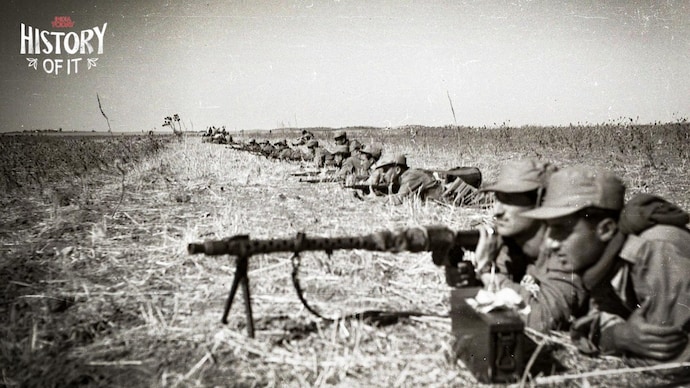
According to military historian Amitzur Ilan in The Origin of the Arab-Israeli Arms Race, the delivery of over 34,000 "Czech Mauser" (Kar98k) bolt-action rifles and more than 5,500 MG 34 and MG 42 machine guns allowed the newly formed Israel Defence Forces (IDF) to standardise its infantry units for the first time.
Prior to this, a single platoon could carry a mishmash of British, French, and homemade firearms, all requiring completely different calibres of ammunition. Standardising on the German 7.92mm cartridge (used by the Mauser rifles and the MG 34 and MG 42 machine guns) allowed Israeli commanders to launch their first coordinated, strategic counter-offensives, such as Operation Nachshon, which successfully broke the siege of Jerusalem.
The most dramatic application of this Nazi-pattern technology occurred in the air war. As aerial warfare historian Alex Yofe documents, Israel purchased 25 Avia S-199 fighter aircraft from Prague.
These planes were constructed using the leftover airframes of Germany's premier fighter, the Messerschmitt Bf 109, which had been manufactured under Nazi occupation at the Avia plant. Because the original German factories that produced the Daimler-Benz fighter engines had been destroyed by Allied bombing, the Czechs fitted the leftover Bf 109 airframes with heavy Junkers Jumo 211 engines, originally designed for German medium bombers.
The resulting hybrid aircraft was a mechanical nightmare. It was unbalanced, notoriously difficult to control during takeoff and landing, and Israeli pilots nicknamed it the Sakeen ("Knife").
The historical turning point occurred on May 29, 1948. A massive Egyptian armoured column of over 6,000 soldiers and dozens of tanks advanced rapidly, and was just 20 miles away from Tel Aviv, Israel's capital. With Israeli ground forces completely stretched, a newly formed squadron of four Avia S-199s launched a surprise bombing on the Egyptian lines.
While the actual structural damage caused by the erratic planes was minimal, the psychological shock was total. The Egyptian military command, completely unaware that Israel possessed any functioning air power, assumed they were facing a much larger, sophisticated force and immediately ordered their entire advance on Tel Aviv to halt. The capital was saved.
Israel ultimately beat back the five Arab armies. The 1948 Israeli-Arab War ended with the 1949 UN armistice agreements, leaving Israel in control of 78% of former Mandatory Palestine.
The monumental significance of this entire arms pipeline was best summarised by Israel's founder himself. In his personal archives and war diaries, Ben-Gurion in 1968 stated, "Czechoslovak arms saved the State of Israel, really and absolutely. Without these weapons, we wouldn't have survived". Those arms were either produced by the Third Reich or produced with leftover Nazi German parts.
In fact, Israeli veterans of the 1948 war would later place a plaque in Prague, acknowledging Czechoslovak's role in Israel's victory through the supply of arms and training. Some of the German weapons received in 1948, specifically the Mauser rifles, would stay on in Israeli service until the 1970s, either in the hands of reserve units, or converted into sniper rifles.
Thus, in one of history's most remarkable ironies, weapons originally manufactured for the wars of Nazi Germany, known for killing six million Jews, ended up saving the newly established Jewish state of Israel from an Arab invasion.
Jewish soldiers quietly infiltrated an abandoned British airstrip in the village of Beit Daras in what is now modern-day Palestine. They then proceeded to strangle the Palestinian soldiers guarding the base, and lit up the runway with torches. Within hours, a dual-engine Douglas DC-3, with a cache of weapons, including 200 rifles, 40 machine guns, and their ammunition, touched down. The arms were sold by Czechoslovakia to the soon-to-be-created Jewish state, and they had been produced by Nazi Germany.
It was March 31, 1948. Israel would be born six weeks later, on May 14, 1948.
Only 36 hours before, David Ben-Gurion, who would go on to become Israel's first Prime Minister, had sent an urgent telegram to Jewish agents in Europe, instructing them to buy as many weapons as they could get their hands on, and get them to Israel by hook or by crook.
There were intelligence inputs that the about-to-be independent state, already battling Palestinian militants and Arab volunteers for control of cities like Jerusalem, was about to face an invasion from a coalition of five Arab states. It needed weapons, and it needed them now.
In a series of airlifts and maritime smuggling operations in those six weeks, the Jewish people would eventually acquire the weapons that ensured Israel's victory in the 1948 Arab-Israeli war. And a significant chunk of those were produced by Nazi Germany, a country which had once strived for the extermination of the Jews.
Israel didn't get any help from the Americans because of an arms embargo in the Middle East by the US and the UN.
We are looking at the Arab-Israeli war and how Nazi Germany-made weapons were used by Israel in the 1948 war because of the warning from US Vice President JD Vance last week.
Vance, in response to criticism from Israeli ministers about the American interim peace deal with Iran, warned Israel's ministers against attacking its "only ally" in the region, pointing directly to Israel's dependence on imported US arms and ammunition.
It is a fact that despite developing an advanced domestic defence industry, Jerusalem has remained dependent on American weapons. Yet during its earliest years, Israel did not source its military equipment from the US.
In a strange twist of irony, weapons originally manufactured by the Nazi regime to fuel its conquests across Europe and North Africa, and for the systematic extermination of the Jewish people ultimately ended up arming the military forces defending the world's only Jewish nation immediately after its birth.
The story starts in 1948, when the newborn state of Israel, surrounded by hostile Arab neighbours, found itself amid conflict.
FIVE ARAB NATIONS ATTACKED ISRAEL JUST A DAY AFTER IT WAS BORN
The territory of Mandatory Palestine was divided into separate Jewish and Arab states and the plan was adopted by the UN General Assembly on November 29, 1947. According to the mandate, British forces had to withdraw from Mandatory Palestine by October 1948.
The UK's accelerated withdrawal plunged the area, comprising modern day Israel and Palestine, into chaos.
According to British government records and accounts of historians like Benny Morris, in 1948: A History of the First Arab-Israeli War, the departing British administration adopted a strict policy of non-intervention in the escalating communal violence between Jewish communities and local Arab populations.
As the British abandoned strategic outposts, police fortresses, and airfields, Jewish and Arab militias engaged in a frantic race to seize these positions.
On the eve of Israel's declaration of independence and before the start of the 1948 Arab-Israeli war, the military readiness of the Yishuv (the Jewish community) was fragile. The Jews didn't have a trained military but only underground militias, the largest of which was the Haganah.
In early May, the newly formed defence forces possessed no heavy artillery, no functional combat aircraft, and only a handful of light tanks. Infantry units shared a patchwork of smuggled, obsolete, or locally improvised weapons, leaving nearly one-third of the personnel completely unarmed.
Compounding this domestic shortage was international diplomatic isolation. Hoping to prevent a regional conflagration, the US State Department and the UNSC embargoed arms shipments to the Middle East.
This embargo hit the nascent Jewish state disproportionately. Neighbouring Arab nations, particularly Egypt and the Hashemite Kingdom of Transjordan, possessed conventional standing armies trained and equipped by the British.
Though the deadline was for October 1948, Britain completed its withdrawal on May 14. On the same day, David Ben-Gurion proclaimed the establishment of the State of Israel and became its first prime minister and defence minister.
A military coalition of five sovereign Arab states—Egypt, Transjordan, Syria, Lebanon, and Iraq—launched a coordinated, multi-front invasion, on May 15, starting the Arab-Israeli War of 1948.
HOW CZECHOSLOVAKIA BECAME NAZI GERMANY'S WEAPONS HUB
After the end of the Second World War, Europe was awash with surplus military gear, particularly German small arms. During their conquests, the Nazis built up vast stockpiles of arms and ammunition wherever they went. Crucially, they also converted local factories in occupied territories to mass-produce war equipment for the Wehrmacht (the German Armed Forces).
Czechoslovakia was a prime example. Prior to its occupation in 1938, the country boasted one of the most advanced defence industries in Europe. Upon taking over, the Nazis integrated this infrastructure into their war machine, using Czechoslovak factories to build everything from Mauser rifles and MG 34 machine guns to tanks and fighter aircraft.
By 1948, independent Czechoslovakia found itself holding massive stockpiles of German-pattern arms, alongside active factories still fully geared up to manufacture them. The Czechoslovak military had little use for this equipment, as the country was transitioning to standard Soviet-derived weaponry under growing communist influence.
However, there was one nation that could find a desperate, immediate use for these surplus arms: the newly born Israel.
HOW CZECHOSLOVAKIA SOLD ISRAEL NAZI WEAPONS UNDER A SECRET DEAL
For the nascent Israeli state, this Czechoslovak surplus became an unexpected lifeline. Facing an immediate invasion and restricted by the Western embargo, Israel had to look for alternative channels.
Israeli PM Shimon Peres detailed the Jewish state's defence pursuits in the book Ben-Gurion: A Political Life. Ben-Gurion dispatched Jewish Agency representative Ehud Avriel to Europe to secure weapons by any means. For context, the Jewish Agency served as the de facto, pre-state government for the Jewish community in Mandatory Palestine until Israel declared independence in 1948.
Upon arriving in Prague, Avriel found an ally in a cash-strapped Czechoslovak government enduring a severe post-war hard-currency crisis. According to fiscal analysis by military historian Amitzur Ilan in The Origin of the Arab-Israeli Arms Race, the Israeli contracts totalled to around $14.5 million, providing Prague with nearly one-third of its entire foreign currency income for 1948.
Facilitated directly by Czechoslovak Foreign Minister Jan Masaryk — as recounted in Avriel's memoir, Open the Gates! —secret contracts were signed in early 1948 using the state-owned Zbrojovka Brno arms company.
To shield the transaction from Western intelligence and United Nations embargo monitors, the operation required deep deception. As documented in Howard M Sachar's A History of Israel: From the Rise of Zionism to Our Time, the contracts were executed using a falsified paper trail, with the purchase orders written on official Ethiopian government stationery to falsely indicate that the German-pattern rifles and machine guns were bound for the Ministry of War in Addis Ababa.
HOW ISRAEL SMUGGLED IN ARMS BEATING EMBARGO
Acquiring the weapons on paper was only the first step; transporting military hardware past a British naval blockade and international radar was an entirely separate feat. The operation to move these arms to the frontlines was split into a covert airlift and a maritime smuggling ring.
The aerial pipeline was codenamed Operation Balak. As detailed by historian Arnold Krammer, the Czechoslovak government permitted the Israelis to use a former German airfield in the city of Zatec. To fly the planes, the Jewish Agency bypassed international law by utilising a front company called Lineas Aereas de Panama. They chartered and purchased surplus American heavy transport planes, including C-54 Skymasters, Curtiss C-46 Commandos, and Douglas DC-3s.
Operating under the cover of darkness, these transport planes made long flights from Czechoslovakia, refuelled at discreet locations in Europe, and made late-night landings at abandoned British airstrips in what is now Palestine, like the one at Beit Daras. The very first arms cargo arrived at Beit Daras on the night of March 31, 1948, just weeks before the formal Arab invasion.
For heavier bulk cargo, Israel relied on a maritime smuggling route. As documented by historian Howard M Sachar, massive quantities of German weapons were packed into crates in Czechoslovakia, transported by rail across Europe to the port of Sibenik (located in modern-day Croatia), and loaded onto cargo vessels.
To evade British naval patrols searching the ships bound for Palestine, the crates of German-pattern weapons were systematically buried under thousands of tons of onions, potatoes, and industrial salt.
HOW NAZI WEAPONS SAVED ISRAEL IN WAR AGAINST ARABS 1948
The influx of these German-designed weapons completely transformed the fortunes of the Israelis in 1948. Up until April 1948, the Haganah had been fighting a purely defensive, fragmented war because their underground units lacked standardised weapons and basic ammunition. The arrival of the Czechoslovak shipments changed everything.
According to military historian Amitzur Ilan in The Origin of the Arab-Israeli Arms Race, the delivery of over 34,000 "Czech Mauser" (Kar98k) bolt-action rifles and more than 5,500 MG 34 and MG 42 machine guns allowed the newly formed Israel Defence Forces (IDF) to standardise its infantry units for the first time.
Prior to this, a single platoon could carry a mishmash of British, French, and homemade firearms, all requiring completely different calibres of ammunition. Standardising on the German 7.92mm cartridge (used by the Mauser rifles and the MG 34 and MG 42 machine guns) allowed Israeli commanders to launch their first coordinated, strategic counter-offensives, such as Operation Nachshon, which successfully broke the siege of Jerusalem.
The most dramatic application of this Nazi-pattern technology occurred in the air war. As aerial warfare historian Alex Yofe documents, Israel purchased 25 Avia S-199 fighter aircraft from Prague.
These planes were constructed using the leftover airframes of Germany's premier fighter, the Messerschmitt Bf 109, which had been manufactured under Nazi occupation at the Avia plant. Because the original German factories that produced the Daimler-Benz fighter engines had been destroyed by Allied bombing, the Czechs fitted the leftover Bf 109 airframes with heavy Junkers Jumo 211 engines, originally designed for German medium bombers.
The resulting hybrid aircraft was a mechanical nightmare. It was unbalanced, notoriously difficult to control during takeoff and landing, and Israeli pilots nicknamed it the Sakeen ("Knife").
The historical turning point occurred on May 29, 1948. A massive Egyptian armoured column of over 6,000 soldiers and dozens of tanks advanced rapidly, and was just 20 miles away from Tel Aviv, Israel's capital. With Israeli ground forces completely stretched, a newly formed squadron of four Avia S-199s launched a surprise bombing on the Egyptian lines.
While the actual structural damage caused by the erratic planes was minimal, the psychological shock was total. The Egyptian military command, completely unaware that Israel possessed any functioning air power, assumed they were facing a much larger, sophisticated force and immediately ordered their entire advance on Tel Aviv to halt. The capital was saved.
Israel ultimately beat back the five Arab armies. The 1948 Israeli-Arab War ended with the 1949 UN armistice agreements, leaving Israel in control of 78% of former Mandatory Palestine.
The monumental significance of this entire arms pipeline was best summarised by Israel's founder himself. In his personal archives and war diaries, Ben-Gurion in 1968 stated, "Czechoslovak arms saved the State of Israel, really and absolutely. Without these weapons, we wouldn't have survived". Those arms were either produced by the Third Reich or produced with leftover Nazi German parts.
In fact, Israeli veterans of the 1948 war would later place a plaque in Prague, acknowledging Czechoslovak's role in Israel's victory through the supply of arms and training. Some of the German weapons received in 1948, specifically the Mauser rifles, would stay on in Israeli service until the 1970s, either in the hands of reserve units, or converted into sniper rifles.
Thus, in one of history's most remarkable ironies, weapons originally manufactured for the wars of Nazi Germany, known for killing six million Jews, ended up saving the newly established Jewish state of Israel from an Arab invasion.

