Ropes cut by ice at 8,000 metres, no oxygen: How deadliest day on K2 killed 11
K2's deadliest disaster unfolded on August 1, 2008, when a summit push by 30 climbers from across the world turned into a fight for survival. The recent Broad Peak avalanche that killed celebrated British-Nepali mountaineer Nirmal Purja, has renewed focus on the perilous Karakoram range. Here's how the ill-fated expedition unfolded 18 years ago.
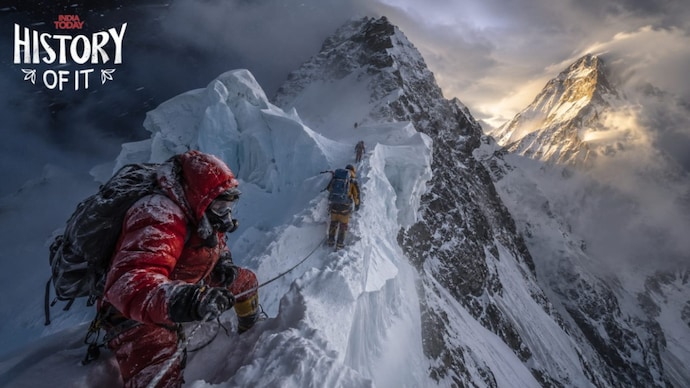
An exhausted group of mountaineers stood beneath a crystal-clear blue sky, their fists raised in triumph at the top of the world. They had just achieved what only an elite few had done before. They had summited K2, the world's toughest and one of its deadliest mountains.
But far below the celebrating climbers, disaster was already unfolding. A massive shelf of ice had collapsed, sweeping away climbers and cutting the fixed ropes that served as their only lifeline down the mountain. As journalist Graham Bowley wrote in his book, No Way Down: "They don't know it yet, but they will be forced to descend into the darkness with no lines." On August 1, 2008, 11 elite climbers would lose their lives, making it the deadliest disaster in K2's history.
On the night of July 31, 2008, around 30 climbers from across the world left Camp IV, perched at nearly 7,900 metres on K2, for their summit push. By August 2, 11 of them were dead, swept away by avalanches, killed in falls, or succumbing to cold and exhaustion in the mountain's 8,000-metre death zone.
The reason we are telling you this story is because of another tragedy that unfolded recently on Broad Peak, the world's 12th-highest mountain in the Karakoram range in Pakistan Occupied Kashmir, just eight kilometres from K2. On July 31, 2026, an avalanche struck an international climbing team between Camp II and Camp III, at an altitude of about 6,600 metres, killing 11 mountaineers.
Among the dead was Nirmal Purja, the celebrated British-Nepali climber who summited all 14 of the world's 8,000-metre peaks in just over six months and was known for his unwavering mantra, "Giving up is not in the blood, sir."
Also among those killed were some of Nepal's finest mountaineers, including Kili Pemba Sherpa, Pur Bahadur Gurung, Nima Sherpa, Nawang Thendu Sherpa and Gyaljen Sherpa — whose combined decades of high-altitude experience, leadership and expertise had guided countless climbers safely through the Himalayas and Karakoram.
Broad Peak, where nearly an entire generation of Nepal's finest were lost, lies in the same Karakoram range as K2. For more than a century, K2 has stood as the ultimate prize in mountaineering. Despite being shorter than Everest, K2 is an unforgiving peak that only the world's finest climbers dare attempt to conquer. Yet, as the events of August 1, 2008 showed, the mountain has long demanded a terrible price from those who attempt to claim its summit.
THE DEADLY ALLURE OF K2
"K2 is a savage mountain that tries to kill you." This was what George Bell, a member of the failed 1953 American K2 expedition had to say about the mountain, which, thanks to him, would acquire the nickname of "The Savage Mountain".
K2, also known as Mount Godwin-Austen, is the world's second-highest mountain at 8,611 metres. Located in the Karakoram range, it straddles Pakistan-Occupied Kashmir and China's Xinjiang region.
Yet, despite standing lower than Mount Everest (8,849 metres), K2 is considered a far more difficult and dangerous climb. As American mountaineer Ed Viesturs, the first American to summit all 14 of the world's 8,000-metre peaks without supplemental oxygen, put it, "K2 does not forgive mistakes. On Everest you can make a mistake and survive, but on K2 if you make a mistake, you die."
As of 2025, only about 964 people have successfully summited K2. By comparison, Mount Everest has seen an estimated 13,737 successful ascents. The human cost of attempting K2 remains staggering. By 2025, the mountain's butcher's bill stood at 96 lives. That means roughly one in every 10 climbers who have attempted K2 has never returned.
This, however, does not stop those who dare from making the climb, regardless of the risks. As Gerlinde Kaltenbrunner, the first woman to summit all 14 8,000-metre peaks without supplemental oxygen, put it, "K2 is the mountain of mountains. It's the purest pyramid, the ultimate challenge."
WHY IS THE K2 CLIMB SO DIFFICULT
Unlike Everest, which has relatively gentler sections and established routes, K2 is a relentlessly steep climb from base to summit. The mountain rises like a near-perfect pyramid, with slopes often between 45 and 80 degrees, forcing climbers to remain on crampons and ice axes for much of the ascent.
Unlike Everest's long trekking sections, K2 demands continuous rock, ice and mixed climbing, with notorious obstacles such as House's Chimney and the Black Pyramid.
The greatest danger comes near the summit, inside the "Death Zone" above 8,000 metres, where climbers must pass through the infamous Bottleneck at around 8,200 metres. This narrow, steep gorge sits directly beneath a massive hanging serac, a towering wall of unstable ice that can collapse without warning.
Reaching its base camp itself requires an arduous trek across the Baltoro Glacier, while rescue operations are notoriously difficult due to the mountain's remoteness and extreme conditions.
Lino Lacedelli, an Italian climber who, along with Achille Compagnoni, made the first historic ascent of K2 in 1954, said, "Up there, you are not fighting against the mountain, you are fighting against yourself, against your own body that wants to stop, to rest, to sleep."
K2's main climbing season runs from late June to early August, when weather conditions are more favourable in the Karakoram range. Teams need to spend weeks acclimatising, establishing camps and fixing ropes, before making the final push between July and August.
K2 has several routes, but the most common is the Abruzzi Spur, first climbed in 1954 by an Italian expedition. Other routes include the Magic Line, the Cesen Route, and the remote North Ridge from the Chinese side.
Unlike Everest's commercialised South Col route, K2 has no easy path to the summit. Mountaineer Reinhold Messner, the first person to climb all 14 eight-thousanders, said, "There are no easy routes on K2; there are only bad routes and worse routes."
HOW THE DEADLIEST DAY IN THE HISTORY OF K2 UNFOLDED
The July-August 2008 climbing season on K2 was an unusually busy one. Around 30 experienced climbers from across the world had gathered at the mountain's base camp, representing expeditions from the US, France, Norway, Serbia, South Korea, Nepal, the Netherlands, Spain and Italy, alongside Nepali Sherpas supporting the Korean team and Pakistani High Altitude Porters (HAPs).
Despite their collective experience, almost none of the climbers had previously stood on K2's summit. The sole exception was Pakistani HAP Shaheen Baig, who had successfully reached the top of K2 in 2004.
On July 31, 2008, these 30 climbers reached Camp IV, located at around 7,800–7,950 metres, just below the beginning of the "death zone". The term refers to altitudes above 8,000 metres, where the human body can no longer properly acclimatise to the extreme lack of oxygen. Simply put, at this height, both body and mind begin to deteriorate rapidly.
On the midnight of July 31, the Sherpas and the HAPs started to prepare the route to the summit and fix ropes. This is where the first complication arose. Shaheen Baig, the most experienced HAP, ended up with a bout of altitude sickness and turned back, unintentionally taking critical gear with him. The remaining less-experienced porters and Sherpas misplace ropes on lower sections, leaving the dangerous Bottleneck (a narrow gorge surrounded by hanging sheets of ice) section under-roped.
Around 3 am on August 1, climbers began leaving Camp IV in darkness and freezing temperatures for the summit. Among them were Norwegian climbers Rolf Bae and Cecilie Skog, Irish climber Gerard McDonnell, French climber Hugues d'Aubarede, Serbian climber Dren Mandic, and Dutch climber Wilco van Rooijen.
As climbers approached the Bottleneck at around 8,200 metres, well within the Death Zone, they encountered delays because of improperly placed ropes. The congestion forced some climbers, including Eric Meyer and Fredrik Strang, to abandon their summit attempts and return to Camp IV.
Disaster struck soon. Dren Mandic, fell while moving past another climber and died from his injuries. Later, Pakistani HAP Jehan Baig died after falling while attempting to assist with recovering Mandic's body. The climb, however, did not stop.
Spaniard Alberto Zerain reached the summit first and descended safely. However, many climbers continued their ascent late into the day. A total of 18 climbers reached the summit on August 1, with some arriving as late as evening — well beyond the recommended turnaround time in the death zone.
Among those who summited was Norwegian climber Rolf Bae, who later turned back just below the top to wait for his wife Cecilie Skog.
Then, disaster struck.
During the descent, Bae, Skog and Norwegian climber Lars Nessa were caught near the Bottleneck when one of the massive seracs collapsed, sending ice and debris down the mountain. Bae was swept away and killed, right in front of his wife Cecile.
The collapse destroyed most of the fixed ropes, leaving climbers stranded high on K2 without their main route of descent. Several climbers were forced to attempt dangerous descents, without protection, running out of oxygen, and in the darkness of the night. And remember, they were in the death zone, where humans practically start dying from the lack of oxygen, and well beyond the recommended turnaround time.
French climber Hugues d'Aubarde died while attempting to descend without fixed ropes. Meanwhile, Gerard McDonnell, Marco Confortola of Italy and Wilco van Rooijen of the Netherlands spent the night exposed above 8,000 metres after becoming trapped on the upper mountains.
Skog and Nessa managed to descend through the Bottleneck and reach Camp IV, while others remained stranded in the death zone as temperatures plunged and exhaustion set in.
In the early hours of August 2, McDonnell helped free several trapped Korean climbers and their Sherpa companions who had become entangled in ropes. He was later separated from the group and died during the descent; accounts differ on whether he was swept away by an avalanche or died after falling.
A further avalanche and ice collapse killed additional climbers, including South Korean climbers and Nepali Sherpas, bringing the final death toll to 11. The victims included climbers from South Korea, France, Ireland, Norway, Pakistan and Serbia.
The survivors faced a desperate descent. Wilco van Rooijen eventually reached safety after suffering severe frostbite, later requiring toe amputations. Marco Confortola, also badly frostbitten, was the last survivor, reaching the Base Camp on August 5 and was evacuated by helicopter on August 6, 2008.
When climbers reach the base of K2 in an area called Concordia, they can find a stone monument called the Gilkey Memorial, named after American climber Art Gilkey. According to some accounts, while suffering from blood clots high on K2, Gilkey sacrificed himself to avoid becoming a burden on his team.
The monument remains today as a tribute to the hundreds of climbers who have died attempting to summit K2, including the 11 climbers who lost their lives on August 1, 2008 — the deadliest day on the world's deadliest mountain.
An exhausted group of mountaineers stood beneath a crystal-clear blue sky, their fists raised in triumph at the top of the world. They had just achieved what only an elite few had done before. They had summited K2, the world's toughest and one of its deadliest mountains.
But far below the celebrating climbers, disaster was already unfolding. A massive shelf of ice had collapsed, sweeping away climbers and cutting the fixed ropes that served as their only lifeline down the mountain. As journalist Graham Bowley wrote in his book, No Way Down: "They don't know it yet, but they will be forced to descend into the darkness with no lines." On August 1, 2008, 11 elite climbers would lose their lives, making it the deadliest disaster in K2's history.
On the night of July 31, 2008, around 30 climbers from across the world left Camp IV, perched at nearly 7,900 metres on K2, for their summit push. By August 2, 11 of them were dead, swept away by avalanches, killed in falls, or succumbing to cold and exhaustion in the mountain's 8,000-metre death zone.
The reason we are telling you this story is because of another tragedy that unfolded recently on Broad Peak, the world's 12th-highest mountain in the Karakoram range in Pakistan Occupied Kashmir, just eight kilometres from K2. On July 31, 2026, an avalanche struck an international climbing team between Camp II and Camp III, at an altitude of about 6,600 metres, killing 11 mountaineers.
Among the dead was Nirmal Purja, the celebrated British-Nepali climber who summited all 14 of the world's 8,000-metre peaks in just over six months and was known for his unwavering mantra, "Giving up is not in the blood, sir."
Also among those killed were some of Nepal's finest mountaineers, including Kili Pemba Sherpa, Pur Bahadur Gurung, Nima Sherpa, Nawang Thendu Sherpa and Gyaljen Sherpa — whose combined decades of high-altitude experience, leadership and expertise had guided countless climbers safely through the Himalayas and Karakoram.
Broad Peak, where nearly an entire generation of Nepal's finest were lost, lies in the same Karakoram range as K2. For more than a century, K2 has stood as the ultimate prize in mountaineering. Despite being shorter than Everest, K2 is an unforgiving peak that only the world's finest climbers dare attempt to conquer. Yet, as the events of August 1, 2008 showed, the mountain has long demanded a terrible price from those who attempt to claim its summit.
THE DEADLY ALLURE OF K2
"K2 is a savage mountain that tries to kill you." This was what George Bell, a member of the failed 1953 American K2 expedition had to say about the mountain, which, thanks to him, would acquire the nickname of "The Savage Mountain".
K2, also known as Mount Godwin-Austen, is the world's second-highest mountain at 8,611 metres. Located in the Karakoram range, it straddles Pakistan-Occupied Kashmir and China's Xinjiang region.
Yet, despite standing lower than Mount Everest (8,849 metres), K2 is considered a far more difficult and dangerous climb. As American mountaineer Ed Viesturs, the first American to summit all 14 of the world's 8,000-metre peaks without supplemental oxygen, put it, "K2 does not forgive mistakes. On Everest you can make a mistake and survive, but on K2 if you make a mistake, you die."
As of 2025, only about 964 people have successfully summited K2. By comparison, Mount Everest has seen an estimated 13,737 successful ascents. The human cost of attempting K2 remains staggering. By 2025, the mountain's butcher's bill stood at 96 lives. That means roughly one in every 10 climbers who have attempted K2 has never returned.
This, however, does not stop those who dare from making the climb, regardless of the risks. As Gerlinde Kaltenbrunner, the first woman to summit all 14 8,000-metre peaks without supplemental oxygen, put it, "K2 is the mountain of mountains. It's the purest pyramid, the ultimate challenge."
WHY IS THE K2 CLIMB SO DIFFICULT
Unlike Everest, which has relatively gentler sections and established routes, K2 is a relentlessly steep climb from base to summit. The mountain rises like a near-perfect pyramid, with slopes often between 45 and 80 degrees, forcing climbers to remain on crampons and ice axes for much of the ascent.
Unlike Everest's long trekking sections, K2 demands continuous rock, ice and mixed climbing, with notorious obstacles such as House's Chimney and the Black Pyramid.
The greatest danger comes near the summit, inside the "Death Zone" above 8,000 metres, where climbers must pass through the infamous Bottleneck at around 8,200 metres. This narrow, steep gorge sits directly beneath a massive hanging serac, a towering wall of unstable ice that can collapse without warning.
Reaching its base camp itself requires an arduous trek across the Baltoro Glacier, while rescue operations are notoriously difficult due to the mountain's remoteness and extreme conditions.
Lino Lacedelli, an Italian climber who, along with Achille Compagnoni, made the first historic ascent of K2 in 1954, said, "Up there, you are not fighting against the mountain, you are fighting against yourself, against your own body that wants to stop, to rest, to sleep."
K2's main climbing season runs from late June to early August, when weather conditions are more favourable in the Karakoram range. Teams need to spend weeks acclimatising, establishing camps and fixing ropes, before making the final push between July and August.
K2 has several routes, but the most common is the Abruzzi Spur, first climbed in 1954 by an Italian expedition. Other routes include the Magic Line, the Cesen Route, and the remote North Ridge from the Chinese side.
Unlike Everest's commercialised South Col route, K2 has no easy path to the summit. Mountaineer Reinhold Messner, the first person to climb all 14 eight-thousanders, said, "There are no easy routes on K2; there are only bad routes and worse routes."
HOW THE DEADLIEST DAY IN THE HISTORY OF K2 UNFOLDED
The July-August 2008 climbing season on K2 was an unusually busy one. Around 30 experienced climbers from across the world had gathered at the mountain's base camp, representing expeditions from the US, France, Norway, Serbia, South Korea, Nepal, the Netherlands, Spain and Italy, alongside Nepali Sherpas supporting the Korean team and Pakistani High Altitude Porters (HAPs).
Despite their collective experience, almost none of the climbers had previously stood on K2's summit. The sole exception was Pakistani HAP Shaheen Baig, who had successfully reached the top of K2 in 2004.
On July 31, 2008, these 30 climbers reached Camp IV, located at around 7,800–7,950 metres, just below the beginning of the "death zone". The term refers to altitudes above 8,000 metres, where the human body can no longer properly acclimatise to the extreme lack of oxygen. Simply put, at this height, both body and mind begin to deteriorate rapidly.
On the midnight of July 31, the Sherpas and the HAPs started to prepare the route to the summit and fix ropes. This is where the first complication arose. Shaheen Baig, the most experienced HAP, ended up with a bout of altitude sickness and turned back, unintentionally taking critical gear with him. The remaining less-experienced porters and Sherpas misplace ropes on lower sections, leaving the dangerous Bottleneck (a narrow gorge surrounded by hanging sheets of ice) section under-roped.
Around 3 am on August 1, climbers began leaving Camp IV in darkness and freezing temperatures for the summit. Among them were Norwegian climbers Rolf Bae and Cecilie Skog, Irish climber Gerard McDonnell, French climber Hugues d'Aubarede, Serbian climber Dren Mandic, and Dutch climber Wilco van Rooijen.
As climbers approached the Bottleneck at around 8,200 metres, well within the Death Zone, they encountered delays because of improperly placed ropes. The congestion forced some climbers, including Eric Meyer and Fredrik Strang, to abandon their summit attempts and return to Camp IV.
Disaster struck soon. Dren Mandic, fell while moving past another climber and died from his injuries. Later, Pakistani HAP Jehan Baig died after falling while attempting to assist with recovering Mandic's body. The climb, however, did not stop.
Spaniard Alberto Zerain reached the summit first and descended safely. However, many climbers continued their ascent late into the day. A total of 18 climbers reached the summit on August 1, with some arriving as late as evening — well beyond the recommended turnaround time in the death zone.
Among those who summited was Norwegian climber Rolf Bae, who later turned back just below the top to wait for his wife Cecilie Skog.
Then, disaster struck.
During the descent, Bae, Skog and Norwegian climber Lars Nessa were caught near the Bottleneck when one of the massive seracs collapsed, sending ice and debris down the mountain. Bae was swept away and killed, right in front of his wife Cecile.
The collapse destroyed most of the fixed ropes, leaving climbers stranded high on K2 without their main route of descent. Several climbers were forced to attempt dangerous descents, without protection, running out of oxygen, and in the darkness of the night. And remember, they were in the death zone, where humans practically start dying from the lack of oxygen, and well beyond the recommended turnaround time.
French climber Hugues d'Aubarde died while attempting to descend without fixed ropes. Meanwhile, Gerard McDonnell, Marco Confortola of Italy and Wilco van Rooijen of the Netherlands spent the night exposed above 8,000 metres after becoming trapped on the upper mountains.
Skog and Nessa managed to descend through the Bottleneck and reach Camp IV, while others remained stranded in the death zone as temperatures plunged and exhaustion set in.
In the early hours of August 2, McDonnell helped free several trapped Korean climbers and their Sherpa companions who had become entangled in ropes. He was later separated from the group and died during the descent; accounts differ on whether he was swept away by an avalanche or died after falling.
A further avalanche and ice collapse killed additional climbers, including South Korean climbers and Nepali Sherpas, bringing the final death toll to 11. The victims included climbers from South Korea, France, Ireland, Norway, Pakistan and Serbia.
The survivors faced a desperate descent. Wilco van Rooijen eventually reached safety after suffering severe frostbite, later requiring toe amputations. Marco Confortola, also badly frostbitten, was the last survivor, reaching the Base Camp on August 5 and was evacuated by helicopter on August 6, 2008.
When climbers reach the base of K2 in an area called Concordia, they can find a stone monument called the Gilkey Memorial, named after American climber Art Gilkey. According to some accounts, while suffering from blood clots high on K2, Gilkey sacrificed himself to avoid becoming a burden on his team.
The monument remains today as a tribute to the hundreds of climbers who have died attempting to summit K2, including the 11 climbers who lost their lives on August 1, 2008 — the deadliest day on the world's deadliest mountain.
An exhausted group of mountaineers stood beneath a crystal-clear blue sky, their fists raised in triumph at the top of the world. They had just achieved what only an elite few had done before. They had summited K2, the world's toughest and one of its deadliest mountains.
But far below the celebrating climbers, disaster was already unfolding. A massive shelf of ice had collapsed, sweeping away climbers and cutting the fixed ropes that served as their only lifeline down the mountain. As journalist Graham Bowley wrote in his book, No Way Down: "They don't know it yet, but they will be forced to descend into the darkness with no lines." On August 1, 2008, 11 elite climbers would lose their lives, making it the deadliest disaster in K2's history.
On the night of July 31, 2008, around 30 climbers from across the world left Camp IV, perched at nearly 7,900 metres on K2, for their summit push. By August 2, 11 of them were dead, swept away by avalanches, killed in falls, or succumbing to cold and exhaustion in the mountain's 8,000-metre death zone.
The reason we are telling you this story is because of another tragedy that unfolded recently on Broad Peak, the world's 12th-highest mountain in the Karakoram range in Pakistan Occupied Kashmir, just eight kilometres from K2. On July 31, 2026, an avalanche struck an international climbing team between Camp II and Camp III, at an altitude of about 6,600 metres, killing 11 mountaineers.
Among the dead was Nirmal Purja, the celebrated British-Nepali climber who summited all 14 of the world's 8,000-metre peaks in just over six months and was known for his unwavering mantra, "Giving up is not in the blood, sir."
Also among those killed were some of Nepal's finest mountaineers, including Kili Pemba Sherpa, Pur Bahadur Gurung, Nima Sherpa, Nawang Thendu Sherpa and Gyaljen Sherpa — whose combined decades of high-altitude experience, leadership and expertise had guided countless climbers safely through the Himalayas and Karakoram.
Broad Peak, where nearly an entire generation of Nepal's finest were lost, lies in the same Karakoram range as K2. For more than a century, K2 has stood as the ultimate prize in mountaineering. Despite being shorter than Everest, K2 is an unforgiving peak that only the world's finest climbers dare attempt to conquer. Yet, as the events of August 1, 2008 showed, the mountain has long demanded a terrible price from those who attempt to claim its summit.
THE DEADLY ALLURE OF K2
"K2 is a savage mountain that tries to kill you." This was what George Bell, a member of the failed 1953 American K2 expedition had to say about the mountain, which, thanks to him, would acquire the nickname of "The Savage Mountain".
K2, also known as Mount Godwin-Austen, is the world's second-highest mountain at 8,611 metres. Located in the Karakoram range, it straddles Pakistan-Occupied Kashmir and China's Xinjiang region.
Yet, despite standing lower than Mount Everest (8,849 metres), K2 is considered a far more difficult and dangerous climb. As American mountaineer Ed Viesturs, the first American to summit all 14 of the world's 8,000-metre peaks without supplemental oxygen, put it, "K2 does not forgive mistakes. On Everest you can make a mistake and survive, but on K2 if you make a mistake, you die."
As of 2025, only about 964 people have successfully summited K2. By comparison, Mount Everest has seen an estimated 13,737 successful ascents. The human cost of attempting K2 remains staggering. By 2025, the mountain's butcher's bill stood at 96 lives. That means roughly one in every 10 climbers who have attempted K2 has never returned.
This, however, does not stop those who dare from making the climb, regardless of the risks. As Gerlinde Kaltenbrunner, the first woman to summit all 14 8,000-metre peaks without supplemental oxygen, put it, "K2 is the mountain of mountains. It's the purest pyramid, the ultimate challenge."
WHY IS THE K2 CLIMB SO DIFFICULT
Unlike Everest, which has relatively gentler sections and established routes, K2 is a relentlessly steep climb from base to summit. The mountain rises like a near-perfect pyramid, with slopes often between 45 and 80 degrees, forcing climbers to remain on crampons and ice axes for much of the ascent.
Unlike Everest's long trekking sections, K2 demands continuous rock, ice and mixed climbing, with notorious obstacles such as House's Chimney and the Black Pyramid.
The greatest danger comes near the summit, inside the "Death Zone" above 8,000 metres, where climbers must pass through the infamous Bottleneck at around 8,200 metres. This narrow, steep gorge sits directly beneath a massive hanging serac, a towering wall of unstable ice that can collapse without warning.
Reaching its base camp itself requires an arduous trek across the Baltoro Glacier, while rescue operations are notoriously difficult due to the mountain's remoteness and extreme conditions.
Lino Lacedelli, an Italian climber who, along with Achille Compagnoni, made the first historic ascent of K2 in 1954, said, "Up there, you are not fighting against the mountain, you are fighting against yourself, against your own body that wants to stop, to rest, to sleep."
K2's main climbing season runs from late June to early August, when weather conditions are more favourable in the Karakoram range. Teams need to spend weeks acclimatising, establishing camps and fixing ropes, before making the final push between July and August.
K2 has several routes, but the most common is the Abruzzi Spur, first climbed in 1954 by an Italian expedition. Other routes include the Magic Line, the Cesen Route, and the remote North Ridge from the Chinese side.
Unlike Everest's commercialised South Col route, K2 has no easy path to the summit. Mountaineer Reinhold Messner, the first person to climb all 14 eight-thousanders, said, "There are no easy routes on K2; there are only bad routes and worse routes."
HOW THE DEADLIEST DAY IN THE HISTORY OF K2 UNFOLDED
The July-August 2008 climbing season on K2 was an unusually busy one. Around 30 experienced climbers from across the world had gathered at the mountain's base camp, representing expeditions from the US, France, Norway, Serbia, South Korea, Nepal, the Netherlands, Spain and Italy, alongside Nepali Sherpas supporting the Korean team and Pakistani High Altitude Porters (HAPs).
Despite their collective experience, almost none of the climbers had previously stood on K2's summit. The sole exception was Pakistani HAP Shaheen Baig, who had successfully reached the top of K2 in 2004.
On July 31, 2008, these 30 climbers reached Camp IV, located at around 7,800–7,950 metres, just below the beginning of the "death zone". The term refers to altitudes above 8,000 metres, where the human body can no longer properly acclimatise to the extreme lack of oxygen. Simply put, at this height, both body and mind begin to deteriorate rapidly.
On the midnight of July 31, the Sherpas and the HAPs started to prepare the route to the summit and fix ropes. This is where the first complication arose. Shaheen Baig, the most experienced HAP, ended up with a bout of altitude sickness and turned back, unintentionally taking critical gear with him. The remaining less-experienced porters and Sherpas misplace ropes on lower sections, leaving the dangerous Bottleneck (a narrow gorge surrounded by hanging sheets of ice) section under-roped.
Around 3 am on August 1, climbers began leaving Camp IV in darkness and freezing temperatures for the summit. Among them were Norwegian climbers Rolf Bae and Cecilie Skog, Irish climber Gerard McDonnell, French climber Hugues d'Aubarede, Serbian climber Dren Mandic, and Dutch climber Wilco van Rooijen.
As climbers approached the Bottleneck at around 8,200 metres, well within the Death Zone, they encountered delays because of improperly placed ropes. The congestion forced some climbers, including Eric Meyer and Fredrik Strang, to abandon their summit attempts and return to Camp IV.
Disaster struck soon. Dren Mandic, fell while moving past another climber and died from his injuries. Later, Pakistani HAP Jehan Baig died after falling while attempting to assist with recovering Mandic's body. The climb, however, did not stop.
Spaniard Alberto Zerain reached the summit first and descended safely. However, many climbers continued their ascent late into the day. A total of 18 climbers reached the summit on August 1, with some arriving as late as evening — well beyond the recommended turnaround time in the death zone.
Among those who summited was Norwegian climber Rolf Bae, who later turned back just below the top to wait for his wife Cecilie Skog.
Then, disaster struck.
During the descent, Bae, Skog and Norwegian climber Lars Nessa were caught near the Bottleneck when one of the massive seracs collapsed, sending ice and debris down the mountain. Bae was swept away and killed, right in front of his wife Cecile.
The collapse destroyed most of the fixed ropes, leaving climbers stranded high on K2 without their main route of descent. Several climbers were forced to attempt dangerous descents, without protection, running out of oxygen, and in the darkness of the night. And remember, they were in the death zone, where humans practically start dying from the lack of oxygen, and well beyond the recommended turnaround time.
French climber Hugues d'Aubarde died while attempting to descend without fixed ropes. Meanwhile, Gerard McDonnell, Marco Confortola of Italy and Wilco van Rooijen of the Netherlands spent the night exposed above 8,000 metres after becoming trapped on the upper mountains.
Skog and Nessa managed to descend through the Bottleneck and reach Camp IV, while others remained stranded in the death zone as temperatures plunged and exhaustion set in.
In the early hours of August 2, McDonnell helped free several trapped Korean climbers and their Sherpa companions who had become entangled in ropes. He was later separated from the group and died during the descent; accounts differ on whether he was swept away by an avalanche or died after falling.
A further avalanche and ice collapse killed additional climbers, including South Korean climbers and Nepali Sherpas, bringing the final death toll to 11. The victims included climbers from South Korea, France, Ireland, Norway, Pakistan and Serbia.
The survivors faced a desperate descent. Wilco van Rooijen eventually reached safety after suffering severe frostbite, later requiring toe amputations. Marco Confortola, also badly frostbitten, was the last survivor, reaching the Base Camp on August 5 and was evacuated by helicopter on August 6, 2008.
When climbers reach the base of K2 in an area called Concordia, they can find a stone monument called the Gilkey Memorial, named after American climber Art Gilkey. According to some accounts, while suffering from blood clots high on K2, Gilkey sacrificed himself to avoid becoming a burden on his team.
The monument remains today as a tribute to the hundreds of climbers who have died attempting to summit K2, including the 11 climbers who lost their lives on August 1, 2008 — the deadliest day on the world's deadliest mountain.

