Chalo Jaipur: Why Karni Sena shifted from street muscle-flexing to silent march
Karni Sena chief Mahipal Makrana's 800-km-long protest padyatra stuck to peace despite a police crackdown, signalling mass mobilisation over public confrontation
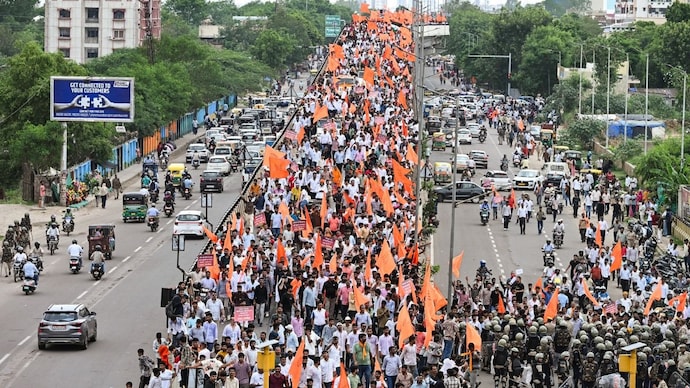
Nevertheless, the march, which had begun on July 21, ended on a violent note on August 3 when police used canes and water cannons against protesters attempting to reach the collectorate by allegedly breaking security barricades.
The death of protester Devraj Singh Palara added a political flashpoint to the events. Palara’s family and the Karni Sena allege his condition deteriorated after being impacted by a water cannon. The claim is yet to be officially established. The Karni Sena is demanding Rs 1 crore as compensation for Palara and a government job for his family, and has otherwise threatened a shutdown of Rajasthan. The government has reportedly offered Rs 21 lakh so far and an investigation into the death.
But the larger story lies elsewhere. Is Makrana transforming himself into a newer avatar of Rajput mobilisation? Unlike previous Karni Sena agitations, his padyatra remained peaceful despite the police crackdown. There was no retaliation against public property or the police, perhaps indicating a preference for mass mobilisation over public confrontation.
Makrana is also seen as trying to broaden the movement beyond Rajput identity. Defending the demand for withdrawal of the UGC regulations rather than merely keeping them under judicial scrutiny, he told INDIA TODAY: “Ours is a valid concern. The UGC provisions presume that general category students are aggressors and oppressors. We fear that even if an SC/ST person approaches a Rajput with a marriage proposal and is refused, it could invite allegations of discrimination.”
The Promotion of Equity in Higher Education Institutions Regulations claim to stop discrimination on Indian campuses on the basis of caste, religion, gender and disability, and ensure a level playing field for all stakeholders. Critics have dubbed the norms as biased against ‘general category’ individuals. Whether or not legally tenable, Makrana’s argument is designed to resonate beyond Rajputs to the wider ‘general category’ constituency.
Another issue he has picked is the Economic Weaker Sections (EWS) quota. Along with Yogendra Singh Rathod, executive president of Samta Andolan, Makrana wants Rajasthan's EWS landholding criteria aligned with the state's OBC norms. In western Rajasthan, families often own large but low-productivity landholdings, leaving many outside the EWS quota net despite modest incomes.
Rathod's experience offers a reality check. For years, Samta Andolan sought to unite communities around reservation reforms and OBC sub-categorisation. Despite sustained campaigns and favourable judicial observations on sub-categorisation, the movement struggled to convert social support into electoral influence.
Makrana faces a similar challenge if he hopes to build a coalition cutting across general castes. His rise also reflects growing disenchantment with established Rajput politicians across parties. On social media, many Rajput voices accuse senior leaders of pursuing dynastic politics while neglecting the community’s concerns.
There is particular resentment over how emerging leaders such as Devi Singh Shekhawat and Anshuman Singh Bhati, both first-time BJP MLAs with strong local support, allegedly faced resistance from influential Rajput leaders during poll ticket distribution and electioneering. Many within the community see this as evidence that established Rajput leaders are unwilling to allow a new generation to emerge.
The Karni Sena also lacks a visible bench of sophisticated, educated and intellectual faces—something essential if it hopes to evolve from a community-based outfit into a broader movement representing general caste interests. Many young Rajputs see themselves as major sufferers of caste reservations. Despite the traditional preference for defence forces, they have increasingly lost their foothold in qualifying as soldiers.
Opportunities as administrators have suffered, with not many of them focused on studying hard, unlike Jats who strive to get through competitive examinations. The correct focus for modern times is also lacking. No wonder, in 2017, they gathered in big numbers in violent protests over the suspected encounter killing of Anand Pal Singh, a Rawana Rajput gangster with a Robin Hood image and a counter to Jat rivals.
That dissatisfaction creates an opening for Makrana. But turning emotional mobilisation into political capital would require far more than successful protests. Rajputs have historically remained among the BJP's most loyal voters. Unless Makrana can expand his appeal to other general category communities on issues such as the UGC regulations and EWS criteria, his influence may remain confined to symbolic street politics.
Yet the Jaipur march has certainly announced a new political player. Whether it marks the birth of a broader social movement or remains another episode of community mobilisation depends on what comes after the slogans fall silent.
Subscribe to India Today Magazine
Nevertheless, the march, which had begun on July 21, ended on a violent note on August 3 when police used canes and water cannons against protesters attempting to reach the collectorate by allegedly breaking security barricades.
The death of protester Devraj Singh Palara added a political flashpoint to the events. Palara’s family and the Karni Sena allege his condition deteriorated after being impacted by a water cannon. The claim is yet to be officially established. The Karni Sena is demanding Rs 1 crore as compensation for Palara and a government job for his family, and has otherwise threatened a shutdown of Rajasthan. The government has reportedly offered Rs 21 lakh so far and an investigation into the death.
But the larger story lies elsewhere. Is Makrana transforming himself into a newer avatar of Rajput mobilisation? Unlike previous Karni Sena agitations, his padyatra remained peaceful despite the police crackdown. There was no retaliation against public property or the police, perhaps indicating a preference for mass mobilisation over public confrontation.
Makrana is also seen as trying to broaden the movement beyond Rajput identity. Defending the demand for withdrawal of the UGC regulations rather than merely keeping them under judicial scrutiny, he told INDIA TODAY: “Ours is a valid concern. The UGC provisions presume that general category students are aggressors and oppressors. We fear that even if an SC/ST person approaches a Rajput with a marriage proposal and is refused, it could invite allegations of discrimination.”
The Promotion of Equity in Higher Education Institutions Regulations claim to stop discrimination on Indian campuses on the basis of caste, religion, gender and disability, and ensure a level playing field for all stakeholders. Critics have dubbed the norms as biased against ‘general category’ individuals. Whether or not legally tenable, Makrana’s argument is designed to resonate beyond Rajputs to the wider ‘general category’ constituency.
Another issue he has picked is the Economic Weaker Sections (EWS) quota. Along with Yogendra Singh Rathod, executive president of Samta Andolan, Makrana wants Rajasthan's EWS landholding criteria aligned with the state's OBC norms. In western Rajasthan, families often own large but low-productivity landholdings, leaving many outside the EWS quota net despite modest incomes.
Rathod's experience offers a reality check. For years, Samta Andolan sought to unite communities around reservation reforms and OBC sub-categorisation. Despite sustained campaigns and favourable judicial observations on sub-categorisation, the movement struggled to convert social support into electoral influence.
Makrana faces a similar challenge if he hopes to build a coalition cutting across general castes. His rise also reflects growing disenchantment with established Rajput politicians across parties. On social media, many Rajput voices accuse senior leaders of pursuing dynastic politics while neglecting the community’s concerns.
There is particular resentment over how emerging leaders such as Devi Singh Shekhawat and Anshuman Singh Bhati, both first-time BJP MLAs with strong local support, allegedly faced resistance from influential Rajput leaders during poll ticket distribution and electioneering. Many within the community see this as evidence that established Rajput leaders are unwilling to allow a new generation to emerge.
The Karni Sena also lacks a visible bench of sophisticated, educated and intellectual faces—something essential if it hopes to evolve from a community-based outfit into a broader movement representing general caste interests. Many young Rajputs see themselves as major sufferers of caste reservations. Despite the traditional preference for defence forces, they have increasingly lost their foothold in qualifying as soldiers.
Opportunities as administrators have suffered, with not many of them focused on studying hard, unlike Jats who strive to get through competitive examinations. The correct focus for modern times is also lacking. No wonder, in 2017, they gathered in big numbers in violent protests over the suspected encounter killing of Anand Pal Singh, a Rawana Rajput gangster with a Robin Hood image and a counter to Jat rivals.
That dissatisfaction creates an opening for Makrana. But turning emotional mobilisation into political capital would require far more than successful protests. Rajputs have historically remained among the BJP's most loyal voters. Unless Makrana can expand his appeal to other general category communities on issues such as the UGC regulations and EWS criteria, his influence may remain confined to symbolic street politics.
Yet the Jaipur march has certainly announced a new political player. Whether it marks the birth of a broader social movement or remains another episode of community mobilisation depends on what comes after the slogans fall silent.
Subscribe to India Today Magazine
Nevertheless, the march, which had begun on July 21, ended on a violent note on August 3 when police used canes and water cannons against protesters attempting to reach the collectorate by allegedly breaking security barricades.
The death of protester Devraj Singh Palara added a political flashpoint to the events. Palara’s family and the Karni Sena allege his condition deteriorated after being impacted by a water cannon. The claim is yet to be officially established. The Karni Sena is demanding Rs 1 crore as compensation for Palara and a government job for his family, and has otherwise threatened a shutdown of Rajasthan. The government has reportedly offered Rs 21 lakh so far and an investigation into the death.
But the larger story lies elsewhere. Is Makrana transforming himself into a newer avatar of Rajput mobilisation? Unlike previous Karni Sena agitations, his padyatra remained peaceful despite the police crackdown. There was no retaliation against public property or the police, perhaps indicating a preference for mass mobilisation over public confrontation.
Makrana is also seen as trying to broaden the movement beyond Rajput identity. Defending the demand for withdrawal of the UGC regulations rather than merely keeping them under judicial scrutiny, he told INDIA TODAY: “Ours is a valid concern. The UGC provisions presume that general category students are aggressors and oppressors. We fear that even if an SC/ST person approaches a Rajput with a marriage proposal and is refused, it could invite allegations of discrimination.”
The Promotion of Equity in Higher Education Institutions Regulations claim to stop discrimination on Indian campuses on the basis of caste, religion, gender and disability, and ensure a level playing field for all stakeholders. Critics have dubbed the norms as biased against ‘general category’ individuals. Whether or not legally tenable, Makrana’s argument is designed to resonate beyond Rajputs to the wider ‘general category’ constituency.
Another issue he has picked is the Economic Weaker Sections (EWS) quota. Along with Yogendra Singh Rathod, executive president of Samta Andolan, Makrana wants Rajasthan's EWS landholding criteria aligned with the state's OBC norms. In western Rajasthan, families often own large but low-productivity landholdings, leaving many outside the EWS quota net despite modest incomes.
Rathod's experience offers a reality check. For years, Samta Andolan sought to unite communities around reservation reforms and OBC sub-categorisation. Despite sustained campaigns and favourable judicial observations on sub-categorisation, the movement struggled to convert social support into electoral influence.
Makrana faces a similar challenge if he hopes to build a coalition cutting across general castes. His rise also reflects growing disenchantment with established Rajput politicians across parties. On social media, many Rajput voices accuse senior leaders of pursuing dynastic politics while neglecting the community’s concerns.
There is particular resentment over how emerging leaders such as Devi Singh Shekhawat and Anshuman Singh Bhati, both first-time BJP MLAs with strong local support, allegedly faced resistance from influential Rajput leaders during poll ticket distribution and electioneering. Many within the community see this as evidence that established Rajput leaders are unwilling to allow a new generation to emerge.
The Karni Sena also lacks a visible bench of sophisticated, educated and intellectual faces—something essential if it hopes to evolve from a community-based outfit into a broader movement representing general caste interests. Many young Rajputs see themselves as major sufferers of caste reservations. Despite the traditional preference for defence forces, they have increasingly lost their foothold in qualifying as soldiers.
Opportunities as administrators have suffered, with not many of them focused on studying hard, unlike Jats who strive to get through competitive examinations. The correct focus for modern times is also lacking. No wonder, in 2017, they gathered in big numbers in violent protests over the suspected encounter killing of Anand Pal Singh, a Rawana Rajput gangster with a Robin Hood image and a counter to Jat rivals.
That dissatisfaction creates an opening for Makrana. But turning emotional mobilisation into political capital would require far more than successful protests. Rajputs have historically remained among the BJP's most loyal voters. Unless Makrana can expand his appeal to other general category communities on issues such as the UGC regulations and EWS criteria, his influence may remain confined to symbolic street politics.
Yet the Jaipur march has certainly announced a new political player. Whether it marks the birth of a broader social movement or remains another episode of community mobilisation depends on what comes after the slogans fall silent.
Subscribe to India Today Magazine

