Did Noida workers protest in the heat of the moment? Climate change study says…
Extreme temperatures can be an invisible trigger, says the study, as India battles the rising occupational heat burden on workers and factory output
But that seems to be only part of the story. A February 2026 research study, ‘Breaking Point: Heat and the Garment Floor’, by HeatWatch and the Tata Institute of Social Sciences (TISS), suggests climate change is the underlying scourge invisibly fuelling such protests.
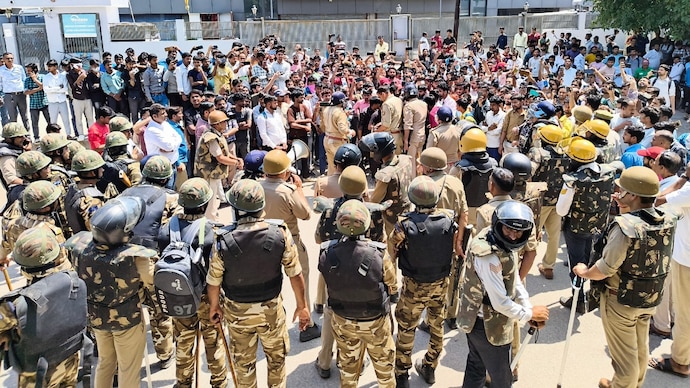
The protests in Noida did not begin on April 13. They started on April 10 when thousands of garment workers from the Phase 2 Hosiery Complex launched a strike. They were demanding wage parity with neighbouring Haryana, where the government had just announced a 35 per cent hike in minimum wages, raising unskilled workers’ pay from Rs 11,274 to Rs 15,220 per month.
The demonstration rapidly spread to factories of the Motherson Group, Richa Global Exports and several garment exporters. The Noida protesters demanded a minimum monthly salary of Rs 20,000, arguing that even at the revised rates, take-home pay after provident fund (PF) and employees’ state insurance (ESI) deductions was barely enough to cover their expenses in the National Capital Region (NCR).
By April 15, after vehicles had been set afire in the protests, including police SUVs burnt to cinders, and more than 396 arrests made, the Uttar Pradesh government announced an interim wage revision: for unskilled workers, from Rs 11,313 per month to Rs 13,690; for semi-skilled workers, from Rs 12,445 to Rs 15,059; and for the skilled, from Rs 13,940 to Rs 16,868. The final rates are to be fixed in May.
However, the research study argues an underrated factor behind the protests: soaring temperatures on the streets. Noida was experiencing temperatures of 36-39°C when the protests erupted, with forecasts pointing to 42°C. The workers at the centre of the unrest—contractual, migrant, garment and hosiery sector employees—are precisely the population that Indian field research has consistently identified as bearing the highest occupational heat burden in the country.
The evidence is alarming. The study ‘Breaking Point: Heat and the Garment Floor’ had covered 115 garment workers and conducted 47 in-depth interviews across 15 factories in Tamil Nadu, Delhi-NCR and Gujarat. It found that 87 per cent of the respondents had reported heat-related symptoms, such as headaches, dizziness, weakness and muscle cramps, in the preceding 12 months while 69 per cent said heat had affected their ability to work.
Critically, 78 per cent workers skipped toilet breaks to meet production targets, nearly doubling their heat-stress levels than those who did not. Around 45 per cent workers showed amber-to-brown urine, a clinical marker of dehydration and kidney strain.
Factory floors are heat traps. Eleven of the 15 surveyed factories had metal or asbestos roofs. Jet-dyeing machines operate at 125-130°C. Seven factories had no equipment to measure temperature or humidity. In the four that did, sensors were activated only during buyer visits.
The economic consequence is quantifiable. A study on informal workers in Delhi found that a 1°C rise in average temperatures results in a 16 per cent drop in daily net earnings and a 14 per cent rise in medical expenditures. A Journal of Political Economy study, using microdata from Delhi-NCR garment factories, found that factory output falls by 2 per cent per °C annually. A 2025 Springer Nature study of 3,000 informal workers found garment workers had a 98.5 per cent heat-induced productivity loss rate, the highest among sectors surveyed.
The burden follows workers home. Delhi’s night-time cooling capacity has declined 42 per cent since 2001, from a 15°C day-to-night differential to just 8.6°C by 2025. Most protesting workers are migrants from Bihar and eastern Uttar Pradesh and live in cramped, unventilated rooms. A systematic review of heat and sleep quality found that night-time temperatures above 25°C are strongly linked with poor sleep. Workers arrive at the next 12-hour shift carrying residual heat load and sleep deficit.
India’s policy architecture has no answer for any of this. The government’s Occupational Safety, Health and Working Conditions Code, 2020, the same legislation that expanded permissible working time to 12 hours—itself a core grievance among Noida workers—does not recognise heat as an explicit occupational hazard. The Factories Act of 1948 covers only enclosed factory workrooms and has never applied to informal or outdoor workers.
Heatwaves are not among India’s 12 nationally notified disasters, capping state relief at 10 per cent of the State Disaster Response Fund. Of the 15 state Heat Action Plans reviewed by the Council on Energy, Environment and Water (CEEW), a not-for-profit public policy entity, only two had undertaken heat-risk assessments at the occupational group level. Uttar Pradesh’s heat-action plan mentions water, shade and ORS supplements but no enforceable standards for factory floors.
The problem cannot be entirely understood without acknowledging the climate factor. Multiple research works in the recent past have concluded that while working conditions certainly need a significant upgrade, factors leading to extreme heat stress are the core reason for exceptional worker distress. The Indian economy has an 85 per cent informal workforce and 57 per cent of the country’s districts face high to very high heat risk. With another scorching summer ahead, can the occupational heat burden on workers be ignored any longer?
Subscribe to India Today Magazine
But that seems to be only part of the story. A February 2026 research study, ‘Breaking Point: Heat and the Garment Floor’, by HeatWatch and the Tata Institute of Social Sciences (TISS), suggests climate change is the underlying scourge invisibly fuelling such protests.
The protests in Noida did not begin on April 13. They started on April 10 when thousands of garment workers from the Phase 2 Hosiery Complex launched a strike. They were demanding wage parity with neighbouring Haryana, where the government had just announced a 35 per cent hike in minimum wages, raising unskilled workers’ pay from Rs 11,274 to Rs 15,220 per month.
The demonstration rapidly spread to factories of the Motherson Group, Richa Global Exports and several garment exporters. The Noida protesters demanded a minimum monthly salary of Rs 20,000, arguing that even at the revised rates, take-home pay after provident fund (PF) and employees’ state insurance (ESI) deductions was barely enough to cover their expenses in the National Capital Region (NCR).
By April 15, after vehicles had been set afire in the protests, including police SUVs burnt to cinders, and more than 396 arrests made, the Uttar Pradesh government announced an interim wage revision: for unskilled workers, from Rs 11,313 per month to Rs 13,690; for semi-skilled workers, from Rs 12,445 to Rs 15,059; and for the skilled, from Rs 13,940 to Rs 16,868. The final rates are to be fixed in May.
However, the research study argues an underrated factor behind the protests: soaring temperatures on the streets. Noida was experiencing temperatures of 36-39°C when the protests erupted, with forecasts pointing to 42°C. The workers at the centre of the unrest—contractual, migrant, garment and hosiery sector employees—are precisely the population that Indian field research has consistently identified as bearing the highest occupational heat burden in the country.
The evidence is alarming. The study ‘Breaking Point: Heat and the Garment Floor’ had covered 115 garment workers and conducted 47 in-depth interviews across 15 factories in Tamil Nadu, Delhi-NCR and Gujarat. It found that 87 per cent of the respondents had reported heat-related symptoms, such as headaches, dizziness, weakness and muscle cramps, in the preceding 12 months while 69 per cent said heat had affected their ability to work.
Critically, 78 per cent workers skipped toilet breaks to meet production targets, nearly doubling their heat-stress levels than those who did not. Around 45 per cent workers showed amber-to-brown urine, a clinical marker of dehydration and kidney strain.
Factory floors are heat traps. Eleven of the 15 surveyed factories had metal or asbestos roofs. Jet-dyeing machines operate at 125-130°C. Seven factories had no equipment to measure temperature or humidity. In the four that did, sensors were activated only during buyer visits.
The economic consequence is quantifiable. A study on informal workers in Delhi found that a 1°C rise in average temperatures results in a 16 per cent drop in daily net earnings and a 14 per cent rise in medical expenditures. A Journal of Political Economy study, using microdata from Delhi-NCR garment factories, found that factory output falls by 2 per cent per °C annually. A 2025 Springer Nature study of 3,000 informal workers found garment workers had a 98.5 per cent heat-induced productivity loss rate, the highest among sectors surveyed.
The burden follows workers home. Delhi’s night-time cooling capacity has declined 42 per cent since 2001, from a 15°C day-to-night differential to just 8.6°C by 2025. Most protesting workers are migrants from Bihar and eastern Uttar Pradesh and live in cramped, unventilated rooms. A systematic review of heat and sleep quality found that night-time temperatures above 25°C are strongly linked with poor sleep. Workers arrive at the next 12-hour shift carrying residual heat load and sleep deficit.
India’s policy architecture has no answer for any of this. The government’s Occupational Safety, Health and Working Conditions Code, 2020, the same legislation that expanded permissible working time to 12 hours—itself a core grievance among Noida workers—does not recognise heat as an explicit occupational hazard. The Factories Act of 1948 covers only enclosed factory workrooms and has never applied to informal or outdoor workers.
Heatwaves are not among India’s 12 nationally notified disasters, capping state relief at 10 per cent of the State Disaster Response Fund. Of the 15 state Heat Action Plans reviewed by the Council on Energy, Environment and Water (CEEW), a not-for-profit public policy entity, only two had undertaken heat-risk assessments at the occupational group level. Uttar Pradesh’s heat-action plan mentions water, shade and ORS supplements but no enforceable standards for factory floors.
The problem cannot be entirely understood without acknowledging the climate factor. Multiple research works in the recent past have concluded that while working conditions certainly need a significant upgrade, factors leading to extreme heat stress are the core reason for exceptional worker distress. The Indian economy has an 85 per cent informal workforce and 57 per cent of the country’s districts face high to very high heat risk. With another scorching summer ahead, can the occupational heat burden on workers be ignored any longer?
Subscribe to India Today Magazine

