How PoK killings weaken Pakistan's moral high ground bid on Kashmir
A ground assessment of how the protests and state-inflicted violence in Pakistan Occupied Kashmir (PoK) are being interpreted in the Kashmir Valley
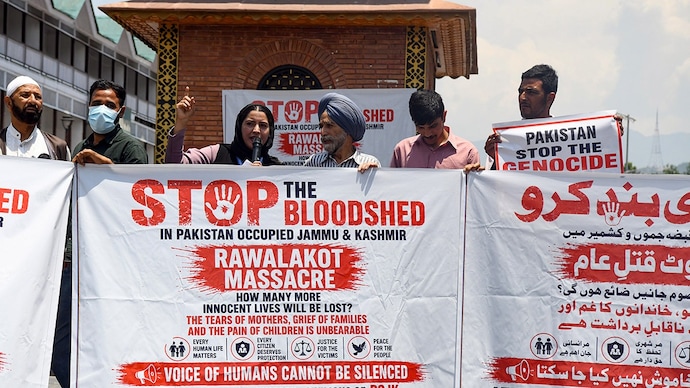
The protests in PoK are being led by the Jammu Kashmir Joint Awami Action Committee (JAAC), an umbrella grouping formed in 2023 and representing traders and civil society groups of the region. Before violence erupted on June 9, the local government had proscribed the JAAC under a regional anti-terrorism legislative framework.
The protesters have been demanding that the quota of 12 seats for refugees in PoK’s legislature be abolished. The refugees, in this context, mean those who left Jammu and Kashmir to settle in Pakistan.
Professor Noor Ahmad Baba, a prominent Srinagar-based political scientist and former dean of the School of Social Sciences at the Central University of Kashmir, views the events unfolding in PoK as “a challenging situation” for both the Pakistan and PoK governments. “It does create a predicament and may weaken their moral claim on Kashmir,” he said.
Asked how the protests and the state-inflicted violence in PoK would be interpreted in the Kashmir Valley, Baba told INDIA TODAY: “The major [protest] issue concerns the proposal to do away with the 12 reserved seats for migrant Kashmiris. This also suggests that the Jammu Kashmir Joint Awami Action Committee, spearheading this agitation, may be less inclined to share the burden of larger Kashmir-related concerns. It further reflects a desire for a greater say in local political affairs and a focus on their own political empowerment through the removal of reserved seats for Kashmiri migrants.”
Expressing concern over the repressive actions in PoK, he added: “The way forward is to resolve issues through accommodation and peaceful dialogue.”
PoK—which carries the nomenclature Azad Jammu and Kashmir in Pakistan—has its own prime minister and legislative assembly under what is termed as a semi-autonomous system. However, the real power and authority is seen to be in the hands of the military establishment of Pakistan.
According to academician and political analyst Dr Siddiq Wahid of Shiv Nadar University, Delhi-NCR, the protests appear to be the “manifestation of a global issue” of the 21st century. “All over the world, there is growing tension between ‘the people’ and the ‘state’. Pakistan is not immune to this phenomenon. But indeed, the intensity of that tension is increasing there,” noted Wahid, who was formerly vice-chancellor of the Islamic University of Science and Technology, Kashmir.
Wahid agreed with Baba that the violent suppression of protests in PoK has undermined Pakistan’s moral position over Kashmir. “It not only undermines but taints the moral position of any state that uses violence against people—be it one’s own or people of states that are adversaries,” he said.
Mirwaiz Umar Farooq, leader of the Hurriyat Conference, has expressed alarm over the unrest in PoK. “Deeply disturbed by the news coming from across the LoC (Line of Control). The killing of more than a dozen protesting civilians and police personnel is extremely sad. The government there should know better than to use force to handle public grievances and demands in this manner,” he posted on X.
“When people take to the streets to express their concerns, it is a signal that they seek to be heard. It is the responsibility of those in authority to listen, engage and peacefully resolve the matter rather than allow it to escalate into violence, arbitrary arrests and loss of life,” Mirwaiz wrote.
The ruling National Conference’s president Dr Farooq Abdullah demanded a UN probe into the killings. “The UN human rights group should probe these killings by going there. The world should know what’s happening there. Atrocities are taking place,” Abdullah told the media in Srinagar on June 11.
For the BJP, a dominant political force in the Jammu region, the violence has once again upfronted the starkly contrasting development of J&K. “They are looking at the development model of Jammu and Kashmir, particularly after Narendra Modi became the prime minister. The people in PoK are seeking the same rights, but what they are getting is bullets,” said Sunil Sethi, the BJP’s chief spokesperson in J&K.
Subscribe to India Today Magazine
The protests in PoK are being led by the Jammu Kashmir Joint Awami Action Committee (JAAC), an umbrella grouping formed in 2023 and representing traders and civil society groups of the region. Before violence erupted on June 9, the local government had proscribed the JAAC under a regional anti-terrorism legislative framework.
The protesters have been demanding that the quota of 12 seats for refugees in PoK’s legislature be abolished. The refugees, in this context, mean those who left Jammu and Kashmir to settle in Pakistan.
Professor Noor Ahmad Baba, a prominent Srinagar-based political scientist and former dean of the School of Social Sciences at the Central University of Kashmir, views the events unfolding in PoK as “a challenging situation” for both the Pakistan and PoK governments. “It does create a predicament and may weaken their moral claim on Kashmir,” he said.
Asked how the protests and the state-inflicted violence in PoK would be interpreted in the Kashmir Valley, Baba told INDIA TODAY: “The major [protest] issue concerns the proposal to do away with the 12 reserved seats for migrant Kashmiris. This also suggests that the Jammu Kashmir Joint Awami Action Committee, spearheading this agitation, may be less inclined to share the burden of larger Kashmir-related concerns. It further reflects a desire for a greater say in local political affairs and a focus on their own political empowerment through the removal of reserved seats for Kashmiri migrants.”
Expressing concern over the repressive actions in PoK, he added: “The way forward is to resolve issues through accommodation and peaceful dialogue.”
PoK—which carries the nomenclature Azad Jammu and Kashmir in Pakistan—has its own prime minister and legislative assembly under what is termed as a semi-autonomous system. However, the real power and authority is seen to be in the hands of the military establishment of Pakistan.
According to academician and political analyst Dr Siddiq Wahid of Shiv Nadar University, Delhi-NCR, the protests appear to be the “manifestation of a global issue” of the 21st century. “All over the world, there is growing tension between ‘the people’ and the ‘state’. Pakistan is not immune to this phenomenon. But indeed, the intensity of that tension is increasing there,” noted Wahid, who was formerly vice-chancellor of the Islamic University of Science and Technology, Kashmir.
Wahid agreed with Baba that the violent suppression of protests in PoK has undermined Pakistan’s moral position over Kashmir. “It not only undermines but taints the moral position of any state that uses violence against people—be it one’s own or people of states that are adversaries,” he said.
Mirwaiz Umar Farooq, leader of the Hurriyat Conference, has expressed alarm over the unrest in PoK. “Deeply disturbed by the news coming from across the LoC (Line of Control). The killing of more than a dozen protesting civilians and police personnel is extremely sad. The government there should know better than to use force to handle public grievances and demands in this manner,” he posted on X.
“When people take to the streets to express their concerns, it is a signal that they seek to be heard. It is the responsibility of those in authority to listen, engage and peacefully resolve the matter rather than allow it to escalate into violence, arbitrary arrests and loss of life,” Mirwaiz wrote.
The ruling National Conference’s president Dr Farooq Abdullah demanded a UN probe into the killings. “The UN human rights group should probe these killings by going there. The world should know what’s happening there. Atrocities are taking place,” Abdullah told the media in Srinagar on June 11.
For the BJP, a dominant political force in the Jammu region, the violence has once again upfronted the starkly contrasting development of J&K. “They are looking at the development model of Jammu and Kashmir, particularly after Narendra Modi became the prime minister. The people in PoK are seeking the same rights, but what they are getting is bullets,” said Sunil Sethi, the BJP’s chief spokesperson in J&K.
Subscribe to India Today Magazine

