Why investors should look beyond large caps: Edelweiss' Radhika Gupta
Investors must prepare for a journey where uncertainty is the norm, said Edelweiss MD and CEO Radhika Gupta.
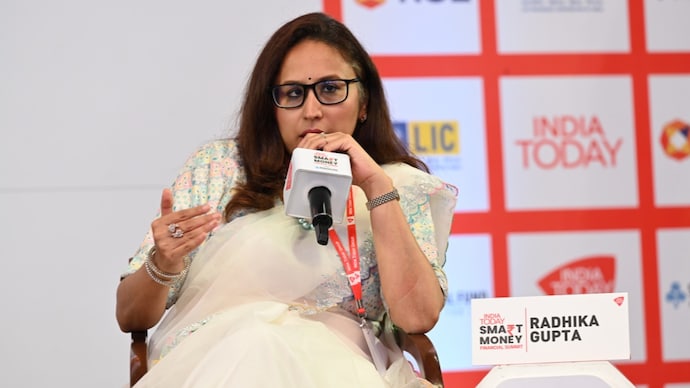
Speaking at a fireside chat at India Today’s Smart Money Financial Conclave, Gupta emphasised that investors should not view markets as a series of isolated events and instead prepare for an investing journey where volatility is the norm.
"Investing conditions are never optimal," she said. "Investors have a tendency to look at the market as a collection of events. The reality is one event has happened, another event will happen.”
Referring to the recent easing of geopolitical tensions and concerns around oil prices, Gupta said the immediate risks for India may have subsided, but uncertainty is unlikely to disappear. “I always say that investing in India is a little bit like walking down a road where there is a pot of gold at the end,” she said. “Five years later, 10 years later, Indian equities have made money. The Indian economy has created wealth. But unfortunately, like the roads of Mumbai, that road to the pot of gold is always under construction and full of potholes. Some flyovers are broken and somewhere there is an accident.” Hence, said Gupta, investors should expect short-term turbulence while remaining focused on India’s long-term earnings recovery.
She highlighted that despite the global uncertainty domestic investors have displayed remarkable maturity as mutual fund inflows have continued to be strong despite tapering returns over the past couple of years. “It is not a disconnect. I see it as something structurally very positive,” Gupta said, adding that instead of panicking when markets corrected, investors continued putting money into equities.
She pointed out that the national SIP (Systematic Investment Plan) book has grown tenfold since she entered the mutual fund industry in 2017. The perception that large-cap stocks are inherently safer than mid- and small-cap companies is not true for India, explained Gupta. Several sectors expected to drive the country’s next phase of growth, including capital markets, hospitals, clean energy and premium consumption, are largely represented in the mid-cap space rather than among the country’s top 100 listed companies.
“If I were to build a portfolio for the next 10 years, I would not build a pure large-cap biased one,” Gupta said. “I would build a multi-cap portfolio with meaningful exposure to both large and mid-cap companies.”
On overseas investing, Gupta argued that international exposure should be viewed as a strategic asset allocation decision rather than a tactical response to whichever market is outperforming. “The premise of having 10 to 15 per cent of your portfolio abroad is a strong one,” she said, adding that different markets outperform at different stages of the economic cycle and overseas investing also offers exposure to themes that are not yet adequately represented in India.
However, she cautioned investors against chasing recent winners. “You shouldn’t do it just because Korea and Taiwan made a lot of money in the past year,” she said. “It should be a principle of asset allocation.”
Despite global investors increasingly comparing India with other Asian markets, Gupta remains firmly optimistic about India’s long-term prospects. “I am the greatest advocate for investing in India,” she said. “I left the US in 2009 to move back, and till date I rate that as the best investment call of my life.”
She argued that while India still has work to do in areas such as research and development and ease of doing business, the country’s long-term growth story remains intact. “We continue to be one of the fastest-growing major economies in the world. That thesis has not changed,” she said.
Looking ahead, Gupta identified financial services, capital markets, power, defence and premium consumption as sectors she is optimistic about, while emphasising that India’s strength lies in being a diversified economy rather than being dependent on one dominant sector.
On the growing participation of women in investing, Gupta highlighted that women now account for a rising share of new mutual fund investors and younger women are increasingly taking charge of their financial decisions. “We should stop this narrative that women can’t invest,” she said. “For decades and centuries, mothers, mothers-in-law and grandmothers have been the CFOs of our homes. We have been damn good CFOs and savers. The translation to investments is happening.”
On portfolio construction, Gupta recommended what she calls the “BAT framework”—Beta, Alpha and Tax Efficiency. She explained that while simply participating in the markets was enough during periods when equities were delivering 30-40 per cent annual returns, the investing environment has now changed. As returns drop to a more sustainable 10-12 per cent range, investors need to be more deliberate about how they build their portfolios. “In a high-return environment, participation is enough. With moderate returns, participation has to be supplemented with precision,” she said. That means paying closer attention to asset allocation, generating alpha through better investment choices and ensuring investments are structured in a tax-efficient manner. She also suggested that investors explore hybrid products and other tax-efficient investment vehicles where appropriate, rather than relying solely on direct equity exposure.
Key takeaways
- Investors need to accept that markets will continue to be shaped by geopolitical events, policy changes and global uncertainty. Rather than waiting for the “perfect time” to invest, they should prepare for a long-term journey through periodic volatility.
- India’s long-term investment story remains intact. Despite global uncertainties and comparisons with markets like Taiwan, Korea and Japan, India’s structural growth story has not changed. The country continues to be among the world’s fastest-growing major economies.
- One of the biggest positives for India’s markets is the changing behaviour of retail investors. Instead of pulling money out during market corrections, investors continued investing through SIPs and mutual funds, reflecting growing financial discipline.
- Large caps are not automatically safer than mid and small caps. Many of India’s strongest structural growth themes, from hospitals to capital markets and premium consumption, are represented in mid- and small-cap companies.
- Instead of concentrating investments in the top 100 companies, portfolios should be built with exposure across large-, mid- and, where suitable, small-cap stocks to capture India’s broader growth opportunities.
- International investing should be strategic, not opportunistic. Investors should maintain 10-15 per cent exposure to overseas markets as part of long-term asset allocation rather than chasing whichever country has recently delivered the best returns.
- Specialised Investment Funds (SIFs) fill a crucial gap as they combine the flexibility of alternative investment products with the operational and tax efficiency of mutual funds, making sophisticated investment strategies accessible to a much wider set of investors.
Subscribe to India Today Magazine
Speaking at a fireside chat at India Today’s Smart Money Financial Conclave, Gupta emphasised that investors should not view markets as a series of isolated events and instead prepare for an investing journey where volatility is the norm.
"Investing conditions are never optimal," she said. "Investors have a tendency to look at the market as a collection of events. The reality is one event has happened, another event will happen.”
Referring to the recent easing of geopolitical tensions and concerns around oil prices, Gupta said the immediate risks for India may have subsided, but uncertainty is unlikely to disappear. “I always say that investing in India is a little bit like walking down a road where there is a pot of gold at the end,” she said. “Five years later, 10 years later, Indian equities have made money. The Indian economy has created wealth. But unfortunately, like the roads of Mumbai, that road to the pot of gold is always under construction and full of potholes. Some flyovers are broken and somewhere there is an accident.” Hence, said Gupta, investors should expect short-term turbulence while remaining focused on India’s long-term earnings recovery.
She highlighted that despite the global uncertainty domestic investors have displayed remarkable maturity as mutual fund inflows have continued to be strong despite tapering returns over the past couple of years. “It is not a disconnect. I see it as something structurally very positive,” Gupta said, adding that instead of panicking when markets corrected, investors continued putting money into equities.
She pointed out that the national SIP (Systematic Investment Plan) book has grown tenfold since she entered the mutual fund industry in 2017. The perception that large-cap stocks are inherently safer than mid- and small-cap companies is not true for India, explained Gupta. Several sectors expected to drive the country’s next phase of growth, including capital markets, hospitals, clean energy and premium consumption, are largely represented in the mid-cap space rather than among the country’s top 100 listed companies.
“If I were to build a portfolio for the next 10 years, I would not build a pure large-cap biased one,” Gupta said. “I would build a multi-cap portfolio with meaningful exposure to both large and mid-cap companies.”
On overseas investing, Gupta argued that international exposure should be viewed as a strategic asset allocation decision rather than a tactical response to whichever market is outperforming. “The premise of having 10 to 15 per cent of your portfolio abroad is a strong one,” she said, adding that different markets outperform at different stages of the economic cycle and overseas investing also offers exposure to themes that are not yet adequately represented in India.
However, she cautioned investors against chasing recent winners. “You shouldn’t do it just because Korea and Taiwan made a lot of money in the past year,” she said. “It should be a principle of asset allocation.”
Despite global investors increasingly comparing India with other Asian markets, Gupta remains firmly optimistic about India’s long-term prospects. “I am the greatest advocate for investing in India,” she said. “I left the US in 2009 to move back, and till date I rate that as the best investment call of my life.”
She argued that while India still has work to do in areas such as research and development and ease of doing business, the country’s long-term growth story remains intact. “We continue to be one of the fastest-growing major economies in the world. That thesis has not changed,” she said.
Looking ahead, Gupta identified financial services, capital markets, power, defence and premium consumption as sectors she is optimistic about, while emphasising that India’s strength lies in being a diversified economy rather than being dependent on one dominant sector.
On the growing participation of women in investing, Gupta highlighted that women now account for a rising share of new mutual fund investors and younger women are increasingly taking charge of their financial decisions. “We should stop this narrative that women can’t invest,” she said. “For decades and centuries, mothers, mothers-in-law and grandmothers have been the CFOs of our homes. We have been damn good CFOs and savers. The translation to investments is happening.”
On portfolio construction, Gupta recommended what she calls the “BAT framework”—Beta, Alpha and Tax Efficiency. She explained that while simply participating in the markets was enough during periods when equities were delivering 30-40 per cent annual returns, the investing environment has now changed. As returns drop to a more sustainable 10-12 per cent range, investors need to be more deliberate about how they build their portfolios. “In a high-return environment, participation is enough. With moderate returns, participation has to be supplemented with precision,” she said. That means paying closer attention to asset allocation, generating alpha through better investment choices and ensuring investments are structured in a tax-efficient manner. She also suggested that investors explore hybrid products and other tax-efficient investment vehicles where appropriate, rather than relying solely on direct equity exposure.
Key takeaways
- Investors need to accept that markets will continue to be shaped by geopolitical events, policy changes and global uncertainty. Rather than waiting for the “perfect time” to invest, they should prepare for a long-term journey through periodic volatility.
- India’s long-term investment story remains intact. Despite global uncertainties and comparisons with markets like Taiwan, Korea and Japan, India’s structural growth story has not changed. The country continues to be among the world’s fastest-growing major economies.
- One of the biggest positives for India’s markets is the changing behaviour of retail investors. Instead of pulling money out during market corrections, investors continued investing through SIPs and mutual funds, reflecting growing financial discipline.
- Large caps are not automatically safer than mid and small caps. Many of India’s strongest structural growth themes, from hospitals to capital markets and premium consumption, are represented in mid- and small-cap companies.
- Instead of concentrating investments in the top 100 companies, portfolios should be built with exposure across large-, mid- and, where suitable, small-cap stocks to capture India’s broader growth opportunities.
- International investing should be strategic, not opportunistic. Investors should maintain 10-15 per cent exposure to overseas markets as part of long-term asset allocation rather than chasing whichever country has recently delivered the best returns.
- Specialised Investment Funds (SIFs) fill a crucial gap as they combine the flexibility of alternative investment products with the operational and tax efficiency of mutual funds, making sophisticated investment strategies accessible to a much wider set of investors.
Subscribe to India Today Magazine

