In Lucknow village, a 'Cyber Panchayat' brainstorms to save the next online-fraud victim
The timing is significant: the internet is booming in rural India, smartphones and digital payments are commonplace, but cyber-scam awareness perhaps isn't
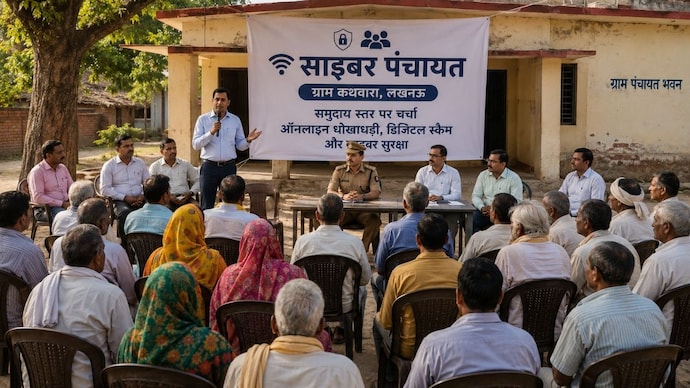
The latest example came from Kathwara village in Lucknow’s Bakshi Ka Talab (BKT) area, where residents gathered not for a government awareness drive or a police outreach programme, but for what organisers called a ‘Cyber Panchayat’, a community-level discussion on online fraud, digital scams and cyber safety.
The programme was organised jointly by Psy-Naree, a mental health and women’s empowerment organisation, and RT Cyber Academy, led by cyber-safety expert Rakshit Tandon. According to the organisers, this was the third such rural cyber-awareness workshop they have conducted, reflecting a broader effort to take cyber-safety conversations beyond urban centres.
The timing is significant. Over the past few years, internet penetration in rural India has expanded rapidly. Smartphones and digital payments have become commonplace even in remote villages. But experts have repeatedly pointed out that awareness about online fraud has not grown at the same pace.
As a result, villages are increasingly finding themselves vulnerable to the same cyber threats that once primarily targeted urban users. Fraudulent calls, pitching fake investment schemes, job scams, KYC update frauds and digital arrest scams, are routinely being reported from smaller towns and rural areas. What makes the problem particularly challenging is that victims often hesitate to report fraud.
During the Kathwara session, organisers deliberately linked cyber awareness with mental health, arguing that the consequences of online fraud extend beyond financial losses. Discussions focused not only on how scams operate but also on the emotional impact they can leave on families.
The session covered practical issues that many villagers encounter in daily life. These included protecting OTPs and banking credentials, identifying fake callers impersonating police or government agencies, understanding the risks of sharing bank accounts, recognising investment traps and reporting cybercrime through the national helpline 1930.
Instead of relying only on lectures, organisers screened short films based on real cybercrime cases to demonstrate how fraudsters approach potential victims and how such scams can be avoided.
Residents were administered a ‘cyber safety pledge’, a commitment to follow basic cyber safety practices and encourage others in the village to do the same. The organisers believe it may be among the first village-level cyber-safety oaths of its kind in Uttar Pradesh.
The initiative also highlights a trend that has quietly emerged in recent years. While governments and law-enforcement agencies continue to run awareness campaigns, private organisations, educational groups and civil society initiatives are increasingly stepping into the space, particularly in areas where formal digital-literacy programmes have limited reach.
Colonel Sanjeev Sahai, a mentor associated with Psy Naree, said the effort is intended to be more than a one-day awareness event. According to the organisers, there are plans to continue engagement with the village through programmes related to cybercrime prevention, mental health and women’s empowerment.
Dr Manini Srivastava, another mentor at Psy Naree, said cyberfraud often leaves lasting social and emotional consequences. “Through Cyber Panchayat, Psy Naree is committed to standing with rural communities by combining cyber safety with mental-health awareness, so that people learn not only how to protect themselves online but also how to seek help without fear or shame. Our aim is to adopt this village for sustained, targeted interventions in cybercrime prevention, mental health and women’s empowerment, and work towards shaping it as a safer, stronger and more aware model village,” he said.
For now, Kathwara’s Cyber Panchayat may be a small initiative in a single village. But it also reflects a larger reality that cybercrime is no longer an urban problem. As digital access expands into rural India, awareness efforts are beginning to follow. The challenge ahead will be whether such campaigns can keep pace with the rapidly evolving nature of online fraud and reach communities before they become the next victims.
Subscribe to India Today Magazine
The latest example came from Kathwara village in Lucknow’s Bakshi Ka Talab (BKT) area, where residents gathered not for a government awareness drive or a police outreach programme, but for what organisers called a ‘Cyber Panchayat’, a community-level discussion on online fraud, digital scams and cyber safety.
The programme was organised jointly by Psy-Naree, a mental health and women’s empowerment organisation, and RT Cyber Academy, led by cyber-safety expert Rakshit Tandon. According to the organisers, this was the third such rural cyber-awareness workshop they have conducted, reflecting a broader effort to take cyber-safety conversations beyond urban centres.
The timing is significant. Over the past few years, internet penetration in rural India has expanded rapidly. Smartphones and digital payments have become commonplace even in remote villages. But experts have repeatedly pointed out that awareness about online fraud has not grown at the same pace.
As a result, villages are increasingly finding themselves vulnerable to the same cyber threats that once primarily targeted urban users. Fraudulent calls, pitching fake investment schemes, job scams, KYC update frauds and digital arrest scams, are routinely being reported from smaller towns and rural areas. What makes the problem particularly challenging is that victims often hesitate to report fraud.
During the Kathwara session, organisers deliberately linked cyber awareness with mental health, arguing that the consequences of online fraud extend beyond financial losses. Discussions focused not only on how scams operate but also on the emotional impact they can leave on families.
The session covered practical issues that many villagers encounter in daily life. These included protecting OTPs and banking credentials, identifying fake callers impersonating police or government agencies, understanding the risks of sharing bank accounts, recognising investment traps and reporting cybercrime through the national helpline 1930.
Instead of relying only on lectures, organisers screened short films based on real cybercrime cases to demonstrate how fraudsters approach potential victims and how such scams can be avoided.
Residents were administered a ‘cyber safety pledge’, a commitment to follow basic cyber safety practices and encourage others in the village to do the same. The organisers believe it may be among the first village-level cyber-safety oaths of its kind in Uttar Pradesh.
The initiative also highlights a trend that has quietly emerged in recent years. While governments and law-enforcement agencies continue to run awareness campaigns, private organisations, educational groups and civil society initiatives are increasingly stepping into the space, particularly in areas where formal digital-literacy programmes have limited reach.
Colonel Sanjeev Sahai, a mentor associated with Psy Naree, said the effort is intended to be more than a one-day awareness event. According to the organisers, there are plans to continue engagement with the village through programmes related to cybercrime prevention, mental health and women’s empowerment.
Dr Manini Srivastava, another mentor at Psy Naree, said cyberfraud often leaves lasting social and emotional consequences. “Through Cyber Panchayat, Psy Naree is committed to standing with rural communities by combining cyber safety with mental-health awareness, so that people learn not only how to protect themselves online but also how to seek help without fear or shame. Our aim is to adopt this village for sustained, targeted interventions in cybercrime prevention, mental health and women’s empowerment, and work towards shaping it as a safer, stronger and more aware model village,” he said.
For now, Kathwara’s Cyber Panchayat may be a small initiative in a single village. But it also reflects a larger reality that cybercrime is no longer an urban problem. As digital access expands into rural India, awareness efforts are beginning to follow. The challenge ahead will be whether such campaigns can keep pace with the rapidly evolving nature of online fraud and reach communities before they become the next victims.
Subscribe to India Today Magazine

