Was Elephanta Island near Mumbai an international trade point? ASI says…
The ongoing excavation by the Archaeological Survey of India (ASI) aims to determine the nature and extent of previous habitations on the island
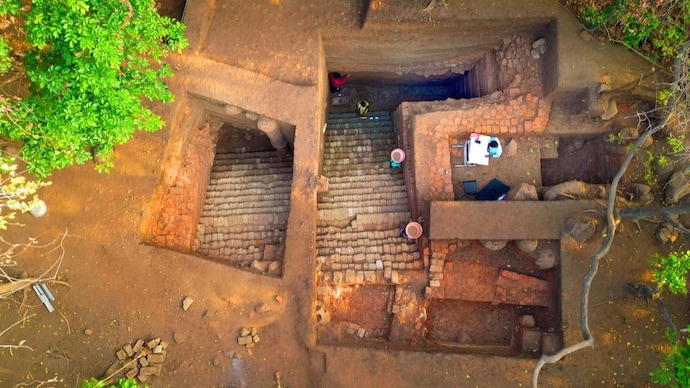
A team from the ASI, led by superintending archaeologist Abhijit Ambekar, has been excavating a site in Morabandar, located on the eastern side of the island. The aim is to establish the chronology and determine the nature and extent of previous habitations on the island.
The Elephanta Caves, located on the Elephanta or Gharapuri Island 10 km off Mumbai in the Arabian Sea, are known for their rock-carved cave temples. It’s a UNESCO World Heritage Site. The island consists of three villages, Shetbandar, Rajbander and Morabandar, and is a magnet for tourists from India and abroad.
The place may have been the capital of the Konkan Shilaharas. The Kharepatan plates of Anantadeva from the dynasty refer to Puri (Gharapuri). The ASI’s findings will help deduce the medieval past of Mumbai and surrounding areas, including northern Konkan.
While western India has over 900 known rock-cut monuments belonging to Buddhist, Brahminical and Jain traditions, about 130 of these are on islands near Mumbai, notably the Elephanta Island and Salsette.
Ambekar said excavation in the Elephanta Island had yielded a rectangular reservoir connected with a perpendicular stepped junction towards the north (T-shaped stepped tank) that throws light on ancient water management systems on the island. It is not rock-cut like the other structures on the island, but was engineered and built to ensure drinking water for the island’s inhabitants.
“One of the significant discoveries from the site is a massive structure—about 14.7 metres in length and 6.7 metres and 10.8 metres wide—forming a T shape. The excavation has reached up to a depth of five metres so far and exposed 20 steps. These steps are constructed using stone blocks that aren’t from the island,” said Ambekar.
Ambekar noted that while the island was known for rock-cut wonders, such cisterns used for water storage have been found earlier. “But here is a carefully designed architecture for [storage of] water. While the island gets a very large quantity of rainwater, due to its rocky terrain, very less water seeped into the land. On an island facing water scarcity after monsoon months, such structures become a necessity,” he added.
The tank can be compared with stepwell formations in Gujarat and Rajasthan, where the steps lead to a central tank. The form is believed to have originated around 7th Century CE, and the discovery at Elephanta may be a local variant of the same.
Archaeologists have found Indo-Mediterranean (Roman) amphora sherds, along with other imported ceramics and glass, indicating that the island was a part of long-distance trade networks. Ambekar said the Elephanta Island may have been an anchoring point for ships, and goods may have been loaded onto smaller vessels for Kalyan, Thane, and further to the mainland via the Ulhas Creek, and vice-versa.
The excavations have also yielded imported ceramics, represented by a few shards of Turquoise Glazed Ware and a combined hoard of over 3,000 potsherds belonging to torpedo jars of Mesopotamia origin and Amphora jars of Mediterranean region. Torpedo jars from Mesopotamia and Mediterranean amphorae were significant ancient maritime commercial vessels, transporting liquid commodities, including wine, oil and fish sauce.
Mediterranean amphorae were prevalent from early historic periods, although torpedo jars emerged later (around 2nd or 3rd century CE), featuring distinctive bitumen-lined, handle-less, and elongated forms that enabled efficient bulk transport across the Gulf and Indian Ocean, the ASI said.
The team has also recovered 11 coins, including six made of copper and five from lead. Two of these copper coins from the locality have been identified by Professor Abhijit Dandekar from the Deccan College Post-Graduate and Research Institute, Pune, as coins of Krishnaraja of the Kalachuri dynasty. The identification is based on the depiction of a seated bull facing right on the obverse and a temple symbol within a beaded border along with the legend ‘r Karja’ on the reverse. The K.J. Somaiya College in Mumbai is also a collaborator.
Another site at Morabandar has yielded two large storage jars with considerable dimensions—one is around 1.25 metres tall and another broken jar has a diameter of 1.22 metres. This finding is notable as it is located in proximity to structural findings identified as warehouses for the storage of goods. A substantial quantity of amphorae and Torpedo jar sherds has been recorded here, in addition to iron ingots and a stone anchor.
Additionally, 80 metres distant, there exists a brick water tank and a rock-carved water tank, both apparently utilised in the fabric-dyeing process, identifiable as dyeing vats. The discovery of such large storage jars is important, likely indicating their usage for water storage. The brick-built and rock-cut tanks, along with storage jars, suggest potential fabric-dyeing activities at the site, noted Ambekar.
Gharapuri, according to legend, was the royal seat of the demon king Banasura, whose daughter was married to Aniruddha, the grandson of Lord Krishna. In his work on the historical geography of Maharashtra and Goa, H.S. Thosar, former head of the department of history at the Elphinstone College in Mumbai, writes that there was some sort of historical relationship between the Elephanta Island and Aniruddha. It is also possible that Aniruddhapuri, which was the royal seat of the Traikuta dynasty, whose dominions covered northern Konkan, was identical with this island.
Subscribe to India Today Magazine
A team from the ASI, led by superintending archaeologist Abhijit Ambekar, has been excavating a site in Morabandar, located on the eastern side of the island. The aim is to establish the chronology and determine the nature and extent of previous habitations on the island.
The Elephanta Caves, located on the Elephanta or Gharapuri Island 10 km off Mumbai in the Arabian Sea, are known for their rock-carved cave temples. It’s a UNESCO World Heritage Site. The island consists of three villages, Shetbandar, Rajbander and Morabandar, and is a magnet for tourists from India and abroad.
The place may have been the capital of the Konkan Shilaharas. The Kharepatan plates of Anantadeva from the dynasty refer to Puri (Gharapuri). The ASI’s findings will help deduce the medieval past of Mumbai and surrounding areas, including northern Konkan.
While western India has over 900 known rock-cut monuments belonging to Buddhist, Brahminical and Jain traditions, about 130 of these are on islands near Mumbai, notably the Elephanta Island and Salsette.
Ambekar said excavation in the Elephanta Island had yielded a rectangular reservoir connected with a perpendicular stepped junction towards the north (T-shaped stepped tank) that throws light on ancient water management systems on the island. It is not rock-cut like the other structures on the island, but was engineered and built to ensure drinking water for the island’s inhabitants.
“One of the significant discoveries from the site is a massive structure—about 14.7 metres in length and 6.7 metres and 10.8 metres wide—forming a T shape. The excavation has reached up to a depth of five metres so far and exposed 20 steps. These steps are constructed using stone blocks that aren’t from the island,” said Ambekar.
Ambekar noted that while the island was known for rock-cut wonders, such cisterns used for water storage have been found earlier. “But here is a carefully designed architecture for [storage of] water. While the island gets a very large quantity of rainwater, due to its rocky terrain, very less water seeped into the land. On an island facing water scarcity after monsoon months, such structures become a necessity,” he added.
The tank can be compared with stepwell formations in Gujarat and Rajasthan, where the steps lead to a central tank. The form is believed to have originated around 7th Century CE, and the discovery at Elephanta may be a local variant of the same.
Archaeologists have found Indo-Mediterranean (Roman) amphora sherds, along with other imported ceramics and glass, indicating that the island was a part of long-distance trade networks. Ambekar said the Elephanta Island may have been an anchoring point for ships, and goods may have been loaded onto smaller vessels for Kalyan, Thane, and further to the mainland via the Ulhas Creek, and vice-versa.
The excavations have also yielded imported ceramics, represented by a few shards of Turquoise Glazed Ware and a combined hoard of over 3,000 potsherds belonging to torpedo jars of Mesopotamia origin and Amphora jars of Mediterranean region. Torpedo jars from Mesopotamia and Mediterranean amphorae were significant ancient maritime commercial vessels, transporting liquid commodities, including wine, oil and fish sauce.
Mediterranean amphorae were prevalent from early historic periods, although torpedo jars emerged later (around 2nd or 3rd century CE), featuring distinctive bitumen-lined, handle-less, and elongated forms that enabled efficient bulk transport across the Gulf and Indian Ocean, the ASI said.
The team has also recovered 11 coins, including six made of copper and five from lead. Two of these copper coins from the locality have been identified by Professor Abhijit Dandekar from the Deccan College Post-Graduate and Research Institute, Pune, as coins of Krishnaraja of the Kalachuri dynasty. The identification is based on the depiction of a seated bull facing right on the obverse and a temple symbol within a beaded border along with the legend ‘r Karja’ on the reverse. The K.J. Somaiya College in Mumbai is also a collaborator.
Another site at Morabandar has yielded two large storage jars with considerable dimensions—one is around 1.25 metres tall and another broken jar has a diameter of 1.22 metres. This finding is notable as it is located in proximity to structural findings identified as warehouses for the storage of goods. A substantial quantity of amphorae and Torpedo jar sherds has been recorded here, in addition to iron ingots and a stone anchor.
Additionally, 80 metres distant, there exists a brick water tank and a rock-carved water tank, both apparently utilised in the fabric-dyeing process, identifiable as dyeing vats. The discovery of such large storage jars is important, likely indicating their usage for water storage. The brick-built and rock-cut tanks, along with storage jars, suggest potential fabric-dyeing activities at the site, noted Ambekar.
Gharapuri, according to legend, was the royal seat of the demon king Banasura, whose daughter was married to Aniruddha, the grandson of Lord Krishna. In his work on the historical geography of Maharashtra and Goa, H.S. Thosar, former head of the department of history at the Elphinstone College in Mumbai, writes that there was some sort of historical relationship between the Elephanta Island and Aniruddha. It is also possible that Aniruddhapuri, which was the royal seat of the Traikuta dynasty, whose dominions covered northern Konkan, was identical with this island.
Subscribe to India Today Magazine

