What Maharashtra aims to achieve with India's first-ever statewide water audit
'Water 7/12' will evaluate water stocks in rural areas, monitor usage and introduce a system of tradeable 'water credits'
The concept will be rolled out as a pilot, as decided in a meeting presided by state revenue minister Chandrashekhar Bawankule in Mumbai. It was attended by senior officials from the revenue, water supply and sanitation, and rural development departments, besides Subramanya Kusnur, founder of AqVerium, the world’s first digital water bank.
Kusnur, in collaboration with Avinash Kadam, the water expert from IIT Bombay, and economist Uday Nair, has developed a modern ‘water accounting framework’ and ‘water balance-sheet’. The system will audit water resources, enabling transparent tracking of water stocks—inflow, outflow and remaining annual balance—at the gram panchayat and watershed levels. The audits will record the accurate storage and consumption of water, ensure data-driven decisions on usage, and enforce accountability and water governance.
Officials said the goal was to develop the concept of “water as a measurable asset” and verify stocks. The surplus or deficit of water will be calculated based on the opening stocks, recharge and supply, minus the usage and outflows. Urban or rural areas that are water-positive will be able to sell their water credits to water-guzzling industries such as those manufacturing beer, soft drinks and packaged water.
The concept will also be integrated into water conservation schemes, such as the state government’s flagship Jalyukta Shivar Abhiyan, which aims to address water scarcity, and initiatives by groups like the Paani Foundation. This means that individuals and communities that conserve water will be rewarded through ‘water credits’ and be able to monetise this as an asset.
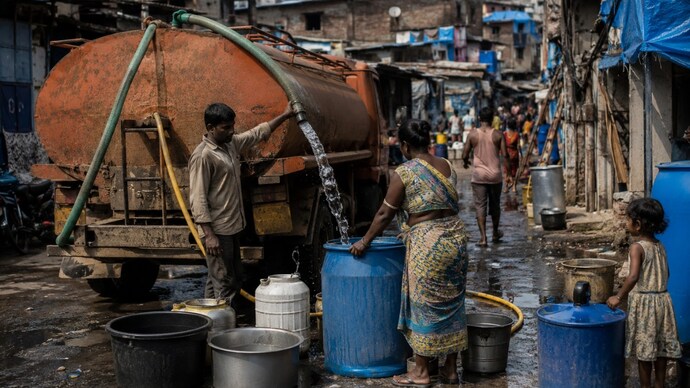
Kusnur said water stress and falling groundwater levels were being reflected in scarcity of water for drinking and agriculture. “If water is not given the same respect as currency, no one will respect it,” he noted.
The water audits will be undertaken like financial audits, and positive or negative water balance-sheets drawn up. Sources of water, such as rainfall and borewells, will be mapped, and groundwater data drawn based on information from Maharashtra’s Groundwater Surveys and Development Agency and geo-spatial mapping. Blockchain technology will be used to monitor water use and deficiencies.
Kusnur said they had already launched water ecosystem mapping at Marul Haveli in Satara district and Kadus at Khed Shivapur in Pune district. A municipal council is also being considered for the project. The focus will be on harvesting, recycling and monetisation of water.
AqVerium is the world's only platform to issue AquaKredits or water credits, with 1,000 litres of water having the value of a credit. Kusnur said they had issued around seven million water credits so far.
An AquaKredit is described as “a standardised, tradeable unit representing one kilolitre of water conserved, recycled or harvested. Each kredit is independently verified and recorded on an immutable ledger”. These water credits are issued for recycled water, rainwater harvesting and conservation savings.
While concretisation prevents water percolation into the ground and affects groundwater levels, officials said it has been contemplated that around 15 per cent land in urban layouts be kept unpaved to ensure water seepage and percolation. Instead of large sewage treatment plants, a cluster-based or decentralised model has been mooted to ensure better coverage. Universal metering of water supply connections is also being considered to ensure that consumption is recorded accurately.
According to the Maharashtra Water Resources Regulatory Authority (MWRRA), only 55 per cent of the dependable water yield is available in four of the five river basins (Krishna, Godavari, Tapi and Narmada) east of the Western Ghats. These four basins comprise 92 per cent of the cultivable land and over 60 per cent of the rural population.
An approximate 49 per cent of the area of these four river basins, comprising 43 per cent of the population, is already considered as a deficit or highly deficit in water. The size of these deficit areas is likely to increase steadily with increasing population and economic growth.
As per MWRRA, the remaining 45 per cent water flow is from the westward flowing rivers, which originate in the Western Ghats, are monsoon specific and drain into the Arabian Sea.
The geographical area of Maharashtra measures 30.8 million hectares and its cultivable area 2.25 million hectares. Forty per cent of this is drought prone and about 7 per cent flood prone.
Subscribe to India Today Magazine
The concept will be rolled out as a pilot, as decided in a meeting presided by state revenue minister Chandrashekhar Bawankule in Mumbai. It was attended by senior officials from the revenue, water supply and sanitation, and rural development departments, besides Subramanya Kusnur, founder of AqVerium, the world’s first digital water bank.
Kusnur, in collaboration with Avinash Kadam, the water expert from IIT Bombay, and economist Uday Nair, has developed a modern ‘water accounting framework’ and ‘water balance-sheet’. The system will audit water resources, enabling transparent tracking of water stocks—inflow, outflow and remaining annual balance—at the gram panchayat and watershed levels. The audits will record the accurate storage and consumption of water, ensure data-driven decisions on usage, and enforce accountability and water governance.
Officials said the goal was to develop the concept of “water as a measurable asset” and verify stocks. The surplus or deficit of water will be calculated based on the opening stocks, recharge and supply, minus the usage and outflows. Urban or rural areas that are water-positive will be able to sell their water credits to water-guzzling industries such as those manufacturing beer, soft drinks and packaged water.
The concept will also be integrated into water conservation schemes, such as the state government’s flagship Jalyukta Shivar Abhiyan, which aims to address water scarcity, and initiatives by groups like the Paani Foundation. This means that individuals and communities that conserve water will be rewarded through ‘water credits’ and be able to monetise this as an asset.
Kusnur said water stress and falling groundwater levels were being reflected in scarcity of water for drinking and agriculture. “If water is not given the same respect as currency, no one will respect it,” he noted.
The water audits will be undertaken like financial audits, and positive or negative water balance-sheets drawn up. Sources of water, such as rainfall and borewells, will be mapped, and groundwater data drawn based on information from Maharashtra’s Groundwater Surveys and Development Agency and geo-spatial mapping. Blockchain technology will be used to monitor water use and deficiencies.
Kusnur said they had already launched water ecosystem mapping at Marul Haveli in Satara district and Kadus at Khed Shivapur in Pune district. A municipal council is also being considered for the project. The focus will be on harvesting, recycling and monetisation of water.
AqVerium is the world's only platform to issue AquaKredits or water credits, with 1,000 litres of water having the value of a credit. Kusnur said they had issued around seven million water credits so far.
An AquaKredit is described as “a standardised, tradeable unit representing one kilolitre of water conserved, recycled or harvested. Each kredit is independently verified and recorded on an immutable ledger”. These water credits are issued for recycled water, rainwater harvesting and conservation savings.
While concretisation prevents water percolation into the ground and affects groundwater levels, officials said it has been contemplated that around 15 per cent land in urban layouts be kept unpaved to ensure water seepage and percolation. Instead of large sewage treatment plants, a cluster-based or decentralised model has been mooted to ensure better coverage. Universal metering of water supply connections is also being considered to ensure that consumption is recorded accurately.
According to the Maharashtra Water Resources Regulatory Authority (MWRRA), only 55 per cent of the dependable water yield is available in four of the five river basins (Krishna, Godavari, Tapi and Narmada) east of the Western Ghats. These four basins comprise 92 per cent of the cultivable land and over 60 per cent of the rural population.
An approximate 49 per cent of the area of these four river basins, comprising 43 per cent of the population, is already considered as a deficit or highly deficit in water. The size of these deficit areas is likely to increase steadily with increasing population and economic growth.
As per MWRRA, the remaining 45 per cent water flow is from the westward flowing rivers, which originate in the Western Ghats, are monsoon specific and drain into the Arabian Sea.
The geographical area of Maharashtra measures 30.8 million hectares and its cultivable area 2.25 million hectares. Forty per cent of this is drought prone and about 7 per cent flood prone.
Subscribe to India Today Magazine

