Why copper plates discovered at a Maharashtra temple have historians curious
Plans are afoot to approach the Archaeological Survey of India to decipher the copper plates carrying inscriptions in Devanagari and Sanskrit
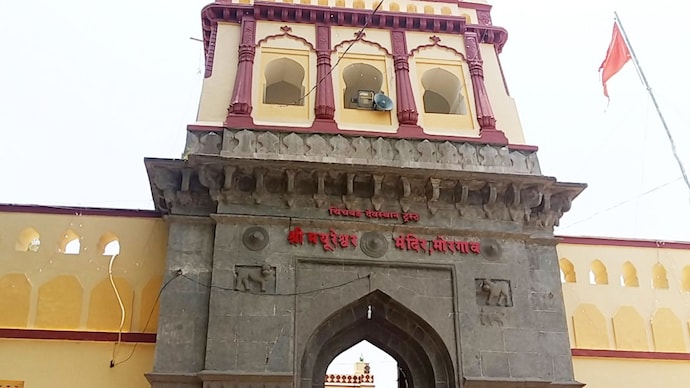
This is the first time an inscription has been found at an Ashtavinayak shrine and can help ascertain the historicity and antiquity of the temple itself, and even the worship of the Lord and the antiquity of the Ganapatya sect, which reveres Ganesha.
Vilas Wahane, assistant director, Directorate of Archaeology and Museums, said the copper plates had emerged during the ongoing conservation, restoration and preservation of the temple. Work in the sanctum sanctorum saw the removal of marble and granite, and a brass and copper prabhaval (halo or arch), which were later-day additions to the shrine.
While removing the prabhaval, the original arch made of stone came to light. It had two copper plates embedded. “A primary reading suggests that one of the two dates back to Shaka 1457 (1628 CE) and the other to 1632 (1710 CE). They have references to the renovation of the temple and donations made for it,” said Wahane. References to the shrine of the saint Moraya Gosavi, who lived at Chinchwad near Pune and was a devotee of Lord Ganesha, were also found.
While it is believed that the present temple at Morgaon may have been built in the Peshwa period (the Peshwas of Pune were Lord Ganesha devotees), the discovery may help push the dating further to the Maratha era as the Peshwas ascended to power as chiefs of the Maratha confederacy only after 1713.
The state government has launched a Rs 148 crore plan to conserve and develop Ashtavinayak temples. This will cover seven of the eight temples that house Lord Ganesha idols considered to be Swayambhu or self-manifested. These are the Mayureshwar Temple (Morgaon, Pune district), Siddhivinayak Temple (Siddhatek, Ahilyanagar or erstwhile Ahmednagar district), Ballaleshwar Temple (Pali, Raigad district), Varadavinayak Temple (Mahad, Raigad district), Chintamani Temple (Theur, Pune district), Girijatmaj Temple (Lenyadri, Pune district), Vighneshwar Temple (Ozar, Pune district) and Mahaganapati Temple (Ranjangaon, Pune district).
The development plan, work on which began around January and is expected to take a year to complete, will cover seven of the eight shrines, except the one at Lenyadri, which is an Archaeological Survey of India (ASI) protected site and is located in a cave around 100 km from Pune. Usually, the Siddhivinayak yatra begins from Morgaon and covers other temples before ending at Morgaon again, which underlines the importance of this shrine located close to Baramati.
Wahane said they would approach the ASI for deciphering the copper plates, which have been inscribed in Devanagari and Sanskrit.
The directorate is also undertaking conservation works at the temple of Shri Ambabai/ Mahalaxmi at Kolhapur, where stone inscriptions were found under the idol of a yogini. The inscription is in the Devanagari and Hale Kannada (a classical form of the Kannada language) script. In 2023, a stone inscription was found in the temple. So far, eight inscriptions have been located and can throw new light on the temple, the period of its construction, royal patronage and history. The directorate will approach the Epigraphical Society of India in Mysuru to read them.
The temple is regarded as one of the ‘Shakti Peeths’ of the Mother Goddess. This temple in Kolhapur, located around 370 km from Mumbai, is said to date back to the Shilahara period (11th century) when it was completed by King Gandaraditya.
Subscribe to India Today Magazine
This is the first time an inscription has been found at an Ashtavinayak shrine and can help ascertain the historicity and antiquity of the temple itself, and even the worship of the Lord and the antiquity of the Ganapatya sect, which reveres Ganesha.
Vilas Wahane, assistant director, Directorate of Archaeology and Museums, said the copper plates had emerged during the ongoing conservation, restoration and preservation of the temple. Work in the sanctum sanctorum saw the removal of marble and granite, and a brass and copper prabhaval (halo or arch), which were later-day additions to the shrine.
While removing the prabhaval, the original arch made of stone came to light. It had two copper plates embedded. “A primary reading suggests that one of the two dates back to Shaka 1457 (1628 CE) and the other to 1632 (1710 CE). They have references to the renovation of the temple and donations made for it,” said Wahane. References to the shrine of the saint Moraya Gosavi, who lived at Chinchwad near Pune and was a devotee of Lord Ganesha, were also found.
While it is believed that the present temple at Morgaon may have been built in the Peshwa period (the Peshwas of Pune were Lord Ganesha devotees), the discovery may help push the dating further to the Maratha era as the Peshwas ascended to power as chiefs of the Maratha confederacy only after 1713.
The state government has launched a Rs 148 crore plan to conserve and develop Ashtavinayak temples. This will cover seven of the eight temples that house Lord Ganesha idols considered to be Swayambhu or self-manifested. These are the Mayureshwar Temple (Morgaon, Pune district), Siddhivinayak Temple (Siddhatek, Ahilyanagar or erstwhile Ahmednagar district), Ballaleshwar Temple (Pali, Raigad district), Varadavinayak Temple (Mahad, Raigad district), Chintamani Temple (Theur, Pune district), Girijatmaj Temple (Lenyadri, Pune district), Vighneshwar Temple (Ozar, Pune district) and Mahaganapati Temple (Ranjangaon, Pune district).
The development plan, work on which began around January and is expected to take a year to complete, will cover seven of the eight shrines, except the one at Lenyadri, which is an Archaeological Survey of India (ASI) protected site and is located in a cave around 100 km from Pune. Usually, the Siddhivinayak yatra begins from Morgaon and covers other temples before ending at Morgaon again, which underlines the importance of this shrine located close to Baramati.
Wahane said they would approach the ASI for deciphering the copper plates, which have been inscribed in Devanagari and Sanskrit.
The directorate is also undertaking conservation works at the temple of Shri Ambabai/ Mahalaxmi at Kolhapur, where stone inscriptions were found under the idol of a yogini. The inscription is in the Devanagari and Hale Kannada (a classical form of the Kannada language) script. In 2023, a stone inscription was found in the temple. So far, eight inscriptions have been located and can throw new light on the temple, the period of its construction, royal patronage and history. The directorate will approach the Epigraphical Society of India in Mysuru to read them.
The temple is regarded as one of the ‘Shakti Peeths’ of the Mother Goddess. This temple in Kolhapur, located around 370 km from Mumbai, is said to date back to the Shilahara period (11th century) when it was completed by King Gandaraditya.
Subscribe to India Today Magazine

