Why Delhi's post-Diwali pollution narrative is as hazy as its toxic air
As ruling BJP and Congress-AAP trade blame over AQI figures, monitoring blips and farm fires, Delhiites ask: where's the clean air to breathe?
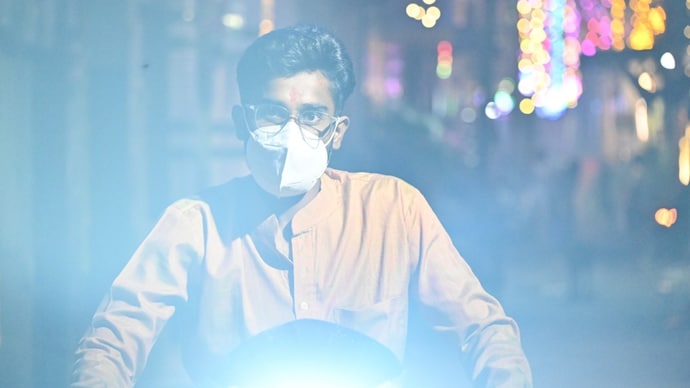
Delhi’s Diwali-day (November 8) Air Quality Index (AQI) was reported at 376, against 345 on the day of the festival in 2025. Both figures fall in the “very poor” AQI category. Whatever improvements the Rekha Gupta government had claimed failed to account on the night of the festival.
The morning-after assessment on November 9 found 14 of the 51 air quality monitoring stations reporting in the “severe” category. The city-wide AQI average hid from plain sight the gravity of the situation, with many areas of Delhi far worse off than what the headline number showed.
The figures, though, do not establish that every pollution-control measure of the government was ineffective. They do, however, expose the gap between claims and the actual quality of Delhi’s air.
Delhi environment minister Manjinder Singh Sirsa had said about a week prior to Diwali that the city had achieved 220 clean-air days in 2026 and its cleanest October in a decade. He pointed to the BJP government’s pollution-control measures, including improved electric vehicle-charging infrastructure, while raising concerns about stubble-burning by farmers in Punjab—a state ruled by the Aam Aadmi Party (AAP) and headed for elections next year.
The Diwali-day figures from the Central Pollution Control Board (CPCB) and the Delhi government’s motoring stations put a key distinction into focus. An annual AQI record and a Diwali-period outcome are two separate benchmarks.
Of the worst locations as per monitoring data, north Delhi’s Bawana, Rohini and Burari and west Delhi’s Punjabi Bagh saw AQI going well past 400. But greener areas, such as Jawaharlal Nehru University and Siri Fort in the city’s south or Lodhi Road in Lutyens’ Delhi, did hardly better—their numbers ranging around 350.
The ‘farm fire’ alarm rang again, and predictably it was blame-game. Delhi minister Kapil Mishra alleged farm fires had been deliberately started in Punjab on the evening of Diwali to worsen Delhi’s air pollution and discredit the BJP government. “Satellite-detected fires had risen from roughly 100-125 daily over the preceding three days to about 1,200 on Diwali evening,” Mishra claimed on November 9. He demanded police cases and an investigation, including scrutiny of AAP leaders’ phone records, and even suggested that AAP boss Arvind Kejriwal could find himself implicated.
Praveen Khandelwal, the BJP MP from Delhi’s Chandni Chowk, blamed successive Congress and AAP governments in the city for failing to address air pollution over the preceding 25 years. He also accused Opposition parties of selectively raising pollution concerns around Hindu festivals and AAP of encouraging stubble-burning in Punjab.
The pollution source-apportionment estimates, however, point towards a problem that cannot be blamed on a single source. The Indian Institute of Tropical Meteorology Decision Support System (IITM-DSS), a numerical model-based pollution tracker for Delhi and the surrounding NCR (National Capital Region), displayed a November 8 estimate that attributed 37 per cent of Delhi’s PM2.5 (very fine particulate matter) levels to local sources and 63 per cent to non-local. In other words, it suggested that about two-thirds of the pollutants might have originated from outside the city.
Delhi’s transport system accounted for around 19 per cent and stubble-burning for 5.1 per cent. Yet these are modelled contributions, not direct proof of what caused the Diwali-night spike. Similarly, non-local pollution cannot simply be treated as synonymous with farm fires.
With clarity on sources of pollution being as hazy as the air itself, Delhi Congress veteran Ajay Maken questioned the missing PM2.5 readings of Diwali night. He claimed 25 monitoring stations had lacked readings between 2 am and 3 am on November 9. These included Anand Vihar, Bawana, Chandni Chowk, Punjabi Bagh, Pusa, R.K. Puram, Mundka and Wazirpur.
Congress spokesperson Pawan Khera questioned whether data had been suppressed or equipment had failed.
AAP's Saurabh Bharadwaj accused the Delhi government of manipulating AQI data. He circulated a video on social media purportedly showing a reading above 3,000 and took a dig at the BJP government’s cloud-seeding plan, which had come a cropper last winter.
Congress leader Jairam Ramesh, on the other hand, argued for a broader policy response, calling for tighter PM2.5 and ozone standards and a public health-oriented law on clean air. For Delhiites, however, the immediate requirement boils down to a simple question: how to find some clean air to breathe.
Subscribe to India Today Magazine

