Why leopard landscape Jawai is now a national conservation test case
As the Rajasthan HC pushes for tighter regulation and explores sanctuary status for Jawai, the larger question: how to protect wildlife beyond forests?
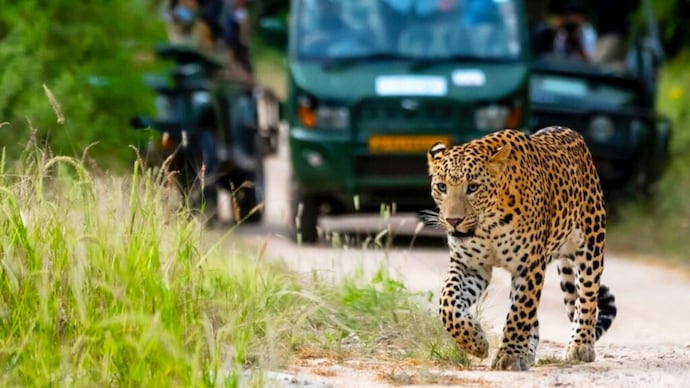
By freezing new construction, halting mining, banning night safaris and drone operations, and asking the Rajasthan government to examine declaring Jawai a leopard sanctuary, the court has effectively acknowledged a larger reality: India’s wildlife future may increasingly depend not on protected forests alone but on landscapes shared with humans. That makes Jawai more than a regional conservation dispute. It is now a national test case.
Located around the Jawai dam region in Rajasthan’s Pali district, the Jawai-Bera belt has acquired global attention over the past decade for an unusual reason. Unlike tigers that largely survive within notified reserves, the leopards here live in open, mixed-use terrain—rocky granite outcrops, village commons, grazing lands, farms and temple caves. Human habitation is not peripheral to the ecosystem; it is embedded within it. This is what makes Jawai exceptional and fragile at the same time.
Wildlife photographers, safari operators and conservationists describe Jawai as one of the world’s rare examples of relatively stable human-leopard coexistence. Leopard sightings are frequent because the wild cats have adapted to living close to villages without the high levels of conflict seen elsewhere in India.
Local communities, particularly the Rabari pastoralists, historically evolved an informal accommodation with the predators. Livestock losses occur, but retaliatory killings have remained comparatively low. That delicate balance, however, has come under growing pressure from commercial tourism and unregulated real-estate expansion.
Luxury camps, boutique resorts, off-road safaris, including safari vehicles driven in night hours with headlights on, and social media-driven tourism transformed Jawai into a high-end wildlife destination. Resorts emerged close to leopard habitats, private land enclosures expanded, vehicle movement intensified and drone filming became common. Conservationists repeatedly warned that the very openness that made Jawai unique was being fragmented.
The high court’s order reflects precisely this concern. Its interim directions are sweeping. The court has not merely targeted one illegal structure or one mining activity; it has attempted to pause an entire pattern of ecological degradation before it becomes irreversible. The prohibition on new construction without court approval, the stay on fresh tourism licences and the ban on habitat-fragmenting practices, such as barbed-wire compartmentalisation, indicate judicial recognition that Jawai’s ecosystem cannot survive piecemeal regulation.
Most significant is the court’s suggestion that the state examine notifying Jawai as a sanctuary under the Wildlife Protection Act, 1972 framework. That proposal raises both opportunity and complexity.
Traditionally, Indian wildlife conservation has depended on fortress-style protected areas—national parks and sanctuaries with clearly demarcated forest boundaries. Jawai does not fit neatly into that model. Much of the leopard movement occurs through revenue land, village commons and privately owned parcels rather than contiguous forest. The animals routinely cross farms, skirt village peripheries and use rocky caves located outside legally protected zones.
This creates a regulatory vacuum. Wildlife protections exist on paper, but land-use regulation across mixed ownership patterns remains weak and inconsistent. Commercial operators can exploit those gaps. A sanctuary notification could theoretically provide legal tools for zoning, corridor protection, carrying-capacity regulation and scientific monitoring of prey movement and breeding areas.
But sanctuary status alone will not solve Jawai’s problems. If implemented clumsily, it could trigger fresh tensions with local communities whose grazing routes, water access and livelihoods are tied to the same landscape. India’s conservation history is full of examples where wildlife protection became alienating because local residents were treated as encroachers.
That is why Jawai’s future depends less on legal notification and more on governance design. The challenge before Rajasthan is to create a hybrid conservation model—one that recognises wildlife movement beyond forests while also protecting community rights and local economies.
The high court itself appears conscious of this balance. Its order does not reject tourism altogether; rather, it seeks regulated eco-tourism under scientific and administrative oversight. The proposed inter-departmental Jawai Safari and Eco-Tourism Coordination Committee is intended to impose ecological discipline on an industry that expanded faster than regulation.
This distinction matters politically as well. Tourism operators and local businesses fear that construction freezes and licencing restrictions could damage incomes dependent on safari tourism, homestays and hospitality. Their concerns are not entirely misplaced. Jawai’s economy today is deeply intertwined with wildlife tourism. But the counterargument from conservationists is equally compelling: if unchecked tourism destroys leopard movement corridors and habitat stability, the tourism economy itself will eventually collapse.
In many ways, Jawai illustrates the central contradiction of modern eco-tourism in India. Wildlife landscapes generate economic value precisely because they remain ecologically intact. But once commercial success arrives, the pressure to monetise every hill, waterbody and safari route begins eroding the same ecosystem that created the attraction.
The high court has effectively intervened before Jawai reaches that tipping point. Its emphasis on implementing draft standard operating procedures immediately is important because Jawai’s crisis has largely been one of governance lagging behind tourism growth.
Now the state has a narrow window to correct course. What happens next will determine whether Jawai evolves into India’s first major coexistence-led leopard conservation model or becomes another cautionary example of ecological branding overtaken by commercial excess.
For that, two factors will be critical. First, science-based landscape planning. Authorities will need accurate mapping of leopard corridors, breeding zones, prey movement and sensitive bird-hatching sites across public and private land. Conservation in Jawai cannot operate through isolated forest patches alone because the animals themselves do not recognise administrative boundaries.
Second, community participation. Any durable conservation framework must include revenue-sharing, compensation mechanisms and negotiated land-use rules that keep local communities invested in coexistence.
The larger significance of Jawai extends far beyond Rajasthan. Across India, leopards, elephants and other wildlife increasingly survive outside conventional protected forests in agricultural belts, peri-urban zones and mixed-use landscapes. Climate stress, habitat fragmentation and expanding infrastructure are accelerating that trend. India’s conservation laws and institutions, however, remain heavily oriented toward forest-centric models.
Jawai may, therefore, force policymakers to confront a difficult but unavoidable question: how should India govern wildlife habitats that are simultaneously ecological zones, tourism economies and lived human spaces? The answer will shape not only the future of Jawai’s leopards but also the future of coexistence-based conservation in India itself.
Subscribe to India Today Magazine
By freezing new construction, halting mining, banning night safaris and drone operations, and asking the Rajasthan government to examine declaring Jawai a leopard sanctuary, the court has effectively acknowledged a larger reality: India’s wildlife future may increasingly depend not on protected forests alone but on landscapes shared with humans. That makes Jawai more than a regional conservation dispute. It is now a national test case.
Located around the Jawai dam region in Rajasthan’s Pali district, the Jawai-Bera belt has acquired global attention over the past decade for an unusual reason. Unlike tigers that largely survive within notified reserves, the leopards here live in open, mixed-use terrain—rocky granite outcrops, village commons, grazing lands, farms and temple caves. Human habitation is not peripheral to the ecosystem; it is embedded within it. This is what makes Jawai exceptional and fragile at the same time.
Wildlife photographers, safari operators and conservationists describe Jawai as one of the world’s rare examples of relatively stable human-leopard coexistence. Leopard sightings are frequent because the wild cats have adapted to living close to villages without the high levels of conflict seen elsewhere in India.
Local communities, particularly the Rabari pastoralists, historically evolved an informal accommodation with the predators. Livestock losses occur, but retaliatory killings have remained comparatively low. That delicate balance, however, has come under growing pressure from commercial tourism and unregulated real-estate expansion.
Luxury camps, boutique resorts, off-road safaris, including safari vehicles driven in night hours with headlights on, and social media-driven tourism transformed Jawai into a high-end wildlife destination. Resorts emerged close to leopard habitats, private land enclosures expanded, vehicle movement intensified and drone filming became common. Conservationists repeatedly warned that the very openness that made Jawai unique was being fragmented.
The high court’s order reflects precisely this concern. Its interim directions are sweeping. The court has not merely targeted one illegal structure or one mining activity; it has attempted to pause an entire pattern of ecological degradation before it becomes irreversible. The prohibition on new construction without court approval, the stay on fresh tourism licences and the ban on habitat-fragmenting practices, such as barbed-wire compartmentalisation, indicate judicial recognition that Jawai’s ecosystem cannot survive piecemeal regulation.
Most significant is the court’s suggestion that the state examine notifying Jawai as a sanctuary under the Wildlife Protection Act, 1972 framework. That proposal raises both opportunity and complexity.
Traditionally, Indian wildlife conservation has depended on fortress-style protected areas—national parks and sanctuaries with clearly demarcated forest boundaries. Jawai does not fit neatly into that model. Much of the leopard movement occurs through revenue land, village commons and privately owned parcels rather than contiguous forest. The animals routinely cross farms, skirt village peripheries and use rocky caves located outside legally protected zones.
This creates a regulatory vacuum. Wildlife protections exist on paper, but land-use regulation across mixed ownership patterns remains weak and inconsistent. Commercial operators can exploit those gaps. A sanctuary notification could theoretically provide legal tools for zoning, corridor protection, carrying-capacity regulation and scientific monitoring of prey movement and breeding areas.
But sanctuary status alone will not solve Jawai’s problems. If implemented clumsily, it could trigger fresh tensions with local communities whose grazing routes, water access and livelihoods are tied to the same landscape. India’s conservation history is full of examples where wildlife protection became alienating because local residents were treated as encroachers.
That is why Jawai’s future depends less on legal notification and more on governance design. The challenge before Rajasthan is to create a hybrid conservation model—one that recognises wildlife movement beyond forests while also protecting community rights and local economies.
The high court itself appears conscious of this balance. Its order does not reject tourism altogether; rather, it seeks regulated eco-tourism under scientific and administrative oversight. The proposed inter-departmental Jawai Safari and Eco-Tourism Coordination Committee is intended to impose ecological discipline on an industry that expanded faster than regulation.
This distinction matters politically as well. Tourism operators and local businesses fear that construction freezes and licencing restrictions could damage incomes dependent on safari tourism, homestays and hospitality. Their concerns are not entirely misplaced. Jawai’s economy today is deeply intertwined with wildlife tourism. But the counterargument from conservationists is equally compelling: if unchecked tourism destroys leopard movement corridors and habitat stability, the tourism economy itself will eventually collapse.
In many ways, Jawai illustrates the central contradiction of modern eco-tourism in India. Wildlife landscapes generate economic value precisely because they remain ecologically intact. But once commercial success arrives, the pressure to monetise every hill, waterbody and safari route begins eroding the same ecosystem that created the attraction.
The high court has effectively intervened before Jawai reaches that tipping point. Its emphasis on implementing draft standard operating procedures immediately is important because Jawai’s crisis has largely been one of governance lagging behind tourism growth.
Now the state has a narrow window to correct course. What happens next will determine whether Jawai evolves into India’s first major coexistence-led leopard conservation model or becomes another cautionary example of ecological branding overtaken by commercial excess.
For that, two factors will be critical. First, science-based landscape planning. Authorities will need accurate mapping of leopard corridors, breeding zones, prey movement and sensitive bird-hatching sites across public and private land. Conservation in Jawai cannot operate through isolated forest patches alone because the animals themselves do not recognise administrative boundaries.
Second, community participation. Any durable conservation framework must include revenue-sharing, compensation mechanisms and negotiated land-use rules that keep local communities invested in coexistence.
The larger significance of Jawai extends far beyond Rajasthan. Across India, leopards, elephants and other wildlife increasingly survive outside conventional protected forests in agricultural belts, peri-urban zones and mixed-use landscapes. Climate stress, habitat fragmentation and expanding infrastructure are accelerating that trend. India’s conservation laws and institutions, however, remain heavily oriented toward forest-centric models.
Jawai may, therefore, force policymakers to confront a difficult but unavoidable question: how should India govern wildlife habitats that are simultaneously ecological zones, tourism economies and lived human spaces? The answer will shape not only the future of Jawai’s leopards but also the future of coexistence-based conservation in India itself.
Subscribe to India Today Magazine

