Why Samrat Choudhary wants yoga in Bihar's schools, colleges
In Patna, the Bihar CM took International Day of Yoga beyond a celebration of physical strength, to a performance of political discipline and endurance
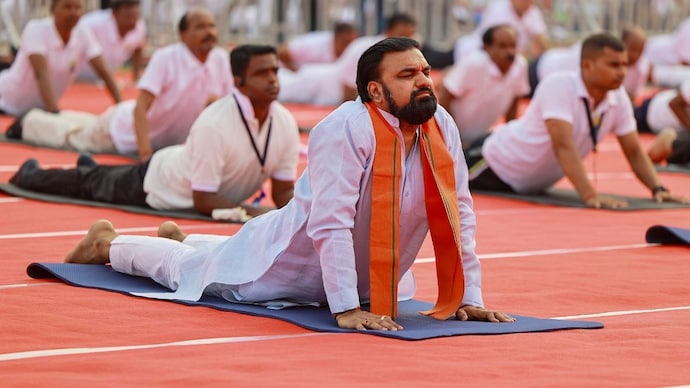
The chief minister’s yoga performance did not merely showcase his physical endurance. It also demonstrated that he practises what he preaches. As Choudhary announced his decision to introduce yoga into the curriculum of Bihar’s schools and colleges from the next academic year, he also underscored that the proposal comes from someone who actively incorporates yoga in his daily life.
In the first posture, seated in calm concentration, Choudhary seemed to be making a case for stillness as an administrative virtue. The back-bending sequence—chest opened, spine arched—suggested both flexibility and strength, a useful leadership combination in Bihar where governance is rarely a straight line and every decision must withstand the demands of inclusive development, bureaucratic efficiency and the ever-rising expectations of the people.
In the standing stretches, arms rising overhead, Choudhary looked like a leader rehearsing the idea of reach: across departments, districts and a vast state that constantly demands its chief minister’s best efforts.
Standing well over six feet, 56-year-old Choudhary carries a commanding figure even before he speaks. Yet what stood out at the Patna event was not merely his height but energy. Through a demanding sequence of stretches, bends and balancing postures, he displayed a level of flexibility and endurance that many younger politicians would envy. Choudhary’s appearance on the yoga mat carried a subtle message: governance demands stamina. He appeared determined to demonstrate that physical fitness was not just a personal indulgence but a professional necessity.
That is perhaps why the scene landed with unusual force. Bihar has had its share of leaders who have mastered posture in the metaphorical sense. Choudhary was showing that posture can also be literal. He was not posing as a yogi. Rather, he was demonstrating control as a leader—not in the absence of strain but despite it.
Choudhary’s enthusiasm for yoga is also part of a larger cultural project. Drawing inspiration from Prime Minister Narendra Modi, whom he credited with transforming yoga from a largely domestic practice into a global movement, the Bihar chief minister views yoga as both a wellness discipline and a civilisational inheritance. His proposal to introduce yoga into Bihar’s education curricula reflects that conviction. In Choudhary’s telling, yoga is not simply exercise; it is an expression of Sanatan values—discipline, balance, self-mastery and harmony with one’s surroundings. By seeking to institutionalise yoga in educational spaces, he is attempting to weave those values into the fabric of Bihar’s public life.
The chief minister has been saying as much in words too. Yoga, he stated, is not merely an ancient Indian practice or a ritual for ceremonial mornings; it is a practical route to health, balance and longevity. More significantly, he announced that the Bihar government intends to bring yoga into the curriculum of schools and colleges so that it reaches children and young adults as everyday learning. The idea is simple enough to be appealing: if the state can teach arithmetic, civics and science, it can also teach the discipline of breath, body and mind. The ambition is to make yoga a practice for everyone, every day.
That choice of word matters. What Choudhary is proposing is not just a programme but a habit, not just a lesson but a culture. In a state where public discourse is often dominated by development deficits, law-and-order anxieties and the brutal arithmetic of jobs, his insistence on yoga feels almost counterintuitive. Yet it also makes sense. A government cannot ask its citizens to be resilient if it does not model resilience itself.
He is, after all, governing a difficult state at a difficult moment. Bihar asks its chief minister to do many things at once: keep the machinery alert, the police responsive, the bureaucracy efficient, the investors interested, the young hopeful, the political allies content and the public persuaded that the future is still under construction. It is a punishing brief. A leader who stands before a crowd and cannot touch his toes—figuratively, if not literally—is hardly in a position to ask others to endure.
The images from the day told their own story. In one, Choudhary sat cross-legged with eyes closed, his face unexpectedly unguarded, as though the state had briefly allowed itself a private minute. In another sequence, he rose into a deep spinal extension, shoulders drawn back and chest lifted towards the sky. The posture conveyed an image of confidence anchored in stability. Leadership, after all, requires the ability to absorb pressure without folding under it. The lifted chest and steady gaze seemed to suggest a willingness to confront challenges directly while maintaining composure. In another frame, he stood upright with arms extended overhead, indicating aspiration and public resolve.
These were not merely yoga postures. They were political metaphors performed in sequence: inwardness, exertion, elevation. The choreography was almost too neat, and that is what made it effective. And yet, the strongest impression Choudhary gave was not of theatricality but insistence. He seemed determined to present fitness as part of governance.
There is a certain realism in that. Bihar needs a leader with stamina, to prevent the public mood from sagging under the combined weight of grand expectations and routine disappointments. A chief minister, then, is not only an administrator. Choudhary, in that sense, is a kind of custodial athlete.
This is also why his talk of putting yoga into school and college timetables feels politically shrewd. It links the body to education, education to culture, and culture to statecraft. It says that health is not a private indulgence but public policy. It suggests that a generation raised with some familiarity with yoga may grow up with a better vocabulary for self-discipline, concentration and composure—all qualities a state badly needs.
There is, inevitably, a symbolic charge to all this. Choudhary’s admirers will see in it a leader who is not content to govern from the chair, but one willing to stand on the mat with everyone else. His critics may see a carefully staged image of vigour. Both things may be true. But politics is often judged by the story it chooses to tell about itself. On this morning, Bihar’s chief minister chose to tell a story of balance: a leader under pressure, bending without breaking, reaching without losing his centre.
Politics rewards velocity; governance rewards endurance. Bihar today presents no shortage of tests—employment, infrastructure, investment, law and order and the management of immense public expectations. Against that backdrop, the image of Choudhary seated cross-legged in meditation, standing tall in balance, or stretching skyward acquires a significance beyond the ceremonial. It becomes a statement of method. The chief minister appears to believe that the strength required to govern a state begins with the discipline to govern oneself. On a red yoga mat in Patna, he offered a glimpse of that philosophy in action.
Subscribe to India Today Magazine
The chief minister’s yoga performance did not merely showcase his physical endurance. It also demonstrated that he practises what he preaches. As Choudhary announced his decision to introduce yoga into the curriculum of Bihar’s schools and colleges from the next academic year, he also underscored that the proposal comes from someone who actively incorporates yoga in his daily life.
In the first posture, seated in calm concentration, Choudhary seemed to be making a case for stillness as an administrative virtue. The back-bending sequence—chest opened, spine arched—suggested both flexibility and strength, a useful leadership combination in Bihar where governance is rarely a straight line and every decision must withstand the demands of inclusive development, bureaucratic efficiency and the ever-rising expectations of the people.
In the standing stretches, arms rising overhead, Choudhary looked like a leader rehearsing the idea of reach: across departments, districts and a vast state that constantly demands its chief minister’s best efforts.
Standing well over six feet, 56-year-old Choudhary carries a commanding figure even before he speaks. Yet what stood out at the Patna event was not merely his height but energy. Through a demanding sequence of stretches, bends and balancing postures, he displayed a level of flexibility and endurance that many younger politicians would envy. Choudhary’s appearance on the yoga mat carried a subtle message: governance demands stamina. He appeared determined to demonstrate that physical fitness was not just a personal indulgence but a professional necessity.
That is perhaps why the scene landed with unusual force. Bihar has had its share of leaders who have mastered posture in the metaphorical sense. Choudhary was showing that posture can also be literal. He was not posing as a yogi. Rather, he was demonstrating control as a leader—not in the absence of strain but despite it.
Choudhary’s enthusiasm for yoga is also part of a larger cultural project. Drawing inspiration from Prime Minister Narendra Modi, whom he credited with transforming yoga from a largely domestic practice into a global movement, the Bihar chief minister views yoga as both a wellness discipline and a civilisational inheritance. His proposal to introduce yoga into Bihar’s education curricula reflects that conviction. In Choudhary’s telling, yoga is not simply exercise; it is an expression of Sanatan values—discipline, balance, self-mastery and harmony with one’s surroundings. By seeking to institutionalise yoga in educational spaces, he is attempting to weave those values into the fabric of Bihar’s public life.
The chief minister has been saying as much in words too. Yoga, he stated, is not merely an ancient Indian practice or a ritual for ceremonial mornings; it is a practical route to health, balance and longevity. More significantly, he announced that the Bihar government intends to bring yoga into the curriculum of schools and colleges so that it reaches children and young adults as everyday learning. The idea is simple enough to be appealing: if the state can teach arithmetic, civics and science, it can also teach the discipline of breath, body and mind. The ambition is to make yoga a practice for everyone, every day.
That choice of word matters. What Choudhary is proposing is not just a programme but a habit, not just a lesson but a culture. In a state where public discourse is often dominated by development deficits, law-and-order anxieties and the brutal arithmetic of jobs, his insistence on yoga feels almost counterintuitive. Yet it also makes sense. A government cannot ask its citizens to be resilient if it does not model resilience itself.
He is, after all, governing a difficult state at a difficult moment. Bihar asks its chief minister to do many things at once: keep the machinery alert, the police responsive, the bureaucracy efficient, the investors interested, the young hopeful, the political allies content and the public persuaded that the future is still under construction. It is a punishing brief. A leader who stands before a crowd and cannot touch his toes—figuratively, if not literally—is hardly in a position to ask others to endure.
The images from the day told their own story. In one, Choudhary sat cross-legged with eyes closed, his face unexpectedly unguarded, as though the state had briefly allowed itself a private minute. In another sequence, he rose into a deep spinal extension, shoulders drawn back and chest lifted towards the sky. The posture conveyed an image of confidence anchored in stability. Leadership, after all, requires the ability to absorb pressure without folding under it. The lifted chest and steady gaze seemed to suggest a willingness to confront challenges directly while maintaining composure. In another frame, he stood upright with arms extended overhead, indicating aspiration and public resolve.
These were not merely yoga postures. They were political metaphors performed in sequence: inwardness, exertion, elevation. The choreography was almost too neat, and that is what made it effective. And yet, the strongest impression Choudhary gave was not of theatricality but insistence. He seemed determined to present fitness as part of governance.
There is a certain realism in that. Bihar needs a leader with stamina, to prevent the public mood from sagging under the combined weight of grand expectations and routine disappointments. A chief minister, then, is not only an administrator. Choudhary, in that sense, is a kind of custodial athlete.
This is also why his talk of putting yoga into school and college timetables feels politically shrewd. It links the body to education, education to culture, and culture to statecraft. It says that health is not a private indulgence but public policy. It suggests that a generation raised with some familiarity with yoga may grow up with a better vocabulary for self-discipline, concentration and composure—all qualities a state badly needs.
There is, inevitably, a symbolic charge to all this. Choudhary’s admirers will see in it a leader who is not content to govern from the chair, but one willing to stand on the mat with everyone else. His critics may see a carefully staged image of vigour. Both things may be true. But politics is often judged by the story it chooses to tell about itself. On this morning, Bihar’s chief minister chose to tell a story of balance: a leader under pressure, bending without breaking, reaching without losing his centre.
Politics rewards velocity; governance rewards endurance. Bihar today presents no shortage of tests—employment, infrastructure, investment, law and order and the management of immense public expectations. Against that backdrop, the image of Choudhary seated cross-legged in meditation, standing tall in balance, or stretching skyward acquires a significance beyond the ceremonial. It becomes a statement of method. The chief minister appears to believe that the strength required to govern a state begins with the discipline to govern oneself. On a red yoga mat in Patna, he offered a glimpse of that philosophy in action.
Subscribe to India Today Magazine

