Why the Mumbai train murder could not be prevented
The world's busiest commuter rail system caters to nearly one crore passengers every day, ruling out security measures such as those available at airports and metros
Mobile footage of the compartment showed a man with a knife and blood on the floor. Western Railway confirmed the incident and the Government Railway Police (GRP) arrested a person within 24 hours. Among all the states, according to National Crime Records Bureau (NCRB) data, Maharashtra registered the highest number of railway cases, including murder, theft and assault-157,418 under the Railway Protection Force (RPF) and 20,519 under the GRP. Theft crimes dominated the list with 19,266 cases on railway property in Maharashtra. Nationwide, the NCRB recorded 173 murders involving GRP jurisdiction, with West Bengal (29), Haryana (24) and Bihar (16) accounting for the highest numbers.
The GRP also registers "unnatural deaths" due to accidents. At 2,282, more people died on the Mumbai suburban railway in 2024 due to trespassing and falling off moving trains, hitting poles and slipping into platform gaps than anywhere else in the country, according to data tabled in the Lok Sabha by railway minister Ashwini Vaishnaw. There were 2,536 cases of such deaths in 2023 and 2,426 in 2022.
Railway crime control is a "multi-layered problem", says Arun Kumar, a former director general of the RPF. While the local police jurisdiction is outside the signal area, the GRP is responsible between two railway signals, and the RPF looks after passenger and property security. "This three-layered system creates problems in effective crime control," says Kumar. "The situation has changed drastically over the years and the security structure needs to be reviewed."
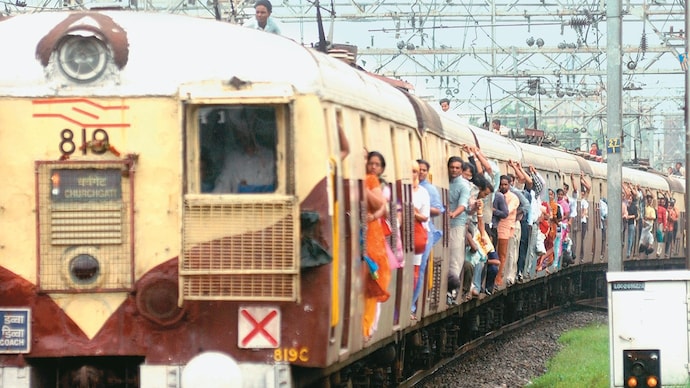
Following Lohar's killing, questions have been raised over how the murderer walked into a crowded train with a lethal weapon. The answer is in the arithmetic. The Mumbai suburban train system operates 3,234 services across 150 stations and 450 kilometres. The Central Railway has a daily passenger traffic of about 62 lakh on a weekday and the Western Railway another 31 lakh, making a total of almost 93 lakh or nearly one crore passengers daily. On January 5, the busiest day ever, there were more than 1.24 crore passengers.
Trains arrive every 3-5 minutes during peak hours. At major stations like Dadar or Andheri, a rake of 12 coaches has to stop for only 10 to 15 seconds. The trains rely on natural ventilation, with neither air-conditioning nor an automated door-closing feature, and closed doors would increase the time passengers spend on the platform. The situation is incompatible with even something as basic as airport-style baggage screening or the frisking that is done at Delhi Metro stations. Although there are 3,386 CCTV cameras at railway stations and CCTV coverage in coaches is expanding, they can only record a crime and not stop it.
The overcrowding is structural as the trains are designed for around 2,000 passengers per 12-car rake even though the load easily hits 4,500 during peak hours-what engineers refer to as "super dense crush load" (14-16 standing passengers per square metre). Breathing space is thin, leading to fights over elbow room, bags and whether to close the door or not. Most end in shouting, but a few end in murder such as in Lohar's case.
The suburban railway is Mumbai's spine. The journey ranges from Chhatrapati Shivaji Maharaj Terminus to Kalyan-around 51 km-and takes 75 to 80 minutes with a Rs 15 fare in a second-class coach. That distance by road at peak times can take more than two hours.
The Mumbai Metro, which is usually held up as the solution, transports 9 lakh passengers a day along four lines. That's only one-tenth of the suburban railway's 93 lakh load. Corridors to far-away townships like Karjat, Kasara and Virar just do not exist. Capacity expansion via the Rs 52,000 crore, three-phase Mumbai Urban Transport Project has added railway lines, air-conditioned locals and Metro corridors, but all these combined are still nowhere near the capacity of the suburban railway. While the city spreads outward, the transport options do not keep up.
The truth about the busiest commuter rail system in the world is that it moves people but cannot screen them. It keeps the city running but cannot protect each passenger.
Subscribe to India Today Magazine
Mobile footage of the compartment showed a man with a knife and blood on the floor. Western Railway confirmed the incident and the Government Railway Police (GRP) arrested a person within 24 hours. Among all the states, according to National Crime Records Bureau (NCRB) data, Maharashtra registered the highest number of railway cases, including murder, theft and assault-157,418 under the Railway Protection Force (RPF) and 20,519 under the GRP. Theft crimes dominated the list with 19,266 cases on railway property in Maharashtra. Nationwide, the NCRB recorded 173 murders involving GRP jurisdiction, with West Bengal (29), Haryana (24) and Bihar (16) accounting for the highest numbers.
The GRP also registers "unnatural deaths" due to accidents. At 2,282, more people died on the Mumbai suburban railway in 2024 due to trespassing and falling off moving trains, hitting poles and slipping into platform gaps than anywhere else in the country, according to data tabled in the Lok Sabha by railway minister Ashwini Vaishnaw. There were 2,536 cases of such deaths in 2023 and 2,426 in 2022.
Railway crime control is a "multi-layered problem", says Arun Kumar, a former director general of the RPF. While the local police jurisdiction is outside the signal area, the GRP is responsible between two railway signals, and the RPF looks after passenger and property security. "This three-layered system creates problems in effective crime control," says Kumar. "The situation has changed drastically over the years and the security structure needs to be reviewed."
Following Lohar's killing, questions have been raised over how the murderer walked into a crowded train with a lethal weapon. The answer is in the arithmetic. The Mumbai suburban train system operates 3,234 services across 150 stations and 450 kilometres. The Central Railway has a daily passenger traffic of about 62 lakh on a weekday and the Western Railway another 31 lakh, making a total of almost 93 lakh or nearly one crore passengers daily. On January 5, the busiest day ever, there were more than 1.24 crore passengers.
Trains arrive every 3-5 minutes during peak hours. At major stations like Dadar or Andheri, a rake of 12 coaches has to stop for only 10 to 15 seconds. The trains rely on natural ventilation, with neither air-conditioning nor an automated door-closing feature, and closed doors would increase the time passengers spend on the platform. The situation is incompatible with even something as basic as airport-style baggage screening or the frisking that is done at Delhi Metro stations. Although there are 3,386 CCTV cameras at railway stations and CCTV coverage in coaches is expanding, they can only record a crime and not stop it.
The overcrowding is structural as the trains are designed for around 2,000 passengers per 12-car rake even though the load easily hits 4,500 during peak hours-what engineers refer to as "super dense crush load" (14-16 standing passengers per square metre). Breathing space is thin, leading to fights over elbow room, bags and whether to close the door or not. Most end in shouting, but a few end in murder such as in Lohar's case.
The suburban railway is Mumbai's spine. The journey ranges from Chhatrapati Shivaji Maharaj Terminus to Kalyan-around 51 km-and takes 75 to 80 minutes with a Rs 15 fare in a second-class coach. That distance by road at peak times can take more than two hours.
The Mumbai Metro, which is usually held up as the solution, transports 9 lakh passengers a day along four lines. That's only one-tenth of the suburban railway's 93 lakh load. Corridors to far-away townships like Karjat, Kasara and Virar just do not exist. Capacity expansion via the Rs 52,000 crore, three-phase Mumbai Urban Transport Project has added railway lines, air-conditioned locals and Metro corridors, but all these combined are still nowhere near the capacity of the suburban railway. While the city spreads outward, the transport options do not keep up.
The truth about the busiest commuter rail system in the world is that it moves people but cannot screen them. It keeps the city running but cannot protect each passenger.
Subscribe to India Today Magazine

