Why Upendra Kushwaha, who helped build JD(U), matters in party's post-Nitish Kumar era
Whether the JD(U) views Kushwaha as yesterday's rival or tomorrow's solution may shape not only its future but the balance within NDA in Biharx'
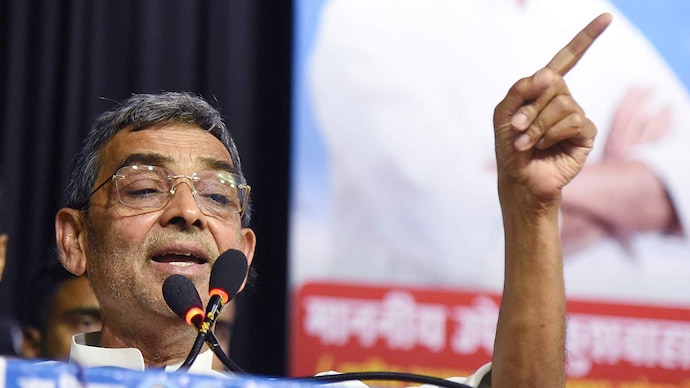
For instance, if former MP Anand Mohan has publicly questioned the circumstances surrounding Nitish’s symbolic retirement from active politics—his stepping down as Bihar chief minister—Rashtriya Lok Morcha (RLM) supremo Upendra Kushwaha has expressed concern over the future of the very party he once helped build.
The two interventions may come from different political perspectives, but they underline the same reality: the JD(U) appears to have entered a period of uncertainty, and even leaders outside its present structure are openly discussing its direction.
With Nitish’s shift to the Rajya Sabha, the JD(U) appears to be struggling to hold on to the massive political legacy that he built over two decades. The party did not merely revolve around Nitish; in many ways, it became an extension of his political identity. His governance model, his carefully crafted social coalition and his image as a moderate administrator became the JD(U)’s greatest electoral asset. Without Nitish at the centre, the party faces the difficult task of preserving that legacy while simultaneously creating a credible leadership for the future.
Nishant Kumar’s entry into politics as Bihar health minister has generated considerable interest. As Nitish’s son, he naturally carries the emotional appeal of continuity. His surname gives him an advantage that no other leader in the party possesses. Yet politics is rarely inherited overnight.
Electoral credibility, administrative experience and mass acceptability take time to develop. Legacy can open the first door, but it cannot guarantee lasting political authority. Nishant may well emerge as a significant leader in the years ahead, but expecting him to instantly command the confidence of Nitish’s traditional support base may be asking for too much, too soon.
That leaves the JD(U) confronting an uncomfortable vacuum. Neither deputy chief minister Vijay Choudhary, 69, nor his fellow deputy chief minister Bijendra Prasad Yadav, 79, has the kind of statewide electoral pull required to hold together the diverse coalition painstakingly assembled by Nitish. Both are experienced administrators and respected within the government, but administrative competence and mass political appeal are not always the same thing.
Likewise, working president Sanjay Jha has played an important organisational role and enjoys considerable influence within the party structure. Yet organisation alone does not automatically translate into electoral magnetism among voters who have historically voted for Nitish rather than merely for the JD(U).
The real concern lies in preserving the coalition that made Nitish repeatedly successful. His strength was never confined to one caste or one community. Over time, he stitched together a broad alliance anchored by Kurmis, Kushwahas, Extremely Backward Classes (EBCs), sections of Mahadalits, women voters and a sizeable group of development-oriented supporters cutting across caste lines. This coalition was as personal as it was political. It rested on trust in Nitish himself.
Without a credible successor capable of speaking to these constituencies, there is every possibility that this carefully nurtured support base may begin to fragment. Some sections may naturally gravitate towards the BJP, especially given the continuing strength of the National Democratic Alliance (NDA) at the national level. Others, particularly among Kushwaha voters and parts of the wider Luv-Kush social coalition, may find themselves increasingly attracted towards the RLM led by Kushwaha.
This is precisely where the conversation becomes both politically interesting and deeply ironic. If one were to examine the available leadership within Bihar’s NDA space purely on political logic, Kushwaha appears to be among the most natural choices for preserving a significant portion of Nitish’s social legacy. Few leaders understand the JD(U)’s organisational DNA as intimately as he does.
Kushwaha was not merely an ally or an occasional associate. He invested years of political effort during the difficult days of the Samata Party and the early expansion of the JD(U). Kushwaha recently admitted in an interview that it was painful to witness the uncertainty surrounding JD(U)’s future. That sentiment does not sound like the words of a casual critic. It reflects the emotional attachment of someone who still sees part of his political journey in the movement he once helped build.
More importantly, Kushwaha continues to enjoy a distinct social appeal. Among sections of the Kushwaha community, he remains one of the most recognisable political faces in Bihar. His appeal also extends beyond his own caste, particularly among segments of the EBCs that have historically appreciated leaders advocating social justice alongside development.
Throughout his political journey, Kushwaha has consistently projected himself as a believer in coalition politics rather than confrontation. Even during periods of disagreement with Nitish, he rarely withheld his appreciation for the latter’s contribution to Bihar’s development. His political relevance was underlined by the BJP’s reported suggestion that he merge the RLM with the party, a proposal he chose not to accept. That decision reflected political patience and an independent identity. It also suggested that Kushwaha continues to believe that his own political space retains relevance within Bihar’s evolving social equations.
Here lies the irony. Kushwaha may well be the leader best positioned to reconnect the JD(U) with sections of its traditional social coalition, but he may also have travelled too far from Nitish for such a reunion to become politically feasible. Years of departures, returns, disagreements and public criticism have left scars not easily erased. Trust, once broken repeatedly, is difficult to rebuild.
There is another dimension that cannot be ignored. Politics is never solely about two individuals. Around every senior leader exists a circle of advisers, organisers, loyalists and emerging power centres whose interests are shaped by existing equations. It is entirely possible that many within the present JD(U) leadership may not welcome the return of a leader possessing Kushwaha’s independent social standing and organisational experience. Unlike many leaders whose influence depends entirely upon the party hierarchy, Kushwaha brings his own constituency, identity and political weight. Such leaders naturally alter internal equations.
For those who have grown influential in the post-Nitish transition, Kushwaha’s return could complicate carefully established balances of power. Political organisations often resist strong entrants not because they lack ability but because they possess too much of it. That creates a paradox.
So, if Kushwaha were not to be welcomed back into the JD(U), another political possibility cannot be overlooked. Rather than fading into the background, he could emerge as the principal claimant to a significant portion of the JD(U)’s traditional social base. With decades of political experience, a deep understanding of the party’s organisational culture and an independent social appeal, Kushwaha possesses the credibility to attract sections of the Kushwaha community, the broader Luv-Kush coalition and segments of the EBC electorate.
Having played a key role in building the party during its formative years, he combines organisational memory with electoral experience. It is perhaps this very combination that may make some within the present JD(U) leadership wary of his return. By remaining outside the party, Kushwaha could steadily position himself as an alternative pole for sections of Nitish’s legacy support base, gradually making that social space his own rather than allowing the JD(U) to retain it by default.
As Bihar moves towards a post-Nitish era, every delay in consolidating leadership carries risks. Voters seldom remain suspended in uncertainty for long. They eventually migrate towards leaders who offer confidence and clarity. If the JD(U) cannot present a persuasive face capable of reassuring the Luv-Kush coalition, the EBCs and other legacy supporters, political drift becomes inevitable. Some voters will move naturally towards the BJP’s expanding organisational network. Others may increasingly see Kushwaha’s RLM as the more authentic custodian of parts of Nitish’s original social coalition.
History often presents political parties with opportunities disguised as uncomfortable choices. Whether the JD(U) views Kushwaha as yesterday’s rival or tomorrow’s solution may ultimately shape not only the party’s future but also the balance of politics within Bihar’s NDA. Sometimes, the best fit is the one waiting just outside the door. The tragedy lies in recognising it only after that door has quietly closed.
Subscribe to India Today Magazine
For instance, if former MP Anand Mohan has publicly questioned the circumstances surrounding Nitish’s symbolic retirement from active politics—his stepping down as Bihar chief minister—Rashtriya Lok Morcha (RLM) supremo Upendra Kushwaha has expressed concern over the future of the very party he once helped build.
The two interventions may come from different political perspectives, but they underline the same reality: the JD(U) appears to have entered a period of uncertainty, and even leaders outside its present structure are openly discussing its direction.
With Nitish’s shift to the Rajya Sabha, the JD(U) appears to be struggling to hold on to the massive political legacy that he built over two decades. The party did not merely revolve around Nitish; in many ways, it became an extension of his political identity. His governance model, his carefully crafted social coalition and his image as a moderate administrator became the JD(U)’s greatest electoral asset. Without Nitish at the centre, the party faces the difficult task of preserving that legacy while simultaneously creating a credible leadership for the future.
Nishant Kumar’s entry into politics as Bihar health minister has generated considerable interest. As Nitish’s son, he naturally carries the emotional appeal of continuity. His surname gives him an advantage that no other leader in the party possesses. Yet politics is rarely inherited overnight.
Electoral credibility, administrative experience and mass acceptability take time to develop. Legacy can open the first door, but it cannot guarantee lasting political authority. Nishant may well emerge as a significant leader in the years ahead, but expecting him to instantly command the confidence of Nitish’s traditional support base may be asking for too much, too soon.
That leaves the JD(U) confronting an uncomfortable vacuum. Neither deputy chief minister Vijay Choudhary, 69, nor his fellow deputy chief minister Bijendra Prasad Yadav, 79, has the kind of statewide electoral pull required to hold together the diverse coalition painstakingly assembled by Nitish. Both are experienced administrators and respected within the government, but administrative competence and mass political appeal are not always the same thing.
Likewise, working president Sanjay Jha has played an important organisational role and enjoys considerable influence within the party structure. Yet organisation alone does not automatically translate into electoral magnetism among voters who have historically voted for Nitish rather than merely for the JD(U).
The real concern lies in preserving the coalition that made Nitish repeatedly successful. His strength was never confined to one caste or one community. Over time, he stitched together a broad alliance anchored by Kurmis, Kushwahas, Extremely Backward Classes (EBCs), sections of Mahadalits, women voters and a sizeable group of development-oriented supporters cutting across caste lines. This coalition was as personal as it was political. It rested on trust in Nitish himself.
Without a credible successor capable of speaking to these constituencies, there is every possibility that this carefully nurtured support base may begin to fragment. Some sections may naturally gravitate towards the BJP, especially given the continuing strength of the National Democratic Alliance (NDA) at the national level. Others, particularly among Kushwaha voters and parts of the wider Luv-Kush social coalition, may find themselves increasingly attracted towards the RLM led by Kushwaha.
This is precisely where the conversation becomes both politically interesting and deeply ironic. If one were to examine the available leadership within Bihar’s NDA space purely on political logic, Kushwaha appears to be among the most natural choices for preserving a significant portion of Nitish’s social legacy. Few leaders understand the JD(U)’s organisational DNA as intimately as he does.
Kushwaha was not merely an ally or an occasional associate. He invested years of political effort during the difficult days of the Samata Party and the early expansion of the JD(U). Kushwaha recently admitted in an interview that it was painful to witness the uncertainty surrounding JD(U)’s future. That sentiment does not sound like the words of a casual critic. It reflects the emotional attachment of someone who still sees part of his political journey in the movement he once helped build.
More importantly, Kushwaha continues to enjoy a distinct social appeal. Among sections of the Kushwaha community, he remains one of the most recognisable political faces in Bihar. His appeal also extends beyond his own caste, particularly among segments of the EBCs that have historically appreciated leaders advocating social justice alongside development.
Throughout his political journey, Kushwaha has consistently projected himself as a believer in coalition politics rather than confrontation. Even during periods of disagreement with Nitish, he rarely withheld his appreciation for the latter’s contribution to Bihar’s development. His political relevance was underlined by the BJP’s reported suggestion that he merge the RLM with the party, a proposal he chose not to accept. That decision reflected political patience and an independent identity. It also suggested that Kushwaha continues to believe that his own political space retains relevance within Bihar’s evolving social equations.
Here lies the irony. Kushwaha may well be the leader best positioned to reconnect the JD(U) with sections of its traditional social coalition, but he may also have travelled too far from Nitish for such a reunion to become politically feasible. Years of departures, returns, disagreements and public criticism have left scars not easily erased. Trust, once broken repeatedly, is difficult to rebuild.
There is another dimension that cannot be ignored. Politics is never solely about two individuals. Around every senior leader exists a circle of advisers, organisers, loyalists and emerging power centres whose interests are shaped by existing equations. It is entirely possible that many within the present JD(U) leadership may not welcome the return of a leader possessing Kushwaha’s independent social standing and organisational experience. Unlike many leaders whose influence depends entirely upon the party hierarchy, Kushwaha brings his own constituency, identity and political weight. Such leaders naturally alter internal equations.
For those who have grown influential in the post-Nitish transition, Kushwaha’s return could complicate carefully established balances of power. Political organisations often resist strong entrants not because they lack ability but because they possess too much of it. That creates a paradox.
So, if Kushwaha were not to be welcomed back into the JD(U), another political possibility cannot be overlooked. Rather than fading into the background, he could emerge as the principal claimant to a significant portion of the JD(U)’s traditional social base. With decades of political experience, a deep understanding of the party’s organisational culture and an independent social appeal, Kushwaha possesses the credibility to attract sections of the Kushwaha community, the broader Luv-Kush coalition and segments of the EBC electorate.
Having played a key role in building the party during its formative years, he combines organisational memory with electoral experience. It is perhaps this very combination that may make some within the present JD(U) leadership wary of his return. By remaining outside the party, Kushwaha could steadily position himself as an alternative pole for sections of Nitish’s legacy support base, gradually making that social space his own rather than allowing the JD(U) to retain it by default.
As Bihar moves towards a post-Nitish era, every delay in consolidating leadership carries risks. Voters seldom remain suspended in uncertainty for long. They eventually migrate towards leaders who offer confidence and clarity. If the JD(U) cannot present a persuasive face capable of reassuring the Luv-Kush coalition, the EBCs and other legacy supporters, political drift becomes inevitable. Some voters will move naturally towards the BJP’s expanding organisational network. Others may increasingly see Kushwaha’s RLM as the more authentic custodian of parts of Nitish’s original social coalition.
History often presents political parties with opportunities disguised as uncomfortable choices. Whether the JD(U) views Kushwaha as yesterday’s rival or tomorrow’s solution may ultimately shape not only the party’s future but also the balance of politics within Bihar’s NDA. Sometimes, the best fit is the one waiting just outside the door. The tragedy lies in recognising it only after that door has quietly closed.
Subscribe to India Today Magazine

