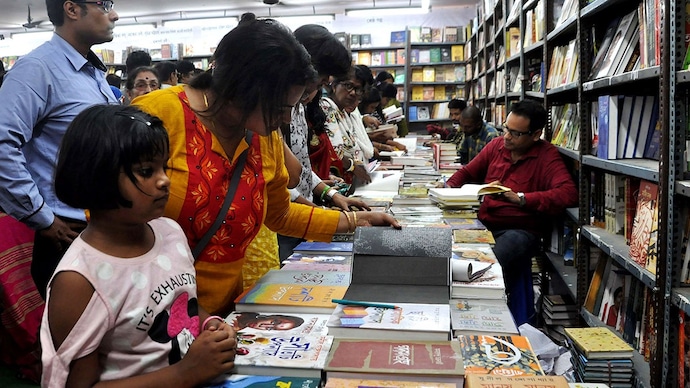
Will the Kolkata Book Fair see an RSS rewrite?
Ahead of the international fair's 2027 Golden Jubilee edition, a Sangh affiliate vies for a firmer foothold in Bengal's publishing ecosystem
While the event is ostensibly a literary tribute, the commemoration of Guha, who passed away on August 29, 2021, is politically significant as the acclaimed novelist had never concealed his ideological leanings. He often spoke publicly about his admiration for the RSS and his reverence for Syama Prasad Mookerjee, whom he regarded as the architect of West Bengal.
“Guha was a member of our party,” says the state BJP social media head Saptarshi Chowdhury, whose name features prominently alongside literary personalities and intellectuals in the invitation card for the programme. “As he was a towering figure of modern Bengali literature, we believe it is only fitting that we celebrate him and his birthday this year. Literary excellence should be remembered irrespective of political convenience.”
The invite also highlights the names of two other senior BJP functionaries—state chief spokesperson Debjit Sarkar and vice-president Tanuja Chakraborty—offering another clue to the Parishad’s orientation. No wonder the event has fuelled a larger conversation on whether the Parishad is merely a cultural platform or the beginning of a long-term attempt by the Sangh ecosystem to establish a foothold in Bengal’s publishing world—and perhaps even challenge the dominance of the Publishers & Booksellers Guild that has organised the International Kolkata Book Fair for half a century.
Officially, BJP leaders dismiss such suggestions. “It is not the job of the BJP or the RSS to organise a book fair,” Chowdhury says. “The Kolkata Book Fair must and will continue in all its glory. It is a globally recognised institution, which must also remain free of any form of corruption.” Yet, conversations within sections of the Sangh suggest the Parishad may be thinking beyond commemorative events.
Sources familiar with the organisation’s plans say the June 29 programme is intended as the first in a series of literary and cultural initiatives leading up to next year’s book fair. The Parishad is expected to hold multiple events over the coming months and gradually build a network among publishers, writers and readers.
The organisation also plans to engage with the state’s library ecosystem. State Mass Education Extension and Library Services minister Gouri Shankar Ghosh is expected to be invited to a future programme. Among the Parishad’s priorities, sources say, are reopening defunct public libraries, auditing the functioning of existing ones and reviving Bengal’s reading culture. Leaders associated with the initiative argue that while the Left Front had built a vibrant library movement across the state, much of that infrastructure deteriorated during the Trinamool Congress years.
The Parishad has also reached out to the very organisation whose position is now the subject of speculation. Confirming that the Publishers & Booksellers Guild received an invitation to the June 29 event, its general secretary Tridib Kumar Chattopadhyay says, “It is a wonderful initiative. I vividly remember how Guha stood by his political convictions even in the presence of the then CPI(M) chief minister Buddhadeb Bhattacharjee even though both of them and their families were close friends.”
Chattopadhyay stops short of taking the literary event to be a challenge to the Guild. “I would not like to jump the gun, but I can say this much—we have shed blood and sweat to earn the international status that the Kolkata Book Fair enjoys today,” he says. “It took decades of work to secure international accreditation and to persuade publishers, writers and readers across the world to make Kolkata a destination. That legacy cannot be built overnight."
The Guild’s confidence stems from its history. Founded in 1975, it organised the first Calcutta Book Fair in 1976. The fair earned recognition from the International Publishers Association in 1983 and gradually evolved into one of the world’s largest non-commercial public book fairs.
Over the decades, the Guild has weathered political transitions, legal battles and repeated attempts to create rival book fairs. Efforts by successive governments in the 1980s, and later another parallel fair in 2008, failed to dent the popularity of the Guild’s event. Since 1995, the Guild has organised the International Kolkata Book Fair with logistical support from the West Bengal government, while remaining financially independent.
After the Trinamool Congress came to power in 2011, a group of publishers launched the Rabindra Boi Mela. In 2021, another fair was organised at Hrishikesh Park under the leadership of Trinamool leader Kunal Ghosh. Neither initiative managed to emerge as a credible alternative to the International Kolkata Book Fair.
Now, as the Guild prepares for the Golden Jubilee edition of the fair in 2027, the arrival of the Bangiya Granthashilpa Parishad has introduced a new cultural dimension to Bengal’s changing political landscape. Whether it remains a literary platform celebrating authors such as Guha or evolves into a larger institutional presence in the publishing ecosystem, it will certainly be closely watched by the literary fraternity in the months ahead.
Subscribe to India Today Magazine
While the event is ostensibly a literary tribute, the commemoration of Guha, who passed away on August 29, 2021, is politically significant as the acclaimed novelist had never concealed his ideological leanings. He often spoke publicly about his admiration for the RSS and his reverence for Syama Prasad Mookerjee, whom he regarded as the architect of West Bengal.
“Guha was a member of our party,” says the state BJP social media head Saptarshi Chowdhury, whose name features prominently alongside literary personalities and intellectuals in the invitation card for the programme. “As he was a towering figure of modern Bengali literature, we believe it is only fitting that we celebrate him and his birthday this year. Literary excellence should be remembered irrespective of political convenience.”
The invite also highlights the names of two other senior BJP functionaries—state chief spokesperson Debjit Sarkar and vice-president Tanuja Chakraborty—offering another clue to the Parishad’s orientation. No wonder the event has fuelled a larger conversation on whether the Parishad is merely a cultural platform or the beginning of a long-term attempt by the Sangh ecosystem to establish a foothold in Bengal’s publishing world—and perhaps even challenge the dominance of the Publishers & Booksellers Guild that has organised the International Kolkata Book Fair for half a century.
Officially, BJP leaders dismiss such suggestions. “It is not the job of the BJP or the RSS to organise a book fair,” Chowdhury says. “The Kolkata Book Fair must and will continue in all its glory. It is a globally recognised institution, which must also remain free of any form of corruption.” Yet, conversations within sections of the Sangh suggest the Parishad may be thinking beyond commemorative events.
Sources familiar with the organisation’s plans say the June 29 programme is intended as the first in a series of literary and cultural initiatives leading up to next year’s book fair. The Parishad is expected to hold multiple events over the coming months and gradually build a network among publishers, writers and readers.
The organisation also plans to engage with the state’s library ecosystem. State Mass Education Extension and Library Services minister Gouri Shankar Ghosh is expected to be invited to a future programme. Among the Parishad’s priorities, sources say, are reopening defunct public libraries, auditing the functioning of existing ones and reviving Bengal’s reading culture. Leaders associated with the initiative argue that while the Left Front had built a vibrant library movement across the state, much of that infrastructure deteriorated during the Trinamool Congress years.
The Parishad has also reached out to the very organisation whose position is now the subject of speculation. Confirming that the Publishers & Booksellers Guild received an invitation to the June 29 event, its general secretary Tridib Kumar Chattopadhyay says, “It is a wonderful initiative. I vividly remember how Guha stood by his political convictions even in the presence of the then CPI(M) chief minister Buddhadeb Bhattacharjee even though both of them and their families were close friends.”
Chattopadhyay stops short of taking the literary event to be a challenge to the Guild. “I would not like to jump the gun, but I can say this much—we have shed blood and sweat to earn the international status that the Kolkata Book Fair enjoys today,” he says. “It took decades of work to secure international accreditation and to persuade publishers, writers and readers across the world to make Kolkata a destination. That legacy cannot be built overnight."
The Guild’s confidence stems from its history. Founded in 1975, it organised the first Calcutta Book Fair in 1976. The fair earned recognition from the International Publishers Association in 1983 and gradually evolved into one of the world’s largest non-commercial public book fairs.
Over the decades, the Guild has weathered political transitions, legal battles and repeated attempts to create rival book fairs. Efforts by successive governments in the 1980s, and later another parallel fair in 2008, failed to dent the popularity of the Guild’s event. Since 1995, the Guild has organised the International Kolkata Book Fair with logistical support from the West Bengal government, while remaining financially independent.
After the Trinamool Congress came to power in 2011, a group of publishers launched the Rabindra Boi Mela. In 2021, another fair was organised at Hrishikesh Park under the leadership of Trinamool leader Kunal Ghosh. Neither initiative managed to emerge as a credible alternative to the International Kolkata Book Fair.
Now, as the Guild prepares for the Golden Jubilee edition of the fair in 2027, the arrival of the Bangiya Granthashilpa Parishad has introduced a new cultural dimension to Bengal’s changing political landscape. Whether it remains a literary platform celebrating authors such as Guha or evolves into a larger institutional presence in the publishing ecosystem, it will certainly be closely watched by the literary fraternity in the months ahead.
Subscribe to India Today Magazine

