First Agniveer batch nears 4-year exit: What comes next for armed forces?
The first naval Agniveer batch is nearing the end of its four-year tenure under Agnipath. Its retention and transition will test the 25 per cent rule and the wider model.
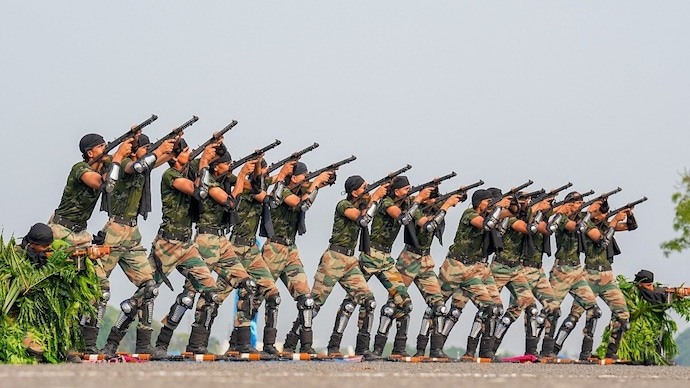
The first batch of Agniveers recruited under the Agnipath scheme is approaching a defining milestone, with the four-year engagement period of the inaugural batch set to come to an end later this year. The Indian Navy, which became the first of the three services to begin training Agniveers, is now also among the first to reach the point where retention and exit will move from policy to implementation.
The milestone comes nearly four years after the first naval Agniveers reported for training at INS Chilka in November 2022. The Navy began training its first batch ahead of the Army and Air Force, making the completion of this cohort an important test of how the Agnipath model will work at the end of its first cycle.
The first batch of nearly 2,600 naval Agniveers, including women, completed their 16-week basic training at INS Chilka in March 2023 and subsequently moved into professional and sea training. The first-ever Agniveer passing-out parade was held at INS Chilka on March 28, 2023.
FOUR YEARS LATER, FIRST BIG TEST OF AGNIPATH
The original architecture of Agnipath provides for a four-year engagement. At the end of that period, Agniveers can apply for continued service in the regular cadre.
Under the existing framework, up to 25 per cent of each specific batch can be retained. Selection is not automatic. The government's original scheme provides that applications will be considered through a centralised process based on objective criteria, including performance during the four-year engagement period, along with organisational requirements and policies laid down by the respective Service.
This means the first batch will effectively provide the Services with their first full-cycle assessment of the model – from recruitment and training to operational employment, performance and eventual retention.
HOW IS THE 25 PER CENT BEING ASSESSED?
The exact service-specific scoring matrix for the first batch has not been publicly detailed in full. What is clear from the official Agnipath framework is that the selection is intended to be centralised, objective and performance-based, rather than an automatic continuation of service.
The Indian Navy's current terms and conditions specifically state that, after four years, applications for permanent enrolment will be considered in a centralised manner based on objective criteria, including performance during the four-year engagement period. The Navy can enrol up to 25 per cent of each specific batch, depending on its requirements and applicable policy.
The original government framework also makes organisational requirements a key factor. Therefore, the final selection is expected to balance an individual's demonstrated performance with the manpower and trade requirements of the service.
Importantly, an Agniveer does not have an automatic right to permanent enrolment. The Navy's current recruitment terms explicitly state that the Service is not obliged to retain Agniveers beyond the four-year engagement period.
SERVICES COULD SEEK A MUCH HIGHER RETENTION RATE
The first exit cycle also coincides with an internal review of the Agnipath model. Recent reports indicate that the Services are examining whether the present 25 per cent ceiling should be increased. The three services are reportedly looking at a much higher retention percentage.
These proposals are under examination and have not been approved as a change to the existing policy.
The Navy's case is particularly significant because sailors are trained to operate increasingly sophisticated weapons, sensors, communication systems and other technical equipment. Four years of training and operational exposure means that releasing a large proportion of trained personnel would also mean losing manpower in whom the Service has invested considerable time and resources.
Whether the government ultimately changes the ceiling, however, will require a formal policy decision. Until then, the existing 25 per cent framework remains the operative rule.
AIR FORCE AND ARMY'S FIRST BATCH WILL FOLLOW IN 2027
The Indian Army's first Agniveer cohort is on a slightly different timeline. While the Navy's inaugural batch entered training in November 2022 and completed its basic training in early 2023, the Army's first batches were trained and inducted subsequently.
The Indian Air Force's first Agniveervayu batch began training soon after, in December 2022, while the Army's maiden batch is expected to complete its four-year tenure in early 2027.
The Army is also reportedly examining whether its retention requirement should be higher than the existing 25 per cent ceiling, with reports indicating that it could seek to retain a higher percentage of its Agniveer batch. Again, this remains under consideration rather than an approved change.
WHAT HAPPENS TO REMAINING AGNIVEERS?
For those who are not retained, the end of the four-year tenure is not designed to be an abrupt transition without support.
Agniveers completing their engagement are entitled to the Seva Nidhi package. The government has also created a range of pathways for their subsequent employment in security forces, police, government organisations and other sectors.
In a significant development ahead of the first exit cycle, the Centre has announced that 50 per cent of vacancies for Constable (General Duty) in the CAPFs and Rifleman posts in Assam Rifles will be reserved for Ex-Agniveers. The government has also provided age-relaxation measures and exemptions from certain stages of recruitment for eligible Ex-Agniveers.
The Ministry of Home Affairs has also been working on recruitment rules and an Ex-Agniveer category aimed at creating a structured route into the CAPFs and Assam Rifles.
States, including Uttar Pradesh, Haryana, Delhi and Gujarat, have enacted up to 20 per cent horizontal reservation for former Agniveers in state police forces, fire services, jail guards and local uniformed departments. States such as Uttarakhand, Madhya Pradesh, Chhattisgarh, Rajasthan, Odisha and Assam also have provisions supporting recruitment preferences for Ex-Agniveers in state-level uniformed services.
Quotas and preference provisions also exist across the Indian Coast Guard, Ministry of Defence civilian offices, Defence Public Sector Undertakings (DPSUs) and the Railway Protection Force (RPF).
PREFERENCE FOR NEXT UNIFORMED JOB
The government is now moving towards a system in which an Agniveer completing four years could potentially choose among multiple avenues – continuation in the Armed Forces if selected, recruitment into CAPFs and Assam Rifles, state police opportunities, or other government and private-sector employment.
A recent report on the proposed induction rules said the services and the Home Ministry were considering a mechanism under which former Agniveers could indicate their preferred force, with the final allotment dependent on vacancies and the recruitment requirements of the respective organisation.
This would represent an important shift. The first batch would not simply mark the end of a four-year military engagement, but the beginning of the first large-scale transition of trained military personnel into the wider security and employment ecosystem.
FIRST BATCH WILL DETERMINE FUTURE OF AGNIPATH
The significance of the first batch goes beyond the number of personnel released or retained.
For the armed forces, this will be the first opportunity to assess whether four years is sufficient to train, employ and develop personnel for increasingly technology-intensive military roles, and whether retaining a larger proportion of them makes operational and manpower sense.
For the government, the first batch will provide the first real-world test of the second pillar of Agnipath: whether those leaving the services after four years can successfully transition into other careers.
The Navy has already demonstrated that the recruitment, training and deployment model can be implemented at scale. Now, as the first cohort approaches the end of its four-year engagement, the question is moving to the next stage: who stays, who leaves, how those decisions are made, and whether the 25 per cent retention ceiling survives the first full test of the Agnipath experiment.
The answer could determine the next phase of India's military manpower policy.
The first batch of Agniveers recruited under the Agnipath scheme is approaching a defining milestone, with the four-year engagement period of the inaugural batch set to come to an end later this year. The Indian Navy, which became the first of the three services to begin training Agniveers, is now also among the first to reach the point where retention and exit will move from policy to implementation.
The milestone comes nearly four years after the first naval Agniveers reported for training at INS Chilka in November 2022. The Navy began training its first batch ahead of the Army and Air Force, making the completion of this cohort an important test of how the Agnipath model will work at the end of its first cycle.
The first batch of nearly 2,600 naval Agniveers, including women, completed their 16-week basic training at INS Chilka in March 2023 and subsequently moved into professional and sea training. The first-ever Agniveer passing-out parade was held at INS Chilka on March 28, 2023.
FOUR YEARS LATER, FIRST BIG TEST OF AGNIPATH
The original architecture of Agnipath provides for a four-year engagement. At the end of that period, Agniveers can apply for continued service in the regular cadre.
Under the existing framework, up to 25 per cent of each specific batch can be retained. Selection is not automatic. The government's original scheme provides that applications will be considered through a centralised process based on objective criteria, including performance during the four-year engagement period, along with organisational requirements and policies laid down by the respective Service.
This means the first batch will effectively provide the Services with their first full-cycle assessment of the model – from recruitment and training to operational employment, performance and eventual retention.
HOW IS THE 25 PER CENT BEING ASSESSED?
The exact service-specific scoring matrix for the first batch has not been publicly detailed in full. What is clear from the official Agnipath framework is that the selection is intended to be centralised, objective and performance-based, rather than an automatic continuation of service.
The Indian Navy's current terms and conditions specifically state that, after four years, applications for permanent enrolment will be considered in a centralised manner based on objective criteria, including performance during the four-year engagement period. The Navy can enrol up to 25 per cent of each specific batch, depending on its requirements and applicable policy.
The original government framework also makes organisational requirements a key factor. Therefore, the final selection is expected to balance an individual's demonstrated performance with the manpower and trade requirements of the service.
Importantly, an Agniveer does not have an automatic right to permanent enrolment. The Navy's current recruitment terms explicitly state that the Service is not obliged to retain Agniveers beyond the four-year engagement period.
SERVICES COULD SEEK A MUCH HIGHER RETENTION RATE
The first exit cycle also coincides with an internal review of the Agnipath model. Recent reports indicate that the Services are examining whether the present 25 per cent ceiling should be increased. The three services are reportedly looking at a much higher retention percentage.
These proposals are under examination and have not been approved as a change to the existing policy.
The Navy's case is particularly significant because sailors are trained to operate increasingly sophisticated weapons, sensors, communication systems and other technical equipment. Four years of training and operational exposure means that releasing a large proportion of trained personnel would also mean losing manpower in whom the Service has invested considerable time and resources.
Whether the government ultimately changes the ceiling, however, will require a formal policy decision. Until then, the existing 25 per cent framework remains the operative rule.
AIR FORCE AND ARMY'S FIRST BATCH WILL FOLLOW IN 2027
The Indian Army's first Agniveer cohort is on a slightly different timeline. While the Navy's inaugural batch entered training in November 2022 and completed its basic training in early 2023, the Army's first batches were trained and inducted subsequently.
The Indian Air Force's first Agniveervayu batch began training soon after, in December 2022, while the Army's maiden batch is expected to complete its four-year tenure in early 2027.
The Army is also reportedly examining whether its retention requirement should be higher than the existing 25 per cent ceiling, with reports indicating that it could seek to retain a higher percentage of its Agniveer batch. Again, this remains under consideration rather than an approved change.
WHAT HAPPENS TO REMAINING AGNIVEERS?
For those who are not retained, the end of the four-year tenure is not designed to be an abrupt transition without support.
Agniveers completing their engagement are entitled to the Seva Nidhi package. The government has also created a range of pathways for their subsequent employment in security forces, police, government organisations and other sectors.
In a significant development ahead of the first exit cycle, the Centre has announced that 50 per cent of vacancies for Constable (General Duty) in the CAPFs and Rifleman posts in Assam Rifles will be reserved for Ex-Agniveers. The government has also provided age-relaxation measures and exemptions from certain stages of recruitment for eligible Ex-Agniveers.
The Ministry of Home Affairs has also been working on recruitment rules and an Ex-Agniveer category aimed at creating a structured route into the CAPFs and Assam Rifles.
States, including Uttar Pradesh, Haryana, Delhi and Gujarat, have enacted up to 20 per cent horizontal reservation for former Agniveers in state police forces, fire services, jail guards and local uniformed departments. States such as Uttarakhand, Madhya Pradesh, Chhattisgarh, Rajasthan, Odisha and Assam also have provisions supporting recruitment preferences for Ex-Agniveers in state-level uniformed services.
Quotas and preference provisions also exist across the Indian Coast Guard, Ministry of Defence civilian offices, Defence Public Sector Undertakings (DPSUs) and the Railway Protection Force (RPF).
PREFERENCE FOR NEXT UNIFORMED JOB
The government is now moving towards a system in which an Agniveer completing four years could potentially choose among multiple avenues – continuation in the Armed Forces if selected, recruitment into CAPFs and Assam Rifles, state police opportunities, or other government and private-sector employment.
A recent report on the proposed induction rules said the services and the Home Ministry were considering a mechanism under which former Agniveers could indicate their preferred force, with the final allotment dependent on vacancies and the recruitment requirements of the respective organisation.
This would represent an important shift. The first batch would not simply mark the end of a four-year military engagement, but the beginning of the first large-scale transition of trained military personnel into the wider security and employment ecosystem.
FIRST BATCH WILL DETERMINE FUTURE OF AGNIPATH
The significance of the first batch goes beyond the number of personnel released or retained.
For the armed forces, this will be the first opportunity to assess whether four years is sufficient to train, employ and develop personnel for increasingly technology-intensive military roles, and whether retaining a larger proportion of them makes operational and manpower sense.
For the government, the first batch will provide the first real-world test of the second pillar of Agnipath: whether those leaving the services after four years can successfully transition into other careers.
The Navy has already demonstrated that the recruitment, training and deployment model can be implemented at scale. Now, as the first cohort approaches the end of its four-year engagement, the question is moving to the next stage: who stays, who leaves, how those decisions are made, and whether the 25 per cent retention ceiling survives the first full test of the Agnipath experiment.
The answer could determine the next phase of India's military manpower policy.
The first batch of Agniveers recruited under the Agnipath scheme is approaching a defining milestone, with the four-year engagement period of the inaugural batch set to come to an end later this year. The Indian Navy, which became the first of the three services to begin training Agniveers, is now also among the first to reach the point where retention and exit will move from policy to implementation.
The milestone comes nearly four years after the first naval Agniveers reported for training at INS Chilka in November 2022. The Navy began training its first batch ahead of the Army and Air Force, making the completion of this cohort an important test of how the Agnipath model will work at the end of its first cycle.
The first batch of nearly 2,600 naval Agniveers, including women, completed their 16-week basic training at INS Chilka in March 2023 and subsequently moved into professional and sea training. The first-ever Agniveer passing-out parade was held at INS Chilka on March 28, 2023.
FOUR YEARS LATER, FIRST BIG TEST OF AGNIPATH
The original architecture of Agnipath provides for a four-year engagement. At the end of that period, Agniveers can apply for continued service in the regular cadre.
Under the existing framework, up to 25 per cent of each specific batch can be retained. Selection is not automatic. The government's original scheme provides that applications will be considered through a centralised process based on objective criteria, including performance during the four-year engagement period, along with organisational requirements and policies laid down by the respective Service.
This means the first batch will effectively provide the Services with their first full-cycle assessment of the model – from recruitment and training to operational employment, performance and eventual retention.
HOW IS THE 25 PER CENT BEING ASSESSED?
The exact service-specific scoring matrix for the first batch has not been publicly detailed in full. What is clear from the official Agnipath framework is that the selection is intended to be centralised, objective and performance-based, rather than an automatic continuation of service.
The Indian Navy's current terms and conditions specifically state that, after four years, applications for permanent enrolment will be considered in a centralised manner based on objective criteria, including performance during the four-year engagement period. The Navy can enrol up to 25 per cent of each specific batch, depending on its requirements and applicable policy.
The original government framework also makes organisational requirements a key factor. Therefore, the final selection is expected to balance an individual's demonstrated performance with the manpower and trade requirements of the service.
Importantly, an Agniveer does not have an automatic right to permanent enrolment. The Navy's current recruitment terms explicitly state that the Service is not obliged to retain Agniveers beyond the four-year engagement period.
SERVICES COULD SEEK A MUCH HIGHER RETENTION RATE
The first exit cycle also coincides with an internal review of the Agnipath model. Recent reports indicate that the Services are examining whether the present 25 per cent ceiling should be increased. The three services are reportedly looking at a much higher retention percentage.
These proposals are under examination and have not been approved as a change to the existing policy.
The Navy's case is particularly significant because sailors are trained to operate increasingly sophisticated weapons, sensors, communication systems and other technical equipment. Four years of training and operational exposure means that releasing a large proportion of trained personnel would also mean losing manpower in whom the Service has invested considerable time and resources.
Whether the government ultimately changes the ceiling, however, will require a formal policy decision. Until then, the existing 25 per cent framework remains the operative rule.
AIR FORCE AND ARMY'S FIRST BATCH WILL FOLLOW IN 2027
The Indian Army's first Agniveer cohort is on a slightly different timeline. While the Navy's inaugural batch entered training in November 2022 and completed its basic training in early 2023, the Army's first batches were trained and inducted subsequently.
The Indian Air Force's first Agniveervayu batch began training soon after, in December 2022, while the Army's maiden batch is expected to complete its four-year tenure in early 2027.
The Army is also reportedly examining whether its retention requirement should be higher than the existing 25 per cent ceiling, with reports indicating that it could seek to retain a higher percentage of its Agniveer batch. Again, this remains under consideration rather than an approved change.
WHAT HAPPENS TO REMAINING AGNIVEERS?
For those who are not retained, the end of the four-year tenure is not designed to be an abrupt transition without support.
Agniveers completing their engagement are entitled to the Seva Nidhi package. The government has also created a range of pathways for their subsequent employment in security forces, police, government organisations and other sectors.
In a significant development ahead of the first exit cycle, the Centre has announced that 50 per cent of vacancies for Constable (General Duty) in the CAPFs and Rifleman posts in Assam Rifles will be reserved for Ex-Agniveers. The government has also provided age-relaxation measures and exemptions from certain stages of recruitment for eligible Ex-Agniveers.
The Ministry of Home Affairs has also been working on recruitment rules and an Ex-Agniveer category aimed at creating a structured route into the CAPFs and Assam Rifles.
States, including Uttar Pradesh, Haryana, Delhi and Gujarat, have enacted up to 20 per cent horizontal reservation for former Agniveers in state police forces, fire services, jail guards and local uniformed departments. States such as Uttarakhand, Madhya Pradesh, Chhattisgarh, Rajasthan, Odisha and Assam also have provisions supporting recruitment preferences for Ex-Agniveers in state-level uniformed services.
Quotas and preference provisions also exist across the Indian Coast Guard, Ministry of Defence civilian offices, Defence Public Sector Undertakings (DPSUs) and the Railway Protection Force (RPF).
PREFERENCE FOR NEXT UNIFORMED JOB
The government is now moving towards a system in which an Agniveer completing four years could potentially choose among multiple avenues – continuation in the Armed Forces if selected, recruitment into CAPFs and Assam Rifles, state police opportunities, or other government and private-sector employment.
A recent report on the proposed induction rules said the services and the Home Ministry were considering a mechanism under which former Agniveers could indicate their preferred force, with the final allotment dependent on vacancies and the recruitment requirements of the respective organisation.
This would represent an important shift. The first batch would not simply mark the end of a four-year military engagement, but the beginning of the first large-scale transition of trained military personnel into the wider security and employment ecosystem.
FIRST BATCH WILL DETERMINE FUTURE OF AGNIPATH
The significance of the first batch goes beyond the number of personnel released or retained.
For the armed forces, this will be the first opportunity to assess whether four years is sufficient to train, employ and develop personnel for increasingly technology-intensive military roles, and whether retaining a larger proportion of them makes operational and manpower sense.
For the government, the first batch will provide the first real-world test of the second pillar of Agnipath: whether those leaving the services after four years can successfully transition into other careers.
The Navy has already demonstrated that the recruitment, training and deployment model can be implemented at scale. Now, as the first cohort approaches the end of its four-year engagement, the question is moving to the next stage: who stays, who leaves, how those decisions are made, and whether the 25 per cent retention ceiling survives the first full test of the Agnipath experiment.
The answer could determine the next phase of India's military manpower policy.

