How rescuers broke through hostel walls, battled fire to find AI171 crash survivors
A year after the AI171 crash, Ahmedabad Municipal Corporation chief Banchanidhi Pani recounted how rescuers broke through hostel walls and firefighters battled intense heat to reach the crashed plane to search for survivors.
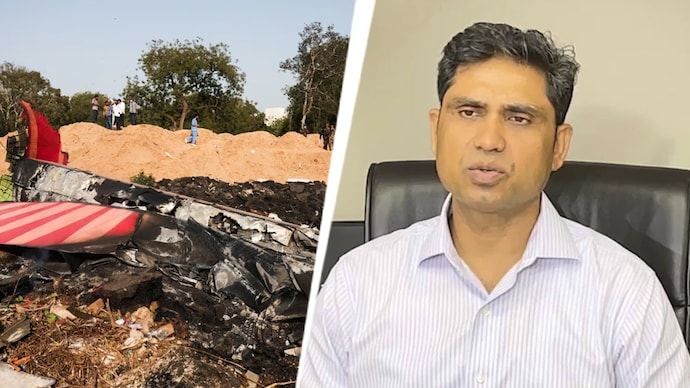
A year after the Air India AI171 crash in Ahmedabad claimed 260 lives, Ahmedabad Municipal Corporation (AMC) Commissioner Banchanidhi Pani on Friday recalled the enormous challenges faced by rescue teams, saying they first had to break through medical hostel walls to reach the crash site. He also recalled how firefighters battled extreme temperatures triggered by the blaze due to the crash that made it difficult to access the area and find survivors.
The crash, one of India's worst aviation disasters, killed 241 people on board the aircraft and 19 others on the ground. The London-bound plane crashed into the BJ Medical College and Hostel, seconds after taking off from Ahmedabad airport. Only one survivor, Viswashkumar Ramesh, a British national, miraculously survived the crash.
Speaking on the first anniversary of the tragedy, Pani said multiple departments of the AMC played a critical role in rescue, recovery and victim identification efforts. "As soon as we received information about the plane crash, our fire brigade, health department and engineering teams immediately reached the crash site. The first step was breaking down walls in various directions to facilitate the rescue operation," he said.
According to the AMC chief, firefighters had to contend with an intense inferno caused by the crash. The blaze was so severe that rescue personnel initially struggled to access the impact zone.
"When the fire broke out due to the plane crash, AMC firefighters immediately arrived at the crash site. However, the fire was so severe that it was difficult to reach the area to extinguish it. The surrounding temperature was so high that the primary challenge for fire brigade personnel was to lower the temperatures," Pani said.
Only after the heat levels were brought under control could rescuers begin retrieving bodies and searching for survivors, he added.
The rescue operation involved more than 60 firefighters and over 90 ambulances. Fire personnel also rescued students trapped inside a nearby hostel affected by the crash, Pani said.
"As crowds gathered at the site within minutes of the accident, authorities created a green corridor to ensure the swift movement of injured persons and recovered bodies to the Civil Hospital," he said.
Pani also said the AMC continued to work around the clock for nearly a month under the guidance of the Centre and the Gujarat government. He recalled that Home Minister Amit Shah visited the site on the day of the accident, while Prime Minister Narendra Modi arrived in Ahmedabad the following morning and issued necessary directions.
The AMC chief also highlighted an unprecedented administrative effort undertaken to ease the burden on grieving families. In coordination with the Civil Hospital, the municipal corporation ensured that death certificates were handed over to relatives at the same time as the bodies, sparing them repeated visits to Ahmedabad.
"So that the relatives of the victims did not have to come to Ahmedabad again and again, and to reduce their difficulties, we coordinated with the civil hospital and handed over death certificates along with the bodies. This was the first time such an action had been taken," he said.
Pani said that various AMC departments, including engineering, fire and electrical teams, continued to assist investigators from the Aircraft Accident Investigation Bureau (AAIB) for nearly a month after the crash. "May God never allow such a tragedy to happen again," he further said.
Meanwhile, the final report of the AAIB, which is probing the crash, is likely to take another two months, top sources tracking the investigation told India Today TV earlier in the day.
A year after the Air India AI171 crash in Ahmedabad claimed 260 lives, Ahmedabad Municipal Corporation (AMC) Commissioner Banchanidhi Pani on Friday recalled the enormous challenges faced by rescue teams, saying they first had to break through medical hostel walls to reach the crash site. He also recalled how firefighters battled extreme temperatures triggered by the blaze due to the crash that made it difficult to access the area and find survivors.
The crash, one of India's worst aviation disasters, killed 241 people on board the aircraft and 19 others on the ground. The London-bound plane crashed into the BJ Medical College and Hostel, seconds after taking off from Ahmedabad airport. Only one survivor, Viswashkumar Ramesh, a British national, miraculously survived the crash.
Speaking on the first anniversary of the tragedy, Pani said multiple departments of the AMC played a critical role in rescue, recovery and victim identification efforts. "As soon as we received information about the plane crash, our fire brigade, health department and engineering teams immediately reached the crash site. The first step was breaking down walls in various directions to facilitate the rescue operation," he said.
According to the AMC chief, firefighters had to contend with an intense inferno caused by the crash. The blaze was so severe that rescue personnel initially struggled to access the impact zone.
"When the fire broke out due to the plane crash, AMC firefighters immediately arrived at the crash site. However, the fire was so severe that it was difficult to reach the area to extinguish it. The surrounding temperature was so high that the primary challenge for fire brigade personnel was to lower the temperatures," Pani said.
Only after the heat levels were brought under control could rescuers begin retrieving bodies and searching for survivors, he added.
The rescue operation involved more than 60 firefighters and over 90 ambulances. Fire personnel also rescued students trapped inside a nearby hostel affected by the crash, Pani said.
"As crowds gathered at the site within minutes of the accident, authorities created a green corridor to ensure the swift movement of injured persons and recovered bodies to the Civil Hospital," he said.
Pani also said the AMC continued to work around the clock for nearly a month under the guidance of the Centre and the Gujarat government. He recalled that Home Minister Amit Shah visited the site on the day of the accident, while Prime Minister Narendra Modi arrived in Ahmedabad the following morning and issued necessary directions.
The AMC chief also highlighted an unprecedented administrative effort undertaken to ease the burden on grieving families. In coordination with the Civil Hospital, the municipal corporation ensured that death certificates were handed over to relatives at the same time as the bodies, sparing them repeated visits to Ahmedabad.
"So that the relatives of the victims did not have to come to Ahmedabad again and again, and to reduce their difficulties, we coordinated with the civil hospital and handed over death certificates along with the bodies. This was the first time such an action had been taken," he said.
Pani said that various AMC departments, including engineering, fire and electrical teams, continued to assist investigators from the Aircraft Accident Investigation Bureau (AAIB) for nearly a month after the crash. "May God never allow such a tragedy to happen again," he further said.
Meanwhile, the final report of the AAIB, which is probing the crash, is likely to take another two months, top sources tracking the investigation told India Today TV earlier in the day.

